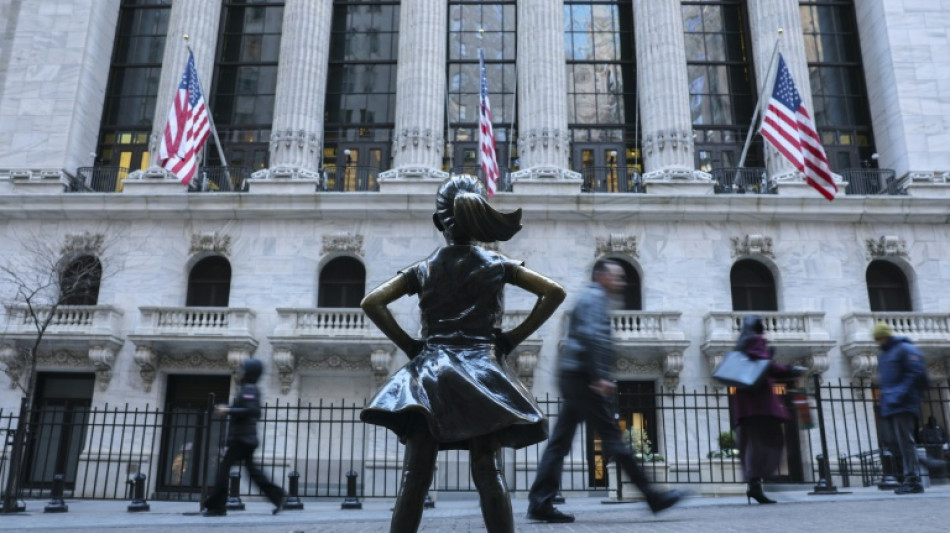
Wall Street intends to stay open around the clock / Photo: ANGELA WEISS - AFP/File

 AI 'warning shots' focus Beijing on national security risks

 Philippine tribe in limbo over US-led tech hub

 Saudi-led coalition says Houthis fired ballistic missile at Riyadh

 Cuba works to restore power after another blackout

 Brigitte Bardot widower slams sale of star's belongings

 Indonesia accepts Malaysia's help to tackle wildfires

 Nvidia, OpenAI CEOs to attend Xi dinner at White House

 Cuba hit with seventh major blackout of the year

 Nigeria miners struggled to breathe in cell before 37 died: survivors

 Warren Buffett steps down as Berkshire Hathaway chairman

 Isolated Syrian-Druze city blames Damascus for shortages

 Kerry James Marshall: American 'blackness' painter celebrated in Europe

 Infantino 'must go', says German FA vice-president

 Japan's busiest rail station tests robot bins

 Backpackers fret over Australian visa crackdown
 Bank of Japan hikes rates to 31-year high to battle inflation

 AI doomsday warnings unlikely to slow IPOs but questions linger

 In Brazil's Amazon, the hunt for oil fuels hopes and fears
 Baby orangutans in India expose 'frightening' scale of trafficking

 Oversight Board blasts 'inadequate' Meta safeguards for AI deepfakes

 Harry makes first public appearance since return to UK

 Princess Diana's brother makes new explosive claims against Charles

 Trump admin overhauls key protection for endangered species

 Mbappe draws political fire over Ceuta t-shirt controversy

 Third malaria death in Germany from outbreak tied to Frankfurt airport

The closing and opening bells of the New York Stock Exchange (NYSE) may become a ringing ritual of yesteryear, as the market moves toward nonstop trading.
This week, the Intercontinental Exchange announced it is developing a platform for 24/7 operations that offers "instant settlement."
The around-the-clock operations would rely on digital tokens mirroring the shares of listed companies, the NYSE's parent company said in a statement.
NASDAQ, another New York-based trading exchange, could follow suit as early as this year.
The move is pending approval by federal regulators at the US Securities and Exchange Commission (SEC), and would amount to a minor revolution for the way money moves in US stock markets.
- 'Waste of time' -
In the early days of the exchange, investors had to be physically present in markets on Wall Street to "stand and yell at each other and wave pieces of paper, and then they would have to write down what everybody bought and sold," Sam Burns, chief strategist at Mill Street Research, told AFP.
That meant "having trading go on all day every day would sort of be impossible to keep up with," Burns said.
Digitized transactions can change all that.
Off-hours trading has already been on the rise since 2019, exploding since 2024 when the daily average topped $61 billion, according to a NYSE report in early 2025.
But the appeal remains limited, according to Steve Hanke, a professor of applied economics at Johns Hopkins University.
"Historically, there is little evidence that supports the idea that the benefits of 24-hour trading outweigh the costs," he said, adding that there "are few market-moving events that occur outside of normal business hours in New York City."
"Night trading proved to be a waste of time," he said.
Hanke said the real advantage in the NYSE's announcement lies in the time needed to finalize a trade -- a process that usually occurs the next day in most stock markets.
"Narrowing the settlement window may prove to be a significant competitive advantage," Hanke said.
- Attracting the young and foreigners -
As host to immense market caps, the US market remains the largest in the world, but competition is growing.
Last year, many European indexes generated returns that outpaced their US counterparts.
With extended hours, Wall Street may be able to attract smaller investors and those outside the Americas.
Nearly 18 percent of US shares belonged to non-US holders in 2024, according to the US Treasury's most recent available figures.
And fans of cryptocurrency trading may jump into stocks, said Burns, the Mill Street Research strategist.
"A lot of retail investors nowadays, particularly younger ones, seem to like the idea of being able to trade stocks all the time the way they do cryptocurrencies and other digital assets, whether it's nights or weekends," Burns said.
It is unlikely that the change would move traditional investors from banker's hours because the impacts of any change are likely to be limited," Burns added.
"Most institutional investors that trade the real money aren't really interested in working or trading on the weekends, and the fact (is) that banks are mostly still closed on the weekends," Burns said.
X.Cheung--CPN