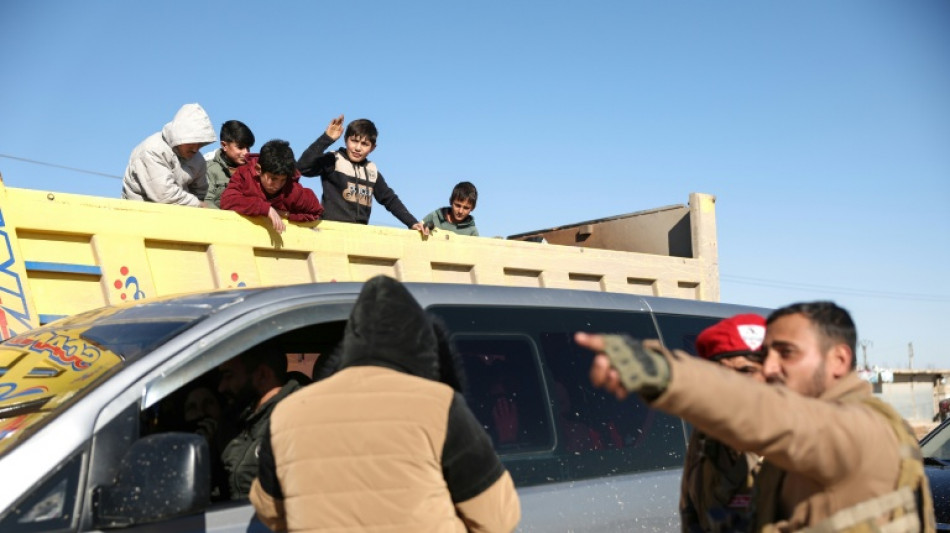
Syrians flee Kurdish-controlled area near Aleppo / Photo: OMAR HAJ KADOUR - AFP

 AI 'warning shots' focus Beijing on national security risks

 Philippine tribe in limbo over US-led tech hub

 Saudi-led coalition says Houthis fired ballistic missile at Riyadh

 Cuba works to restore power after another blackout

 Brigitte Bardot widower slams sale of star's belongings

 Indonesia accepts Malaysia's help to tackle wildfires

 Nvidia, OpenAI CEOs to attend Xi dinner at White House

 Cuba hit with seventh major blackout of the year

 Nigeria miners struggled to breathe in cell before 37 died: survivors

 Warren Buffett steps down as Berkshire Hathaway chairman

 Isolated Syrian-Druze city blames Damascus for shortages

 Kerry James Marshall: American 'blackness' painter celebrated in Europe

 Infantino 'must go', says German FA vice-president

 Japan's busiest rail station tests robot bins

 Backpackers fret over Australian visa crackdown

 Bank of Japan hikes rates to 31-year high to battle inflation

 AI doomsday warnings unlikely to slow IPOs but questions linger

 In Brazil's Amazon, the hunt for oil fuels hopes and fears

 Baby orangutans in India expose 'frightening' scale of trafficking

 Oversight Board blasts 'inadequate' Meta safeguards for AI deepfakes

 Harry makes first public appearance since return to UK

 Princess Diana's brother makes new explosive claims against Charles

 Trump admin overhauls key protection for endangered species

 Mbappe draws political fire over Ceuta t-shirt controversy

 Third malaria death in Germany from outbreak tied to Frankfurt airport

Syrians began fleeing an area east of Aleppo city on Thursday after the army gave civilians a deadline to leave amid fears of an escalation in clashes with Kurdish forces.
The government is seeking to extend its authority across the country following the ouster of longtime leader Bashar al-Assad a year ago.
On Sunday, government troops took full control of Aleppo city over the weekend after capturing two Kurdish-majority neighbourhoods.
It reached a deal in March to fold a Kurdish de facto autonomous administration in the north into the state, but progress on its implementation has stalled.
An AFP correspondent near Deir Hafer, one of the Kurdish-controlled towns being eyed by Damascus, saw many cars, trucks and civilians on foot leaving through a corridor set up by the army on Thursday, but the road was due to close at 5:00 pm (1400 GMT).
Mahmud al-Mussa, 30, said "thousands of people have not left", accusing the US-backed, Kurdish-led Syrian Democratic Forces of not letting them leave.
"They want to use civilians as human shields," he said.
The area targeted extends from near Deir Hafer, around 50 kilometres (30 miles) from Aleppo, to the Euphrates River about 30 kilometres further east, as well as towards the south.
Damascus, which has deployed forces to the region, also accused Kurdish forces of barring the civilians from leaving.
Farhad Shami, spokesperson for the SDF, told AFP the accusations were "unfounded".
Nadima al-Wayss, 54, said she, her brother and her niece had to cross a damaged bridge to leave Deir Hafer through a different road.
"Good people helped me cross the bridge... I was afraid I would fall."
- 'Join hands' -
The SDF controls swathes of Syria's oil-rich north and northeast, much of which it captured during the country's civil war and the fight against the Islamic State group over the past decade.
In a statement on Thursday, the Kurdish-led autonomous administration said they remained open to dialogue with Damascus and called on the international community to prevent a new civil war in Syria.
The SDF warned that the escalation "could lead to general instability, posing a real threat to the security of prisons holding ISIS members", referring to the Islamic State (IS) group.
Camps and prisons in Syria's Kurdish-administered northeast hold tens of thousands of people, many with alleged or perceived links to IS, more than six years after the group's territorial defeat in the country.
Syrian President Ahmed al-Sharaa said "the ball is in (the SDF's) court", calling on the group to "join hands with us... and begin the reconstruction process in Syria".
He made his remarks in an interview with Iraqi Kurdish channel Al Shams, which then decided not to air it.
Syrian state television and other regional channels have since aired excerpts.
"The agreement signed by Mazlum Abdi does not include federalism, self-administration... it includes a unified Syria," Sharaa said, referring to the SDF leader.
The Kurds have called for a decentralised federal system as part of their integration process into the Syrian state, but Sharaa has rejected their demands.
Syria's Kurds faced decades of oppression under former president Assad and his father, Hafez, who preached a Baathist brand of Arab nationalism.
They fear Syria's new Islamist rulers may take away from them the autonomy they carved out during the civil war that erupted with Assad's 2011 crackdown on nationwide democracy protests.
X.Cheung--CPN