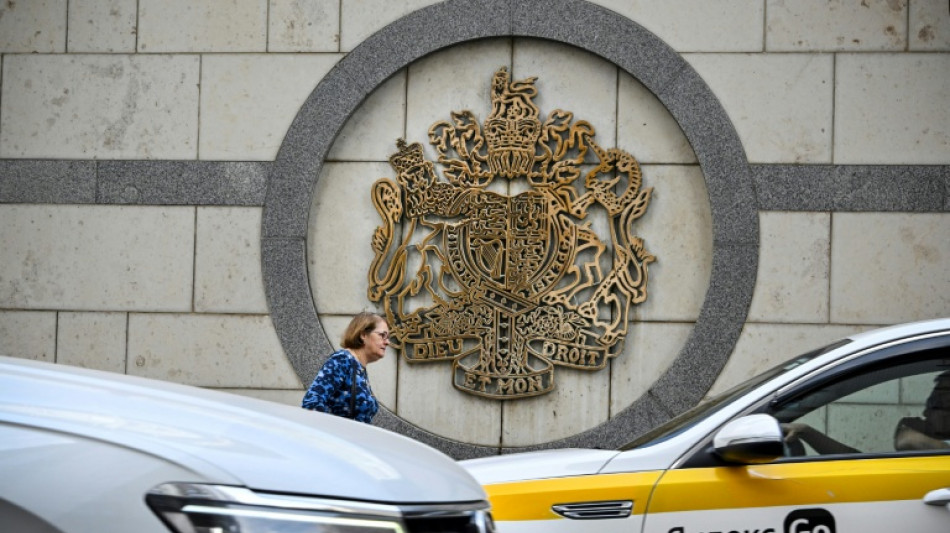
Russia expels UK diplomat accused of being spy / Photo: Alexander NEMENOV - AFP

 AI 'warning shots' focus Beijing on national security risks

 Philippine tribe in limbo over US-led tech hub
 Saudi-led coalition says Houthis fired ballistic missile at Riyadh
 Cuba works to restore power after another blackout
 Brigitte Bardot widower slams sale of star's belongings
 Indonesia accepts Malaysia's help to tackle wildfires
 Nvidia, OpenAI CEOs to attend Xi dinner at White House

 Cuba hit with seventh major blackout of the year

 Nigeria miners struggled to breathe in cell before 37 died: survivors

 Warren Buffett steps down as Berkshire Hathaway chairman

 Isolated Syrian-Druze city blames Damascus for shortages

 Kerry James Marshall: American 'blackness' painter celebrated in Europe

 Infantino 'must go', says German FA vice-president

 Japan's busiest rail station tests robot bins

 Backpackers fret over Australian visa crackdown

 Bank of Japan hikes rates to 31-year high to battle inflation

 AI doomsday warnings unlikely to slow IPOs but questions linger

 In Brazil's Amazon, the hunt for oil fuels hopes and fears

 Baby orangutans in India expose 'frightening' scale of trafficking

 Oversight Board blasts 'inadequate' Meta safeguards for AI deepfakes

 Harry makes first public appearance since return to UK

 Princess Diana's brother makes new explosive claims against Charles

 Trump admin overhauls key protection for endangered species

 Mbappe draws political fire over Ceuta t-shirt controversy

 Third malaria death in Germany from outbreak tied to Frankfurt airport

Russia said Thursday it was expelling a British diplomat, calling him an undercover spy in an accusation blasted by London as "malicious" and "baseless."
The Kremlin has long singled out Britain as one of the most hostile Western states -- with relations virtually frozen even before Moscow's full-scale offensive on Ukraine.
The two countries have expelled each others' embassy staff several times in recent years.
Moscow-London ties have been plagued by spy allegations for decades and were already at their lowest point before Russia's 2022 Ukraine attack.
Since then, Britain became one of Kyiv's strongest backers.
Russia's FSB security service named the man it was expelling as Gareth Samuel Davies -- listed on Moscow's official database of accredited diplomats as the embassy's second secretary.
Russia's foreign ministry summoned the UK's charge d'affaires, saying it issued a "strong protest" and that it had received information that "one of the embassy's diplomatic staff belongs to the UK's intelligence service."
"The individual's accreditation is being revoked. He is required to leave the Russian Federation within two weeks," the ministry said.
Expulsions by one side have typically been followed up by a tit-for-tat response from the other.
Russia warned Britain not to "escalate the situation", pledging to deliver a "firm symmetrical response" should London retaliate.
Britain said it was mulling next steps.
"This is not the first time the Kremlin has made malicious and baseless accusations against our staff," the Foreign Office said in a statement.
"We are carefully considering our options in response."
- Frozen ties -
Outside the foreign ministry in Moscow on Thursday, UK charge d'affaires Danae Dholakia was mobbed by reporters from state media outlets.
UK Prime Minister Keir Starmer has hosted Ukraine's President Volodymyr Zelensky for talks on how to end the war with Russia several times, and is one of the Kremlin's most vocal critics.
This month, Britain and France signed a declaration of intent that sets out deploying troops on Ukrainian territory after a ceasefire.
Russia rejected the post-war plan, saying such troops would be considered "legitimate military targets."
Moscow also recently blasted London for being involved in the planning of a US operation to seize a Russian-flagged tanker in the North Atlantic.
Espionage accusations between the two countries date back far further than the Ukraine offensive.
In 2006, Russian defector Alexander Litvinenko was killed in London, poisoned by polonium in what British investigators said was a hit by the Russian secret service.
And in 2018, the UK said Russian double agent Sergei Skripal was poisoned with a Novichok nerve agent in the British cathedral city of Salisbury.
One member of the public was killed after handling the delivery device, a discarded perfume bottle, triggering the largest Western expulsion of Russian diplomats, alleged to be spies, in decades.
The communication line between Downing Street and the Kremlin has been closed since Russia's offensive.
The last UK leader known to have spoken with Russian President Vladimir Putin was Boris Johnson in February 2022, days before Moscow launched its offensive, when he told the Kremlin chief that sending troops to Ukraine "would be a tragic miscalculation."
burs/st
A.Mykhailo--CPN