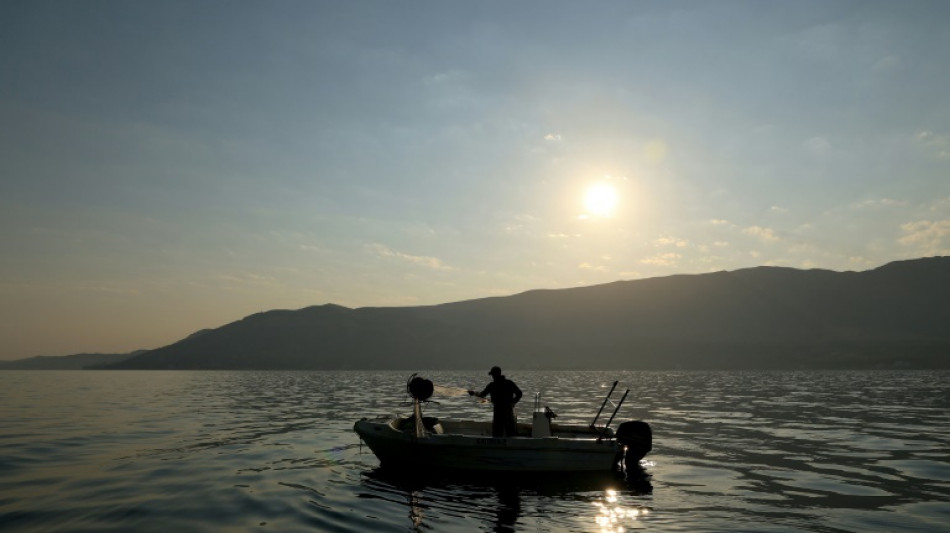
'I lost my battle': warming sea killing Albania fishing / Photo: Adnan Beci - AFP

 Jay-Z rape accuser says she made 'false accusations'

 Trump's photo of Xi greeting carries signs of AI

 First US trial against TikTok to open Monday

 French literary prize removes novel from longlist after AI claims

 Trump accuser E. Jean Carroll finally has her damages

 Heavy fighting, internet disruption as Ethiopia conflict rages
 Asian markets mixed after oil gains

 UN approves resolution on dealing with rising sea levels

 Global stocks mostly fall as oil prices and bond yields rise

 Starbucks to close 250 more cafes in North America

 Stocks fall as oil prices rise and bonds back under pressure

 Top ECB official to resign to take up IMF role

 Eviction of pensioner puts Spain housing crisis in spotlight

 Average EU diesel price hits record 2.23 euros a litre: AFP analysis

 Whitetip Investments Marks 10 Years of Regulation, Transparency & Responsible Trading

 Stocks fall, oil prices rise as global bonds under pressure

 Hungary detects invasive spotted lanternfly for first time in EU

 Forex Expo Dubai 2026 Breaks Guinness World Record Again With 23,816 Attendees

 Asian markets fall on US-China jitters as leaders meet

 As Moscow steps up attacks, Kyiv residents brace for harsh winter

 Markets mixed as China's Xi arrives for US talks

 Archaeological 'breakthrough' could confirm origins of Paris

 Australian PM says OpenAI hacked government health website

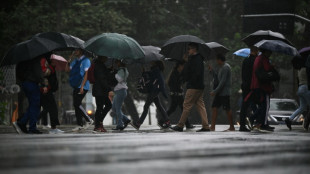 Rio breaks record for rainiest September amid powerful El Nino

 Mandela Digital Extends Early Access Programme to 11 February 2027 Following Strong Response

As dawn broke, fisherman Viktor Kocaj hauled his net on board his battered skiff, but after a whole night in the Adriatic, the catch was too small to even feed his family.
Albanians like him have lived off the sea for generations, but Kocaj fears his way of life in the Bay of Vlore is coming to an end, with warming waters shrinking his catch every year.
"I lost my battle with the sea. I loved it, but it betrayed me," the father of four told AFP.
As Europe bakes in the first heatwave of the summer, sea temperatures are climbing too.
By the end of June, the sea off the Albanian coast had already reached 25.5 degrees Celsius (77.9 degrees Fahrenheit) — 1.5 degrees higher than it was at this time last year.
"My luck deserted me a long time ago," Kocaj said, dejected by his meagre catch.
"Look at my almost empty nets," sighed the 65-year-old, as he prepared to return to port.
A few years ago, he was still able to provide for his family.
But now, he said, he's ruined.
"The rising temperatures have been a fatal blow to the fish, and to us too," he added, struggling to hide his tears.
- Fish have 'almost disappeared' -
In Vlore, Kocaj estimates fish populations have declined by 70 percent.
The situation is no better outside the inlet, where even larger fishing boats in deeper water are struggling, and forecasts are not optimistic.
Reshat Xhelilaj, head of the fishing and aquaculture sector in Vlore, told AFP that he expects a hotter summer than 2024, which saw a deep-sea temperature of up to 30.5C (86.9F).
Walking down the dock, dragging a small bucket half-filled with fish, Kocaj said that around five years ago he could have returned with up to 10 kilos (22 pounds) of hake per day.
Back then, he and his brother fished together. And even with much smaller nets, they brought home enough fish to support both their families.
Now he's alone, and despite casting a kilometre of net and spending hours at sea, he is lucky to come back with two kilos of anything.
"They've almost disappeared," he said of his once-abundant catch.
- 'Devastating' -
"Climate change is a major factor in the decline of fish populations," said Nexhip Hysolokaj, a biology researcher at Tirana's Polis University.
Rising temperatures make it difficult for many marine organisms to reproduce and grow, particularly those adapted for cooler waters.
At least a dozen species of fish, usually found in the Indian and Pacific oceans, are now crowding out local species that are essential to the food chain, such as the endangered sardine, he said.
In Kocaj's catch lies the proof, a highly venomous lionfish, which is common in the Caribbean.
"To his misfortune and mine, it ended up in my nets," the fisherman said.
The spiny fish is edible if cleaned and prepared correctly, and campaigns are underway to help fishermen turn this tropical invader into a profitable alternative.
"Climate change has had devastating effects," warned Captain Baci Dyrmishi, head of the marine fishing association in the bay.
"Temperatures are exceeding forecasts, and the waters are overheating."
Baci said that as the catch shrinks, the number of those living off the sea is dwindling too, and many are leaving the idyllic coastal city to make a living elsewhere.
On the quay at Radhima, once home to over a dozen vessels, only three or four now dock.
M.Davis--CPN