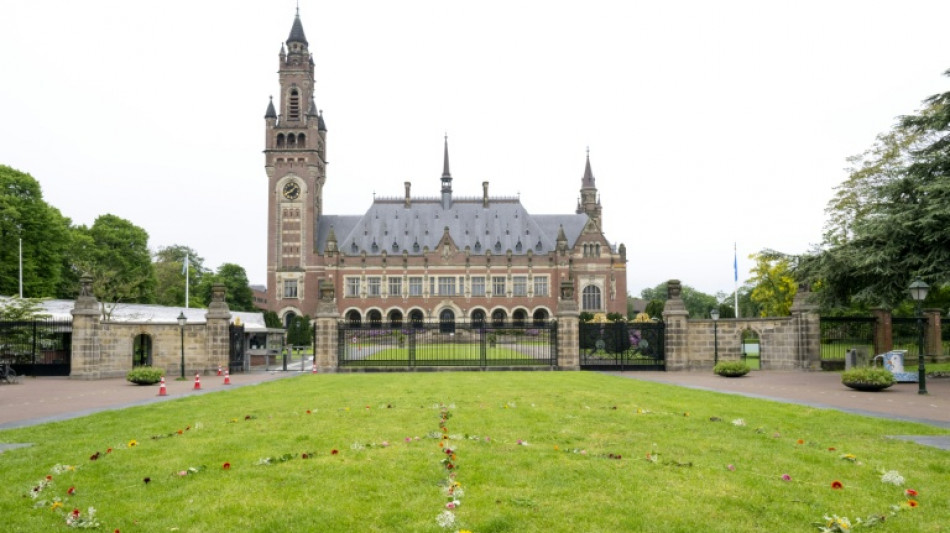
ICJ sides with E.Guinea in spat with Gabon over oil-rich islands / Photo: Nick Gammon - AFP

 S.African women runners arm themselves after string of killings

 Indonesia fires threatens critically-endangered orangutan: IUCN

 Iran proposes Hormuz plan, Trump reportedly refuses
 El Nino rewrites the menu in the world's top restaurants

 Jay-Z rape accuser says she made 'false accusations'

 Trump's photo of Xi greeting carries signs of AI

 First US trial against TikTok to open Monday

 French literary prize removes novel from longlist after AI claims

 Trump accuser E. Jean Carroll finally has her damages

 Heavy fighting, internet disruption as Ethiopia conflict rages
 Asian markets mixed after oil gains

 UN approves resolution on dealing with rising sea levels
 Global stocks mostly fall as oil prices and bond yields rise

 Starbucks to close 250 more cafes in North America
 Stocks fall as oil prices rise and bonds back under pressure

 Top ECB official to resign to take up IMF role

 Eviction of pensioner puts Spain housing crisis in spotlight
 Average EU diesel price hits record 2.23 euros a litre: AFP analysis

 Whitetip Investments Marks 10 Years of Regulation, Transparency & Responsible Trading

 Stocks fall, oil prices rise as global bonds under pressure

 Hungary detects invasive spotted lanternfly for first time in EU

 Forex Expo Dubai 2026 Breaks Guinness World Record Again With 23,816 Attendees

 Asian markets fall on US-China jitters as leaders meet
 As Moscow steps up attacks, Kyiv residents brace for harsh winter

 Markets mixed as China's Xi arrives for US talks
The top United Nations court on Monday sided with Equatorial Guinea in a decades-long dispute with Gabon over three tiny islands in potentially oil-rich waters.
The two west African nations have been squabbling over the 30-hectare (74-acre) island of Mbanie and two smaller low-lying islets, Cocotiers and Conga, since the early 1970s.
The islands themselves are tiny and virtually uninhabited but lie in an area potentially rich in oil and gas.
The dispute dates all the way back to 1900, when then colonial powers France and Spain signed a treaty in Paris setting out the borders between the two countries.
But Gabon argued that a later treaty, the 1974 Bata Convention, then fixed the islands' sovereignty in their favour.
However, the International Court of Justice ruled that the Bata Convention "invoked by the Gabonese Republic is not a treaty having the force of law... and does not constitute a legal title."
It said that the legal title to the islands was held by Spain, which then passed to Equatorial Guinea upon independence in 1968.
Unlike most countries appearing before the ICJ in The Hague, which rules in disputes between states, Guinea and Equatorial Guinea agreed to ask judges for a ruling in an effort to find an amical solution.
The two countries asked the court to decide which legal texts are valid -- the Paris Treaty of 1900 or the Bata Convention of 1974.
In hearings in October, Equatorial Guinea argued that Gabon invaded the islands in 1972 and had occupied them illegally ever since.
Lawyers for the country rubbished the Bata Convention in the October hearings, saying Gabon suddenly produced the document in 2003, surprising everyone.
"No one had seen or heard of this supposed convention," Domingo Mba Esono, Vice-Minister of Mines and Hydrocarbons from Equatorial Guinea, told ICJ judges.
"Moreover, the document presented was not an original but was only an unauthenticated photocopy," said Esono.
Philippe Sands, a lawyer representing Equatorial Guinea, dismissed the Bata Convention as "scraps of paper".
"You are being asked to rule that a state can rely on a photocopy of a photocopy of a purported document, the original of which cannot be found and of which no mention was made or any reliance placed for three decades," said Sands.
Equatorial Guinea has been asking for an original copy of the Bata Convention since 2003, so far in vain.
- 'Badly managed' -
But Marie-Madeleine Mborantsuo, honorary president of Gabon's constitutional court, argued that the Bata Convention "resolves all sovereignty issues regarding the islands and border delimitation".
She admitted that "sadly, neither of the two parties can find the original document", noting it was drawn up in an era before computers and databases.
"Archives were badly managed because of a number of things -- unfavourable climate, a lack of trained personnel and lack of technology," said Mborantsuo.
The court ruled that neither country seemed to regard the Bata Convention as binding upon them, meaning the court did not consider it the correct title in force.
Y.Jeong--CPN