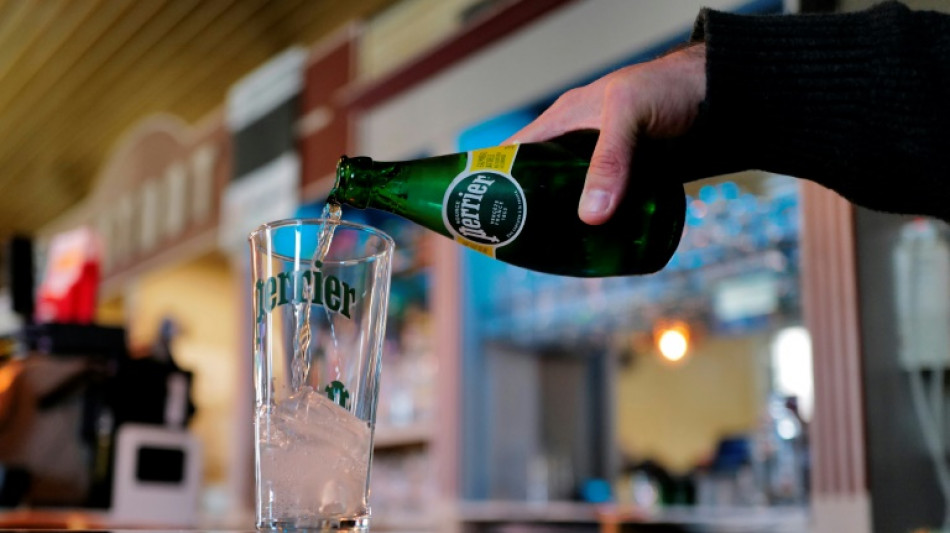
Perrier scandal bubbles up as French parliament slams cover-up / Photo: Sylvain THOMAS - AFP/File

 S.African women runners arm themselves after string of killings

 Indonesia fires threatens critically-endangered orangutan: IUCN

 Iran proposes Hormuz plan, Trump reportedly refuses
 El Nino rewrites the menu in the world's top restaurants
 Jay-Z rape accuser says she made 'false accusations'

 Trump's photo of Xi greeting carries signs of AI

 First US trial against TikTok to open Monday

 French literary prize removes novel from longlist after AI claims
 Trump accuser E. Jean Carroll finally has her damages
 Heavy fighting, internet disruption as Ethiopia conflict rages

 Asian markets mixed after oil gains

 UN approves resolution on dealing with rising sea levels

 Global stocks mostly fall as oil prices and bond yields rise
 Starbucks to close 250 more cafes in North America
 Stocks fall as oil prices rise and bonds back under pressure

 Top ECB official to resign to take up IMF role

 Eviction of pensioner puts Spain housing crisis in spotlight
 Average EU diesel price hits record 2.23 euros a litre: AFP analysis

 Whitetip Investments Marks 10 Years of Regulation, Transparency & Responsible Trading

 Stocks fall, oil prices rise as global bonds under pressure
 Hungary detects invasive spotted lanternfly for first time in EU
 Forex Expo Dubai 2026 Breaks Guinness World Record Again With 23,816 Attendees

 Asian markets fall on US-China jitters as leaders meet

 As Moscow steps up attacks, Kyiv residents brace for harsh winter

 Markets mixed as China's Xi arrives for US talks

The French government "at the highest level" covered up a scandal over the treatment of mineral water by food giant Nestle, including the iconic Perrier brand, an investigation by France's upper house of parliament said Monday.
In recent years the Swiss food and drinks conglomerate has been under pressure over its Perrier and other brands as EU regulations strictly limit what treatments are allowed for any product marketed as natural mineral water.
"In addition to Nestle Waters' lack of transparency, it is important to highlight the state's lack of transparency, both towards local and European authorities and towards the French people," said the report by a commission of inquiry of the French Senate.
The report follows a six-month-long Senate inquiry involving more than 70 hearings.
"This concealment is part of a deliberate strategy, addressed at the first interministerial meeting on natural mineral waters on October 14, 2021," said the report.
"Nearly four years later, transparency has still not been achieved," said the report.
Perrier -- one of the most famous mineral waters in the world, obtained from a spring in southern France and traditionally served on ice with a slice of lemon -- was acquired by Nestle in the early 1990s.
- 'Highest level of the state' -
In late 2020, new management at Nestle Waters claims to have discovered the use of prohibited treatments for mineral water at its Perrier, Hepar and Contrex sites.
The company reached out to the government to submit a plan to tackle the problem in mid-2021, and the Elysee Palace afterwards.
Eighteen months later, a plan to replace prohibited ultraviolet treatments and activated carbon filters with microfiltering was approved by the authorities.
The method can be used to remove iron or manganese but the producer has to prove that the water has not been altered.
European law stipulates that natural mineral waters cannot be disinfected or treated in any way that alters its characteristics.
The report said that "despite the consumer fraud represented by water disinfection", the authorities have not taken legal action in response to the 2021 revelations.
"It was at the highest level of the state that the decision to authorise micro-filtration below the 0.8-micron threshold was taken," the report said.
- 'Known since 2022' -
"We understand better why the French government did not inform the European Commission -- it was clearly too busy covering up a massive fraud," said Ingrid Kragl of the NGO Foodwatch, claiming the cover-up "allowed Nestle to sell fraudulent products and deceive consumers".
The independent food monitor has filed a complaint against Nestle Waters, accusing it of deceiving consumers. An investigation has been launched by a Parisian judge.
During her hearing before the committee on March 19, Nestle Waters chief executive Muriel Lienau stated that "all" of the group's waters were "pure at the source".
But on Monday senator Antoinette Guhl announced that she was taking legal action over this comment for "possible perjury".
In a statement, Lienau said she acknowledged the report, which "recognises the importance of sectoral issues requiring regulatory clarification and a stable framework applicable to all."
Nestle Waters also insisted that it had "never contested" the legitimacy of the Senate's work.
Nestle has already been under pressure in France after its French subsidiary was charged in a case involving contaminated Buitoni-branded pizzas that are suspected of having led to the death of two children in 2022.
The move to allow microfiltration was in line with decisions taken by the authorities, including the office of then-prime minister Elisabeth Borne, even though she did not appear to have been informed, the report added.
The commission also charged that President Emmanuel Macron's office "had known, at least since 2022, that Nestle had been cheating for years".
Alexis Kohler, then secretary general at the Elysee who stepped down earlier this year after eight years in the post, had met with Nestle executives.
Macron in February denied any acknowledgement of the case.
In 2024, Nestle Waters admitted using banned filters and ultra-violet treatment on mineral waters.
The company paid a two-million-euro ($2.2-million) fine to avoid legal action over the use of illegal water sources and filtering.
It said at the time though that the replacement filters were approved by the government and that its water was "pure".
cho-bur-as-sjw/as/phz
T.Morelli--CPN