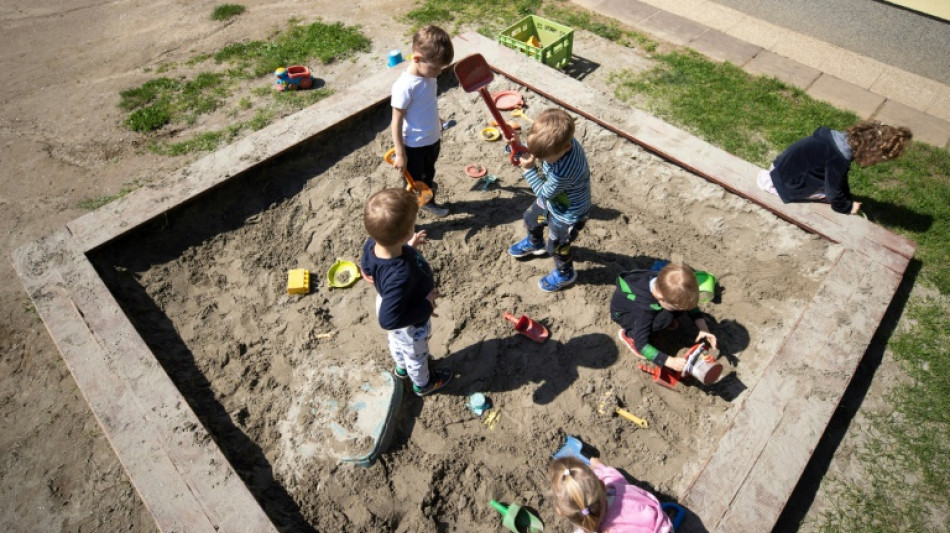
Croatian town pays grandparents for childcare / Photo: DAMIR SENCAR - AFP

 S.African women runners arm themselves after string of killings
 Indonesia fires threatens critically-endangered orangutan: IUCN

 Iran proposes Hormuz plan, Trump reportedly refuses

 El Nino rewrites the menu in the world's top restaurants

 Jay-Z rape accuser says she made 'false accusations'

 Trump's photo of Xi greeting carries signs of AI

 First US trial against TikTok to open Monday
 French literary prize removes novel from longlist after AI claims

 Trump accuser E. Jean Carroll finally has her damages

 Heavy fighting, internet disruption as Ethiopia conflict rages

 Asian markets mixed after oil gains

 UN approves resolution on dealing with rising sea levels
 Global stocks mostly fall as oil prices and bond yields rise
 Starbucks to close 250 more cafes in North America

 Stocks fall as oil prices rise and bonds back under pressure

 Top ECB official to resign to take up IMF role

 Eviction of pensioner puts Spain housing crisis in spotlight

 Average EU diesel price hits record 2.23 euros a litre: AFP analysis

 Whitetip Investments Marks 10 Years of Regulation, Transparency & Responsible Trading

 Stocks fall, oil prices rise as global bonds under pressure
 Hungary detects invasive spotted lanternfly for first time in EU

 Forex Expo Dubai 2026 Breaks Guinness World Record Again With 23,816 Attendees

 Asian markets fall on US-China jitters as leaders meet
 As Moscow steps up attacks, Kyiv residents brace for harsh winter

 Markets mixed as China's Xi arrives for US talks

A Croatian town has come up with a novel solution to solve the dilemma of working parents when there are no public childcare spaces available: pay grandparents to do it.
Samobor, near the capital Zagreb, has become the first in the country to run a "Grandmother-Grandfather Service", which pays 360 euros ($400) a month per child.
The scheme allows grandparents to top up their pension, but the authorities also hope it will boost family ties and tackle social isolation as the population ages.
"The benefits are multiple," Samobor's mayor, Petra Skrobot, told AFP.
"Pensions are rather low and for parents it is sometimes difficult to find adequate care for children.
"We wanted to give the parents the possibility to choose the type of care for their children."
In Croatia, most women use 12 months of maternity leave, though state-funded childcare is available from the age of six months until the child enrols at primary school at age six.
But there are not enough places in public kindergartens, which are run by the authorities at the local level, meaning several thousand children miss out every year.
The problem is most acute in major cities, particularly Zagreb, and many working parents face a choice between paying for a private kindergarten or a nanny out of their own pocket -- or asking their own parents to help.
The "Grandmother-Grandfather Service", based on a similar model in Sweden, is open to children aged four and under.
Grandparents apply for the measure, which was introduced in late March, every month. Twenty-eight people have so far applied.
- 'Deepening bonds' -
Dubravka Koletic, 60, was one of them. She praised the move as "very positive for both grandparents and grandchildren".
"We get some additional euros which is good since our pensions are low, and spend a lot of time with our grandchildren," she told AFP as she played with her 18-month-old grandson Viktor in a park.
In Croatia, the average pension amounts to about 550 euros a month.
"Also, we are becoming even closer," Koletic added.
Her daughter, Danijela Koletic, is also happy even though Viktor did not get a place in a public creche.
"This is really great, it's easier to leave such a small child to someone you trust, while Viktor and his grandmother will further deepen their bonds," said the 41-year-old economist, who has two other children.
Samobor, which is home to around 37,000 people, has two kindergartens with several smaller sites, providing care for more than 1,300 children.
But last year, more than 100 children missed out, especially those aged 18 months or younger.
Josipa Milakovic, who runs the Grigor Vitez kindergarten, called the initiative "a helping hand for parents, providing help in care for the youngest ones in a family surrounding".
Skrobot said counterparts from across the country had contacted her to express an interest in the scheme.
European Union member Croatia, which has a population of 3.8 million people, is facing a demographic crisis, with low birth rates, an ageing population, and emigration.
UN projections estimate that by the end of the century, the population will have fallen to just 2.5 million.
Samobor, however, has bucked the trend and its population has increased, notably with young families seeking a more tranquil setting close to Zagreb.
Primary school class numbers were exceptionally filled last year while numbers of students enrolled dropped elsewhere.
Y.Uduike--CPN