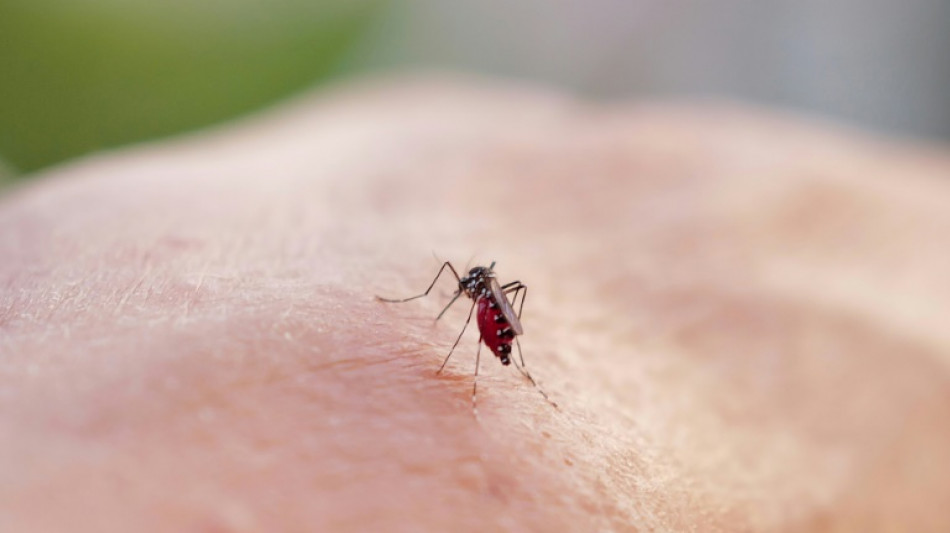
Dengue, chikungunya may soon be endemic in Europe: research / Photo: Valery HACHE - AFP/File

 S.African women runners arm themselves after string of killings

 Indonesia fires threatens critically-endangered orangutan: IUCN

 Iran proposes Hormuz plan, Trump reportedly refuses

 El Nino rewrites the menu in the world's top restaurants

 Jay-Z rape accuser says she made 'false accusations'

 Trump's photo of Xi greeting carries signs of AI

 First US trial against TikTok to open Monday

 French literary prize removes novel from longlist after AI claims

 Trump accuser E. Jean Carroll finally has her damages

 Heavy fighting, internet disruption as Ethiopia conflict rages

 Asian markets mixed after oil gains

 UN approves resolution on dealing with rising sea levels

 Global stocks mostly fall as oil prices and bond yields rise

 Starbucks to close 250 more cafes in North America

 Stocks fall as oil prices rise and bonds back under pressure

 Top ECB official to resign to take up IMF role

 Eviction of pensioner puts Spain housing crisis in spotlight

 Average EU diesel price hits record 2.23 euros a litre: AFP analysis

 Whitetip Investments Marks 10 Years of Regulation, Transparency & Responsible Trading

 Stocks fall, oil prices rise as global bonds under pressure

 Hungary detects invasive spotted lanternfly for first time in EU

 Forex Expo Dubai 2026 Breaks Guinness World Record Again With 23,816 Attendees

 Asian markets fall on US-China jitters as leaders meet

 As Moscow steps up attacks, Kyiv residents brace for harsh winter

 Markets mixed as China's Xi arrives for US talks

The feverish diseases dengue and chikungunya could soon become endemic in Europe as the tiger mosquitoes that transmit these viruses spread farther north due to global warming, according to new research published Thursday.
Roughly half the world's population is already at risk of contracting the two diseases, which were once mainly confined to tropical regions.
Both viruses cause fevers and can be deadly in rare cases, spread by the mosquitoes Aedes aegypti and Aedes albopictus.
The latter, which is known as the tiger mosquito, is venturing further north as the world warms because of human-driven climate change.
The new study, published in the Lancet Planetary Health journal, analyses the impact a number of factors including the climate have had on the spread of the two diseases in Europe over the last 35 years.
The frequency and severity of outbreaks have increased since 2010 as temperatures have risen, according to the study.
Yet just over 300 cases of dengue were recorded in the European Union in 2024 -- the hottest year on record -- compared to 275 over the previous 15 years.
Dengue outbreaks have now hit Italy, Croatia, France and Spain.
"Our findings highlight that the EU is transitioning from sporadic outbreaks of Aedes-borne diseases towards an endemic state," it said.
The higher temperatures soar, the greater the risk of outbreaks caused by tiger mosquitoes, the European research team said.
Under worst-case climate change scenarios, outbreaks of both diseases could rise to five times the current rate by 2060, they projected.
Outbreaks have been more common in wealthier areas, suggesting that better testing is able to spot the virus -- and that cases could be going undetected in poorer areas, the study suggested.
The French Indian Ocean island of Reunion has recently endured a deadly outbreak of chikungunya.
Tiger mosquitoes can also transmit the zika and West Nile viruses, which were not studied in the latest research.
Ng.A.Adebayo--CPN