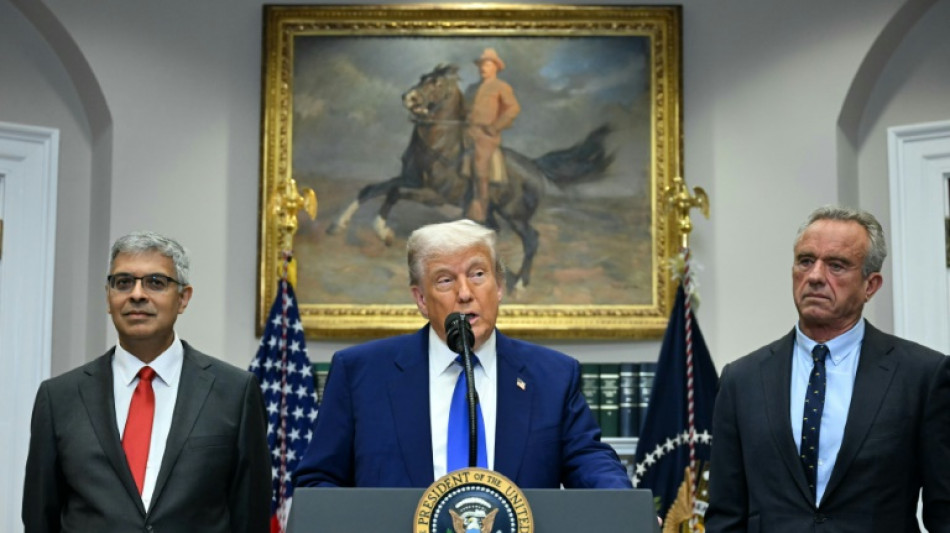
Trump announces drug price cut with swipe at Europe / Photo: Jim WATSON - AFP

 S.African women runners arm themselves after string of killings

 Indonesia fires threatens critically-endangered orangutan: IUCN

 Iran proposes Hormuz plan, Trump reportedly refuses
 El Nino rewrites the menu in the world's top restaurants
 Jay-Z rape accuser says she made 'false accusations'
 Trump's photo of Xi greeting carries signs of AI

 First US trial against TikTok to open Monday

 French literary prize removes novel from longlist after AI claims
 Trump accuser E. Jean Carroll finally has her damages
 Heavy fighting, internet disruption as Ethiopia conflict rages

 Asian markets mixed after oil gains

 UN approves resolution on dealing with rising sea levels

 Global stocks mostly fall as oil prices and bond yields rise
 Starbucks to close 250 more cafes in North America
 Stocks fall as oil prices rise and bonds back under pressure
 Top ECB official to resign to take up IMF role

 Eviction of pensioner puts Spain housing crisis in spotlight
 Average EU diesel price hits record 2.23 euros a litre: AFP analysis
 Whitetip Investments Marks 10 Years of Regulation, Transparency & Responsible Trading

 Stocks fall, oil prices rise as global bonds under pressure
 Hungary detects invasive spotted lanternfly for first time in EU
 Forex Expo Dubai 2026 Breaks Guinness World Record Again With 23,816 Attendees
 Asian markets fall on US-China jitters as leaders meet
 As Moscow steps up attacks, Kyiv residents brace for harsh winter
 Markets mixed as China's Xi arrives for US talks
US President Donald Trump said Monday he would slash drug prices so they match those abroad, accusing Europe in particular of practices that force up prices for Americans.
Republican Trump claimed as he signed the executive order at the White House that drug prices should fall by at least 59 percent -- and in some cases as high as 80 or 90 percent.
He accused the European Union of "brutal" tactics to make pharmaceutical firms sell drugs for lower prices on their territory -- meaning companies then raise prices in the United States to keep their profits up.
"Whoever is paying the lowest price, that's the price that we're going to get," Trump said, flanked by controversial Health Secretary Robert Kennedy Jr.
Under the plan, Trump aims to institute a "Most Favored Nation" policy that pins the cost of drugs sold in the United States to the lowest price paid by other countries for the same drug.
"Even though the United States is home to only 4 percent of the world's population, pharmaceutical companies make more than two thirds of their profits in America," Trump said.
"The European Union has been brutal, brutal. And the drug companies actually told me stories it was just brutal, how they forced them."
Drug prices in the United States are among the highest in the world and they surpass what European countries pay.
Trump said American consumers had been treated like "suckers" and cited in particular the costs of the obesity-reducing drug Ozempic, which he said were vastly lower in Europe.
But the US president's plan will count mainly on the goodwill of pharmaceutical companies to negotiate their prices and could face legal challenges, as did a similar proposal Trump pushed during his first term.
Trump tasked Kennedy, who has caused controversy for his skepticism over vaccinations, to negotiate with pharma firms to lower prices over the next month.
"There has never been a president more willing to stand up to the oligarchs than Donald Trump," Kennedy said as he stood next to the billionaire property developer.
- 'Broken system' -
Drug companies defend the high prices saying these allow them to carry out research and develop new drugs.
Pharma giant Eli Lilly said it was also essential to act against large commissions charged by intermediaries in the United States, such as health insurers and hospitals.
"For Lilly, more than 60 percent of the cost of a medicine goes to middlemen. We look forward to working with the administration to fix this broken system and bring lower prices directly to consumers," a Lily spokesperson said.
Drug lobby organization Pharmaceutical Research and Manufacturers of America (PhRMA) said that "importing foreign prices from socialist countries would be a bad deal for American patients and workers."
Democratic Senator Bernie Sanders questioned Trump's arguments.
"The problem is not that the price of prescription drugs is too low in Europe and Canada. The problem is that the extraordinarily greedy pharmaceutical industry made over $100 billion in profits last year by ripping off the American people," Sanders said in a statement.
"Most favored nation" status is a World Trade Organization rule that aims to prevent discrimination between a country and its trading partners, levelling the playing field for international trade.
This is not the first time that Trump has attempted to lower US drug prices.
During his first 2017-2021 term in office, he announced a similar proposal to cut US drug prices but his plans failed in the face of strong opposition from the pharmaceutical industry.
Last month, the US president signed an executive order aiming to lower crippling drug prices by giving states more leeway to bargain-hunt abroad and improving the process for price negotiations.
C.Peyronnet--CPN