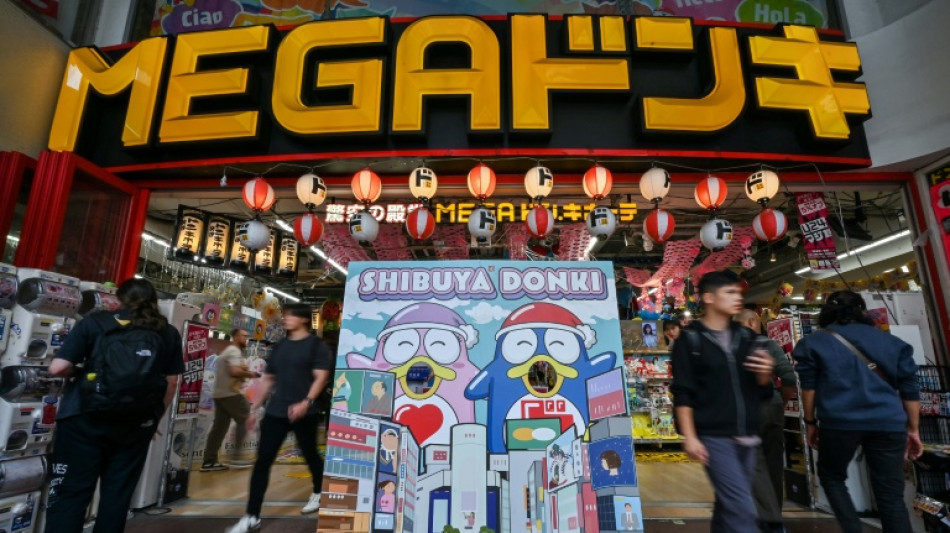
'Treasure hunt': tourists boost sales at Japan's Don Quijote stores / Photo: Richard A. Brooks - AFP

 S.African women runners arm themselves after string of killings

 Indonesia fires threatens critically-endangered orangutan: IUCN

 Iran proposes Hormuz plan, Trump reportedly refuses
 El Nino rewrites the menu in the world's top restaurants
 Jay-Z rape accuser says she made 'false accusations'

 Trump's photo of Xi greeting carries signs of AI

 First US trial against TikTok to open Monday

 French literary prize removes novel from longlist after AI claims
 Trump accuser E. Jean Carroll finally has her damages
 Heavy fighting, internet disruption as Ethiopia conflict rages
 Asian markets mixed after oil gains

 UN approves resolution on dealing with rising sea levels

 Global stocks mostly fall as oil prices and bond yields rise

 Starbucks to close 250 more cafes in North America

 Stocks fall as oil prices rise and bonds back under pressure
 Top ECB official to resign to take up IMF role

 Eviction of pensioner puts Spain housing crisis in spotlight
 Average EU diesel price hits record 2.23 euros a litre: AFP analysis

 Whitetip Investments Marks 10 Years of Regulation, Transparency & Responsible Trading

 Stocks fall, oil prices rise as global bonds under pressure
 Hungary detects invasive spotted lanternfly for first time in EU
 Forex Expo Dubai 2026 Breaks Guinness World Record Again With 23,816 Attendees

 Asian markets fall on US-China jitters as leaders meet

 As Moscow steps up attacks, Kyiv residents brace for harsh winter

 Markets mixed as China's Xi arrives for US talks

Business is booming at Japanese discount chain Don Quijote, which sells everything from nostril-hair wax to compact gadgets and colourful party costumes, thanks to its cult status among tourists but also inflation at home.
At a large Don Quijote store in Tokyo's bustling Shibuya district, hundreds of tourists rush to fill their baskets with snacks and souvenirs from its heaving narrow aisles.
"I was pretty overwhelmed at first, just because there's so many options, everything's in a different language," 27-year-old Garett Bryan from the United States told AFP.
But "I feel like I bought a lot and it was only like $70" including "a coffee cup for my mom, a fan, some Godzilla chopsticks, just a couple toys".
The chaotic cut-price shops nicknamed "Donki" were founded in the 1980s by Takao Yasuda, who named them after his business inspiration: the idealistic protagonist of the classic Spanish novel, "Don Quixote".
He wanted to shake up Japan's staid retail industry with new tactics including late-night opening hours as well as more varied prices and product lines.
Now a record influx of visitors to Japan, fuelled by a weak yen, is boosting sales nationwide.
Revenues at Don Quijote in Japan are "around 1.7 higher than before the pandemic", said Motoki Hara, a manager at the retailer.
Last year its parent firm Pan Pacific International Holdings (PPIH) saw revenue rise around 12 percent year-on-year for its discount chains including Donki, while tax-free sales beat internal forecasts.
Shopping at Don Quijote is like a "treasure hunt" -- a fun experience that foreign visitors love, Hara told AFP.
"Customers end up buying something different than what they came in for," he said beside rows of cherry-blossom flavour KitKats, a popular exclusive product.
- 'Jungle'-like -
Don Quijote and its sister brands have 501 stores in Japan, where 24 new ones opened during the past financial year.
PPIH Group also runs 110 stores abroad, in the United States and across Asia from Taiwan to Thailand.
California is one place being targeted by the company for expansion, according to analyst Paul Kraft, founder of Tokyo-based consultancy firm JapanIQ.
But that plan could be complicated by US President Donald Trump's trade tariffs -- including levies of 24 percent on Japan, which have been paused until July.
Even so, "I wouldn't bet against them, even in this entire high-tariff environment", Kraft said.
"Nobody adjusts as fast as Don Quijote in retail in Japan -- even faster than convenience stores, because they give so much autonomy to their stores."
They are also "some of the smartest and most aggressive buyers that I've seen", with consistently "the best selection of almost anything".
However, in Japan at least, the shopping experience is "cramped, dark, you know, the buildings might be old" with products seemingly "hanging from everywhere".
Don Quijote's omnipresent Santa-hat wearing penguin mascot Donpen and its "Don Don Donki" jingle on repeat just adds to the "jungle"-like experience.
"It is just almost an assault on the senses," Kraft said.
- Inflation hits -
Still, Don Quijote "has grown to be an extremely important retailer in Japan", Kraft said -- especially as rising inflation ramps up demand for cheaper products.
The country's core inflation rate accelerated to 3.2 percent in March, with consumers feeling the pinch on electricity bills as well as kitchen staples like cabbage and rice.
Household consumption fell 1.1 percent in 2024, with some people making the trip to Don Quijote to save.
"It's less expensive than other shops, and they also have famous brands," said a Tokyo resident who shops at the store twice a week and gave her surname as Kuroki.
Shoji Raku, 20, told AFP she shops at Donki for "shampoo, electronics and everything that you don't find elsewhere".
There is even usually a cordoned off adults-only section at Donki stores selling various sex toys.
Tourist sales remain a key focus for the chain, which plans to open two new stores targeted at visitors in Japan next year, centred on duty-free products.
But one Donki customer, Bruno Bosi from Brazil, said shoppers should tread with caution.
"It is a store for you to buy as much as you want -- but I think you need to ask yourself if you need it," he said.
A.Leibowitz--CPN