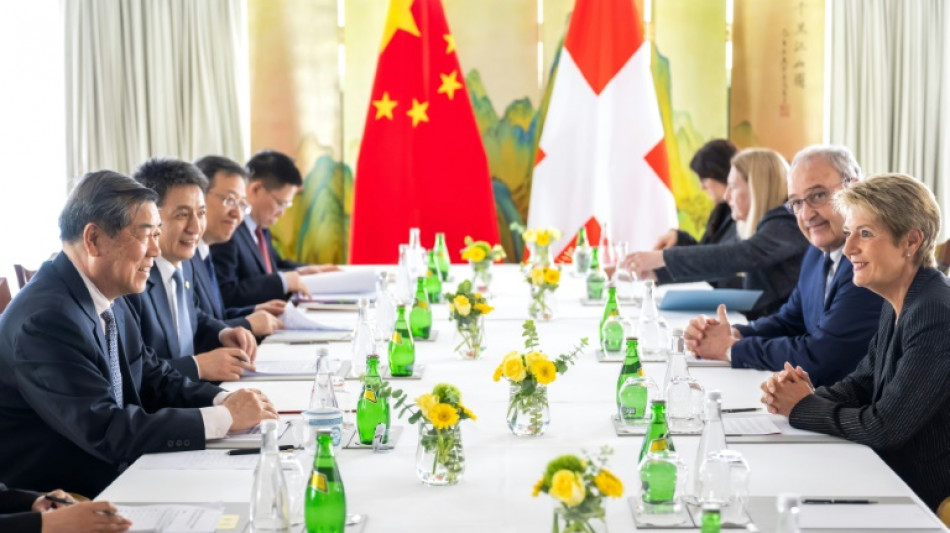
US and China set for talks in bid to 'de-escalate' trade war / Photo: MARTIAL TREZZINI - FDFA/AFP

 Kenya's economy faces climate change risks: World Bank

 Storm-battered Portugal votes in presidential election run-off

 De Beers sale drags in diamond doldrums

 Pakistan's capital picks concrete over trees, angering residents
 Chile's climate summit chief to lead plastic pollution treaty talks
 Opinions of Zuckerberg hang over social media addiction trial jury selection
 Dow surges above 50,000 for first time as US stocks regain mojo

 EU nations back chemical recycling for plastic bottles
 Stocks rebound though tech stocks still suffer
 German exports to US plunge as tariffs exact heavy cost

 'Mona's Eyes': how an obscure French art historian swept the globe

 Russian pensioners turn to soup kitchen as war economy stutters
 Toyota names new CEO, hikes profit forecasts
 Japan to restart world's biggest nuclear plant
 Undercover probe finds Australian pubs short-pouring beer
 Amazon shares plunge as AI costs climb
 Carney scraps Canada EV sales mandate, affirms auto sector's future is electric
 Carney scraps Canada EV sales mandate

 Mining giant Rio Tinto abandons Glencore merger bid
 ECB warns of stronger euro impact, holds rates

 ECB holds interest rates as strong euro causes jitters

 Wind turbine maker Vestas sees record revenue in 2025

 Germany claws back 59 mn euros from Amazon over price controls

 Stock markets drop amid tech concerns before rate calls

 UN human rights agency in 'survival mode': chief

Senior US and Chinese officials will meet in Geneva on Saturday, seeking to de-escalate a trade war sparked by President Donald Trump's sweeping tariff rollout and fuelled by Beijing's strong retaliatory measures.
US Treasury Secretary Scott Bessent and US Trade Representative Jamieson Greer are set to confer with Chinese Vice Premier He Lifeng in the Swiss city in the first such talks between the world's two largest economies since Trump slapped steep new levies on China last month.
The exact venue for the weekend-long talks remained shrouded in secrecy.
Tariffs imposed on the Asian manufacturing giant since the start of the year currently total 145 percent, with cumulative duties on some goods reaching a staggering 245 percent.
In retaliation, China slapped 125 percent levies on US goods, cementing what is effectively a trade embargo between the world's two largest economies.
Trump signalled on Friday that he could lower the sky-high tariffs on Chinese imports, taking to social media to suggest that an "80% Tariff on China seems right!".
"The president would like to work it out with China... He would like to de-escalate the situation," US Commerce Secretary Howard Lutnick told Fox News on Friday evening.
Trump's press secretary, Karoline Leavitt, clarified that the US would not lower tariffs unilaterally, adding that China would need to make concessions as well.
In any case, it would be a symbolic gesture, since the tariffs would remain prohibitively steep.
- 'A good sign' -
"The relationship is not good," said Bill Reinsch, a senior advisor at the Center for Strategic and International Studies (CSIS), referring to current ties between Washington and Beijing.
"We have trade-prohibitive tariffs going in both directions. Relations are deteriorating," said Reinsch, a longtime former member of the American government's US-China Economic and Security Review Commission.
"But the meeting is a good sign."
"I think this is basically to show that both sides are talking -- and that itself is very important," Xu Bin, professor of economics and finance at the China Europe International Business School, told AFP.
"Because China is the only country that has tit-for-tat tariffs against Trump's tariffs."
Beijing has insisted the United States must lift tariffs first and vowed to defend its interests.
Bessent has said the meetings in Switzerland would focus on "de-escalation" and not a "big trade deal".
The head of the Geneva-based World Trade Organization (WTO), Ngozi Okonjo-Iweala, said on Friday she welcomed the talks, calling them a "positive and constructive step toward de-escalation".
Swiss President Karin Keller-Sutter also sounded an upbeat note.
"Yesterday the Holy Spirit was in Rome," she said on Friday, referring to the election of Pope Leo XIV.
"We must hope that he will now go down to Geneva for the weekend."
- 10-percent 'baseline' -
Bessent and He will meet two days after Trump unveiled a trade agreement with Britain, the first deal with any country since he unleashed a blitz of sweeping global tariffs last month.
The five-page, non-legally binding document confirmed to nervous investors that the United States is willing to negotiate sector-specific relief from recent duties -- in this case on British cars, steel and aluminium.
In return, Britain agreed to open up its markets to US beef and other farm products.
But a 10-percent baseline levy on most British goods remained intact and Trump remains "committed" to keeping it in place for other countries in talks with the United States, Leavitt told reporters on Friday.
A few hours later, Trump appeared to contradict her, suggesting there could be some flexibility to the baseline -- but only if the right deals could be reached.
"There could be an exception at some point. We'll see," he said during an Oval Office event.
"If somebody did something exceptional for us, that's always possible."
burs-da-nl/gil
Y.Tengku--CPN