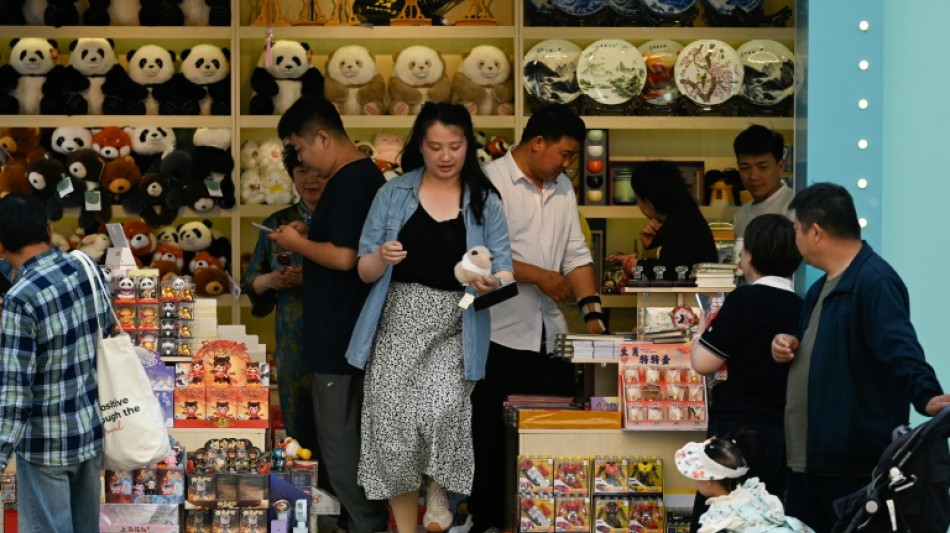
China's consumption slide deepens as tariff war bites / Photo: WANG Zhao - AFP

 Kenya's economy faces climate change risks: World Bank

 Storm-battered Portugal votes in presidential election run-off

 De Beers sale drags in diamond doldrums

 Pakistan's capital picks concrete over trees, angering residents

 Chile's climate summit chief to lead plastic pollution treaty talks

 Opinions of Zuckerberg hang over social media addiction trial jury selection
 Dow surges above 50,000 for first time as US stocks regain mojo

 EU nations back chemical recycling for plastic bottles
 Stocks rebound though tech stocks still suffer

 German exports to US plunge as tariffs exact heavy cost

 'Mona's Eyes': how an obscure French art historian swept the globe

 Russian pensioners turn to soup kitchen as war economy stutters

 Toyota names new CEO, hikes profit forecasts

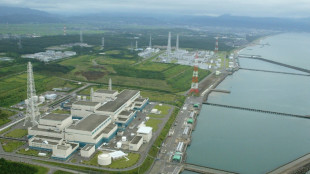 Japan to restart world's biggest nuclear plant

 Undercover probe finds Australian pubs short-pouring beer

 Amazon shares plunge as AI costs climb

 Carney scraps Canada EV sales mandate, affirms auto sector's future is electric

 Carney scraps Canada EV sales mandate

 Mining giant Rio Tinto abandons Glencore merger bid

 ECB warns of stronger euro impact, holds rates

 ECB holds interest rates as strong euro causes jitters

 Wind turbine maker Vestas sees record revenue in 2025

 Germany claws back 59 mn euros from Amazon over price controls

 Stock markets drop amid tech concerns before rate calls

 UN human rights agency in 'survival mode': chief

China said Saturday that consumer prices slumped in April for the third straight month, reflecting persistent challenges as leaders attempt to revive an economy stymied by sluggish spending and a fierce trade war with Washington.
The world's second-largest economy has grappled with persistent deflationary pressure in recent years, as longstanding woes in the property sector and export headwinds impede growth.
The latest figures come ahead of Saturday's start to a meeting of key economic officials from China and the United States in Switzerland, offering a potential off-ramp for the high-stakes trade war launched by President Donald Trump.
US tariffs on imports from manufacturing powerhouse China now stand at a staggering 145 percent for many products -- and reach as high as 245 percent cumulatively on others.
Trump suggested Friday that the tariffs could be cut to 80 percent, though Beijing has demanded a complete cancellation of the levies that are compounding other challenges facing the Chinese economy.
The consumer price index (CPI) -- a key measure of inflation -- was down 0.1 percent last month year-on-year, according to data released Saturday by the National Bureau of Statistics (NBS), following previous drops in February and March.
The reading was in line with a Bloomberg forecast of a 0.1 percent year-on-year decline based on a survey of economists, and consistent with the slight drop recorded in March.
NBS statistician Dong Lijuan said Saturday in a statement about the data that "international imported factors have a certain downward impact on prices in some industries".
"China still faces persistent deflationary pressure," said Zhiwei Zhang, President and Chief Economist at Pinpoint Asset Management, in a note.
The intensity of contributing factors "may rise in coming months as exports will likely weaken", said Zhang, adding that "more proactive fiscal policy is necessary to boost domestic demand".
- 'Downward pressure' -
The NBS also announced Saturday that April's producer price index (PPI) -- another indicator of inflation -- declined 2.7 percent year-on-year, accelerating from the 2.5 percent drop recorded in March.
China's PPI has remained mired in negative territory for more than two years and the drop recorded Saturday was in line with expectations.
"Changes in the international trade environment and a rapid decline in some international bulk commodities have affected the decline in prices in related domestic industries," Dong said of the PPI data.
The deflationary run is due in part to a recent slump in oil prices, wrote Zichun Huang and Julian Evans-Pritchard of Capital Economics in a note on Friday.
But, they added, "we suspect that overcapacity in Chinese industry continued to put downward pressure on factory-gate prices too".
China's exports rose last month despite the trade war, official data showed Friday, an unexpected development attributed by experts to a re-routing of trade to Southeast Asia to mitigate US tariffs.
The trade figures from the Chinese customs bureau showed that while exports to the United States dropped sharply in April, those to Thailand, Indonesia and Vietnam surged by double digits.
Chinese policymakers this week eased key monetary policy tools in a bid to ramp up domestic activity.
Those included cuts to a key interest rate and moves to lower the amount banks must hold in reserve in a bid to boost lending -- adding to Beijing's sweeping push since September to revitalise the economy.
M.García--CPN