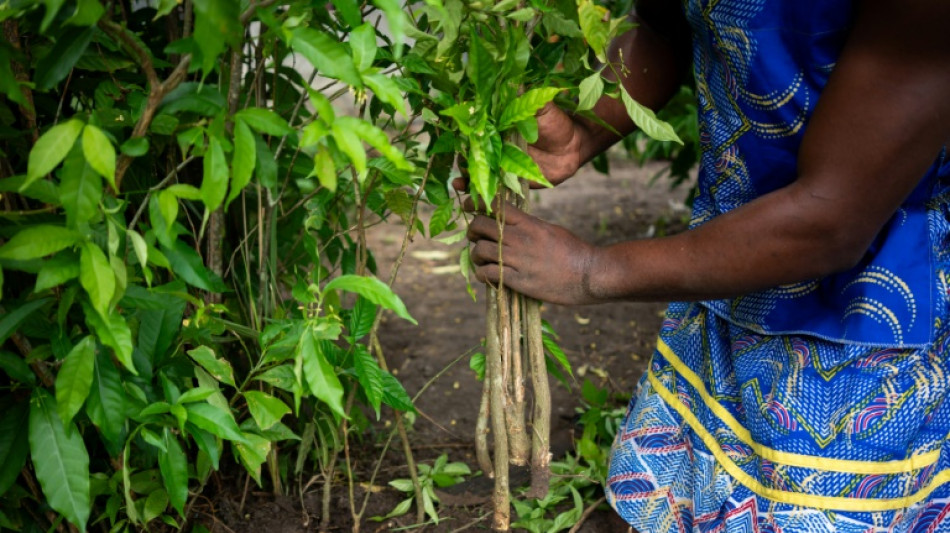
Gabon longs to cash in on sacred hallucinogenic remedy / Photo: Nao Mukadi - AFP

 Kenya's economy faces climate change risks: World Bank

 Storm-battered Portugal votes in presidential election run-off

 De Beers sale drags in diamond doldrums
 Pakistan's capital picks concrete over trees, angering residents
 Chile's climate summit chief to lead plastic pollution treaty talks
 Opinions of Zuckerberg hang over social media addiction trial jury selection
 Dow surges above 50,000 for first time as US stocks regain mojo

 EU nations back chemical recycling for plastic bottles
 Stocks rebound though tech stocks still suffer

 German exports to US plunge as tariffs exact heavy cost

 'Mona's Eyes': how an obscure French art historian swept the globe

 Russian pensioners turn to soup kitchen as war economy stutters

 Toyota names new CEO, hikes profit forecasts

 Japan to restart world's biggest nuclear plant
 Undercover probe finds Australian pubs short-pouring beer
 Amazon shares plunge as AI costs climb
 Carney scraps Canada EV sales mandate, affirms auto sector's future is electric
 Carney scraps Canada EV sales mandate

 Mining giant Rio Tinto abandons Glencore merger bid

 ECB warns of stronger euro impact, holds rates
 ECB holds interest rates as strong euro causes jitters
 Wind turbine maker Vestas sees record revenue in 2025

 Germany claws back 59 mn euros from Amazon over price controls

 Stock markets drop amid tech concerns before rate calls
 UN human rights agency in 'survival mode': chief

Beneath yellow fruit, hidden within the roots of the iboga plant in the forests of Gabon, lies a sacred treasure that the country is keen to make the most of.
For centuries, religious devotees have eaten it -- a psychotropic shrub that users say has addiction-fighting powers.
It fascinates foreign visitors, psychiatric patients and rich pharmaceutical companies that want to market it.
Now this central African country, where its use is enshrined in ancestral tradition, is scrambling to avoid missing out on the boom.
Teddy Van Bonda Ndong, 31, an initiate in the Bwiti spiritual tradition, calls it "sacred wood". He consumes it in small amounts daily, he said, for his "mental and physical health".
"It has a lot of power to help human beings," added Stephen Windsor-Clive, a 68-year-old retiree.
"It's untapped. A mysterious force lies within this plant."
He travelled to Gabon from Britain and consumed iboga -- in a powder ground from its roots -- during a 10-day Bwiti ceremony.
He tried it with a view to adopting it as a treatment for his daughter, who suffers from mental illness.
- Economic potential -
Given the interest, Gabon is seeking to channel the plant onto the international marketplace.
Exports of iboga products, including its active ingredient ibogaine, are few and strictly regulated in the country.
It grows mostly in the wild, but "more and more effort is being made to domesticate the plant", said Florence Minko, an official in the forestry ministry.
Potentially toxic in high doses, ibogaine can have effects similar to LSD, mescaline or amphetamines, and cause anxiety and hallucinations.
But users believe it can help drug addicts kick their habit and treat post-traumatic stress and neurological illnesses.
Yoan Mboussou, a local microbiologist and Bwiti initiate, hopes to gain an export licence for the 500-milligram ibogaine capsules he produces at his laboratory near the capital Libreville.
He sells them in Gabon as a food supplement, declaring them to have "anti-fatigue, antioxidant and anti-addictive" qualities.
Iboga, he believes, "is a potential lever to develop the economy and the whole country".
- Tradition and IP -
Countries such as the United States and France class iboga as a narcotic because of health risks identified in studies, especially heart issues. But it is used in treatment centres in countries including the Netherlands, Mexico and Portugal.
Numerous studies have examined its effects -- both helpful and harmful -- and scientists have taken out dozens of international patents for ibogaine therapeutic treatments.
"Most of those are based on studies of iboga use by Gabonese people, particularly by Bwiti practitioners," said Yann Guignon, from the Gabonese conservation group Blessings Of The Forest.
Despite the plant's "colossal therapeutic benefits", "Gabon is clearly missing out on the economic potential of iboga," he added.
"It did not position itself in this market in time by developing productive iboga plantations, a national processing laboratory and a proper industrial policy."
Overseas laboratories meanwhile have worked out how to make synthetic ibogaine and to extract it from other plants, such as Voacanga africana.
That flowering tree is available in greater quantities in Ghana and Mexico, which "can produce ibogaine at unbeatable prices", said Guignon.
And "Gabonese traditional knowledge is not protected by intellectual property regulations."
Currently only one company in Gabon has a licence to export iboga products -- though Minko, from the forestry ministry, said the country hopes this number will rise in the coming years.
She said companies were likely to produce more, spurred by revenue guarantees under the Nagoya Protocol, an international agreement on biological diversity and resource-sharing.
She wants the country to obtain a "made in Gabon" certificate of origin for iboga.
"This is a huge resource for Gabon. We have drawn up a national strategy for the conservation and sustainable use of the product," she said.
"Gatherings will soon be organised, bringing together all the groups concerned: NGOs, traditional practitioners and scientists."
- Soothing properties -
After harvesting iboga to the sound of traditional harps and consuming it in the initiation ceremony, Stephen Windsor-Clive was convinced by the benefits of iboga.
"I definitely want to bring my daughter here and have her have the experience," he said.
"This is my last attempt to find something which might be of assistance to her."
Another visitor, Tafara Kennedy Chinyere, travelled from Zimbabwe to discover Gabon and found, in the initiation, relief from anxiety and his "inner demons".
"I feel good in my body, in myself," he said, sitting under a tree after the ceremony.
"I feel like the iboga helped me to let go of things that you no longer need in your life."
D.Philippon--CPN