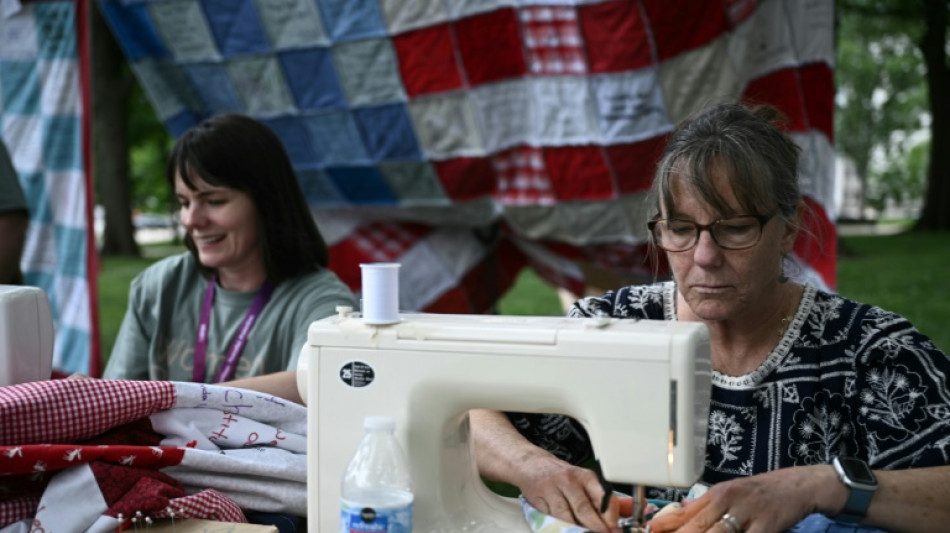
'No one is illegal': Mormon women stage patchwork protest in Washington / Photo: Brendan SMIALOWSKI - AFP

 Kenya's economy faces climate change risks: World Bank

 UK foreign office to review pay-off to Epstein-linked US envoy

 French police arrest five over crypto-linked magistrate kidnapping

 What's at stake for Indian agriculture in Trump's trade deal?

 Neglected killer: kala-azar disease surges in Kenya

 Spain, Portugal face fresh storms, torrential rain

 Crypto firm accidentally sends $40 bn in bitcoin to users

 Danone expands recall of infant formula batches in Europe

 Why bitcoin is losing its luster after stratospheric rise

 Digital euro delay could leave Europe vulnerable, ECB warns

 Stellantis takes massive hit for 'overestimation' of EV shift

 In Dakar fishing village, surfing entices girls back to school

 As Estonia schools phase out Russian, many families struggle

 Bangladesh Islamist leader seeks power in post-uprising vote

 UK royal finances in spotlight after Andrew's downfall

 New Zealand deputy PM defends claims colonisation good for Maori

 Deadly storm sparks floods in Spain, raises calls to postpone Portugal vote

 Lower pollution during Covid boosted methane: study

 Record January window for transfers despite drop in spending

 Davos forum opens probe into CEO Brende's Epstein links

 Greece aims to cut queues at ancient sites with new portal

 What does Iran want from talks with the US?

 Bitcoin under $70,000 for first time since Trump's election

 Germany claws back 70 mn euros from Amazon over price controls

 BBVA posts record profit after failed Sabadell takeover

At the base of the Capitol in Washington, dozens of Mormon women gathered Tuesday for a unique type of protest: meticulously sewing together giant quilts to call on legislators to protect the US Constitution as Donald Trump gets closer and closer to ignoring it.
The assembly involves thousands of quilt squares submitted by women across the country, all of whom are concerned about the political situation in the United States as Trump cracks down harshly on illegal migration, fires tens of thousands of civil servants, challenges institutions like the news media and universities, and seemingly tramples the rule of law.
Organized by members of Mormon Women for Ethical Government, a nonpartisan faith-based political advocacy group, the patchwork included messages like "No one is illegal," "We are all immigrants," and "A government of laws and not of men."
Although Mormons -- formally called the Church of Jesus Christ of Latter-day Saints -- generally align with the US religious right, the women who came to Washington felt compelled to defend the Constitution, regardless of their party affiliation.
"I think as Latter-day Saints, participating in the process is kind of an extension of our faith," said Chelsea Robarge Fife, a 49-year-old woman from Salt Lake City, Utah.
"We believe in shared principles of kindness, of respect, of doing our part, and so engaging with our elected officials is kind of an extension of the principles we try to live anyway," she continued.
Robarge Fife said "many of us have very different politics" about the women quilting in protest, "but the one thing we all agree upon is that the Constitution keeps us strong."
- Speaking through fabric -
"The Constitution is our common thread, and so preserving the checks and balances that are outlined there is the surest way to ensure a healthy democracy."
Since his return to office in January, Trump has sought to expand executive power to an extraordinary extent, undermining the checks and balances inherent in America's co-equal branches of government. Among other things he has repeatedly questioned the legitimacy of judges who rule against him and ignored some of their rulings.
On Sunday, when asked whether he would respect the Constitution, Trump replied: "I don't know."
The group will deliver 68 quilts to a variety of elected legislators, asking each of them to take action.
One quilt destined for the Speaker of the House of Representatives, Republican Mike Johnson from Louisiana, addressed the Trump administration's anti-migrant policies: "You cannot take dignity from others because you have none."
"Let's revive this tradition of speaking through fabric," said Jessica Preece, 44, from Utah.
"I think that part of the reason it works so well is because so many women are very comfortable with fabric.
"They're comfortable with this, with this craft and so it feels very safe and normal and authentic to do this," she continued.
Jennifer Thomas, another Mormon woman standing next to Preece, nodded in agreement.
She said the best way to be heard politically is to remind lawmakers "that the best way to defend that is together, not alone."
"We've become so polarized, and this has just been, I think, an experience for people to depolarize and say, what do we actually share in common?"
M.Davis--CPN