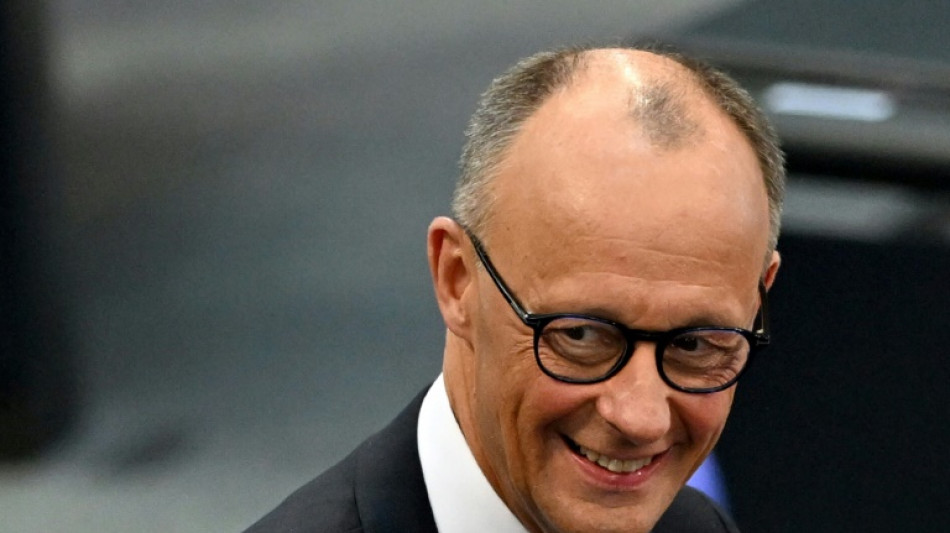
Germany's Merz elected chancellor after surprise setback / Photo: RALF HIRSCHBERGER - AFP

 Kenya's economy faces climate change risks: World Bank

 UK foreign office to review pay-off to Epstein-linked US envoy
 French police arrest five over crypto-linked magistrate kidnapping

 What's at stake for Indian agriculture in Trump's trade deal?

 Neglected killer: kala-azar disease surges in Kenya

 Spain, Portugal face fresh storms, torrential rain

 Crypto firm accidentally sends $40 bn in bitcoin to users

 Danone expands recall of infant formula batches in Europe

 Why bitcoin is losing its luster after stratospheric rise

 Digital euro delay could leave Europe vulnerable, ECB warns
 Stellantis takes massive hit for 'overestimation' of EV shift

 In Dakar fishing village, surfing entices girls back to school

 As Estonia schools phase out Russian, many families struggle

 Bangladesh Islamist leader seeks power in post-uprising vote

 UK royal finances in spotlight after Andrew's downfall

 New Zealand deputy PM defends claims colonisation good for Maori

 Deadly storm sparks floods in Spain, raises calls to postpone Portugal vote
 Lower pollution during Covid boosted methane: study
 Record January window for transfers despite drop in spending
 Davos forum opens probe into CEO Brende's Epstein links
 Greece aims to cut queues at ancient sites with new portal
 What does Iran want from talks with the US?

 Bitcoin under $70,000 for first time since Trump's election

 Germany claws back 70 mn euros from Amazon over price controls

 BBVA posts record profit after failed Sabadell takeover

Germany's conservative leader Friedrich Merz won on Tuesday a nail-biter second vote in parliament to become chancellor after he lost the first round in a stunning early setback.
Merz, 69, scored an absolute majority of 325 against 289 in the secret vote in the lower house of parliament.
He takes over at the helm of a coalition between his CDU/CSU alliance and the centre-left Social Democrats (SPD) of the outgoing chancellor, Olaf Scholz.
President Frank-Walter Steinmeier was set to appoint him as post-war Germany's 10th chancellor later Tuesday, along with his cabinet, before Merz is due to visit Paris and then Warsaw on Wednesday.
His victory caps a long ambition to lead Europe's biggest economy, which was first foiled decades ago by party rival Angela Merkel who went on to serve as chancellor for 16 years.
Merz's eventual victory on Tuesday was bittersweet as the initial defeat -- the first such outcome in Germany's post-war history -- pointed to rumblings of discontent within his uneasy coalition.
The unprecedented first-round loss was "a bad start" for Merz and "shows that he cannot fully rely on his two coalition parties, wrote analyst Holger Schmieding of Berenberg Bank.
"That will sow some doubts about his ability to fully pursue his agenda, damaging his domestic and international authority at least initially."
The far-right Alternative for Germany (AfD) especially cheered the heavy political blow to Merz, who has vowed to restore stability in Berlin after half a year of political turmoil.
"Merz should step aside and the way should be cleared for a general election," AfD co-leader Alice Weidel said earlier, calling the first-round result a "good day for Germany".
- 'World is watching' -
The first secret vote was expected to be a formality but turned to disaster for Merz when he failed to muster the required absolute majority, falling short by six votes.
The early setback for Merz stunned Germany and set off frantic crisis meetings in the Bundestag.
Merz has vowed to revive the ailing economy and strengthen Berlin's role in Europe as it responds to rapid change since US President Donald Trump returned to power.
Trump has heaped pressure on European allies, complaining they spend too little on NATO and imposing tariffs that are especially painful to export power Germany.
CDU parliamentary leader Jens Spahn had emphasised the urgency of a new government taking office, given the economic and geopolitical turbulence.
"The whole of Europe, perhaps even the whole world, is watching this second round of voting," Spahn said before the second vote, urging MPs to "be aware of this special responsibility".
- 'Profound upheaval' -
Merz, who boasts a strong business background but has never held a government leadership post, said on Monday: "We live in times of profound change, of profound upheaval... and of great uncertainty.
"And that is why we know that it is our historic obligation to lead this coalition to success," he said.
To take over as chancellor, Merz needed an absolute majority of 316 votes.
But in Tuesday's first vote, he only won the backing of 310 MPs, with 307 voting against him.
Capital Economics analyst Franziska Palmas argued Merz's initial setback "does leave Merz severely weakened and suggests that hopes for more stability in German politics may be disappointed".
H.Müller--CPN