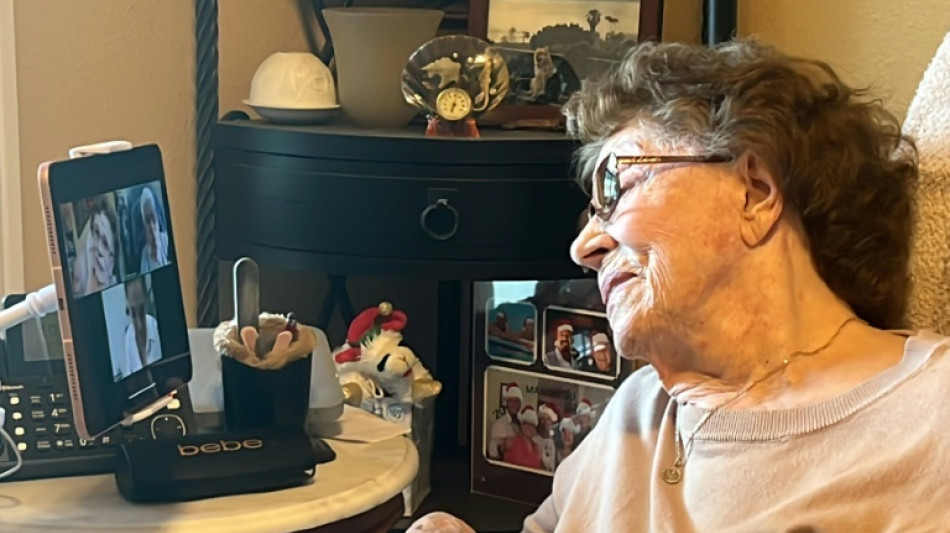
French Resistance members reunited 80 years after end of WWII / Photo: Gianrigo MARLETTA - AFP

 Kenya's economy faces climate change risks: World Bank

 US astronaut to take her 3-year-old's cuddly rabbit into space

 Storm-battered Portugal votes in presidential election run-off

 De Beers sale drags in diamond doldrums

 Pakistan's capital picks concrete over trees, angering residents

 Chile's climate summit chief to lead plastic pollution treaty talks

 Opinions of Zuckerberg hang over social media addiction trial jury selection

 Dow surges above 50,000 for first time as US stocks regain mojo

 EU nations back chemical recycling for plastic bottles

 Stocks rebound though tech stocks still suffer

 German exports to US plunge as tariffs exact heavy cost

 'Mona's Eyes': how an obscure French art historian swept the globe

 Russian pensioners turn to soup kitchen as war economy stutters
 Toyota names new CEO, hikes profit forecasts

 Japan to restart world's biggest nuclear plant

 Undercover probe finds Australian pubs short-pouring beer

 Amazon shares plunge as AI costs climb

 Carney scraps Canada EV sales mandate, affirms auto sector's future is electric

 Carney scraps Canada EV sales mandate

 Mining giant Rio Tinto abandons Glencore merger bid

 ECB warns of stronger euro impact, holds rates

 ECB holds interest rates as strong euro causes jitters

 Wind turbine maker Vestas sees record revenue in 2025

 Germany claws back 59 mn euros from Amazon over price controls

 Stock markets drop amid tech concerns before rate calls

Renee Guette, 98, laughed as she looked at her computer screen in Texas. On the other end of the video call was 97-year-old Andree Dupont, living in France.
The women, who supported the French resistance against Nazi occupation, had a moving reunion in April -- it was the first time they had seen each other since being freed from a German concentration camp 80 years ago.
"Dedee, it's funny to see you after all these years. We've become old girls!" Guette said, using Dupont's nickname.
"Seeing you again fills me with emotion," said Dupont, her voice trembling.
"I give you a big kiss, my darling," she added, blowing a kiss to the screen during the call, which was witnessed by AFP.
"Are the memories coming back for you too?" Dupont asked.
"Oh yes!" Guette said. "But they are not coming out of my head. There are too many things we can't explain."
As the 80th anniversary of Victory in Europe Day, marking the end of World War II on the continent, approaches, the women shared their emotional story of wartime sacrifice and suffering.
Dupont and Guette were both born in 1927 and grew up in French villages around 350 kilometers (220 miles) apart.
After World War II broke out and Nazi Germany invaded France, both women -- aged just 16 -- joined the resistance networks in their villages in 1943.
Dupont became a "liaison officer" transmitting messages -- and sometimes weapons -- across the western Sarthe region using only her bicycle.
One day, she recalled, "I had a towel with a dismantled revolved inside, and I smiled as I passed the Germans."
Guette was a postal worker who smuggled ration coupons and messages to resistance fighters.
- Deported -
In April 1944, disaster struck as Dupont was arrested along with other members of her village's resistance network -- 16 people in all, including her father and aunt.
"I was folding the laundry at around 10 at night. I heard knocking on the doors and knew what was happening right away," she said.
Guette was caught four days later by a French agent of the Gestapo, the secret police of Nazi Germany.
"He told me, 'So, a young girl from a good family who took a turn for the worst,'" Guette remembered. "And I told him that he hadn't turned out any better. And he slapped me!"
The two teenagers met at a prison in Romainville close to Paris. They learned about D-Day -- the Allied invasion of France in June 1944 -- but the glimmer of hope the news offered was soon crushed.
"We thought we were saved! But the Germans needed us to work in the war factories," explained Guette.
On June 25, 1944, Guette -- prisoner 43,133 -- was transferred to the HASAG Leipzig sub-camp linked to Buchenwald. It held 5,000 women forced to manufacture weapons. Dupont was prisoner 41,129.
The pair recalled working at night with newspaper shoved under their clothes to protect against the cold, their hair being infested with lice, and beatings from German guards.
They also described the naked bodies of those who did not survive, piled up and waiting to be moved to the crematorium.
"They did a lot of nasty things to us," said Guette.
- Freedom -
By mid-April 1945, weeks before the Allies accepted Germany's surrender, the Nazis evacuated the Leipzig camp, and inmates began the so-called "death marches," designed to keep large number of concentration camp prisoners out of Allied hands.
Guette told of walking all day and night with bloody feet, surviving only off rapeseed and potatoes.
She recalled washing for the first time in months in the Elbe, one of central Europe's largest rivers, and also a bullet whizzing past her left ear during fighting between the "Boche" -- a derogatory term for Germans -- and American soldiers.
Victory in Europe was formally declared on May 8, 1945, and the pair found themselves back in France.
In Paris, Dupont found her mother, and her father did return from the camps. But her aunt was killed in the gas chambers. Guette headed home on the train.
"You know what, Dedee. When I got there, I was not even sure I was home. Did that happen to you?" Guette asked.
Dupont replied: "I knew I was home when I saw the village clock tower."
Guette, who has lived in the United States since the 1970s, no longer travels to her home country but said she would like to see Dupont again, even if it means getting there "on all fours."
"Lots of love, Dedee, perhaps we'll find each other again up there," Guette said before the women ended their call.
J.Bondarev--CPN