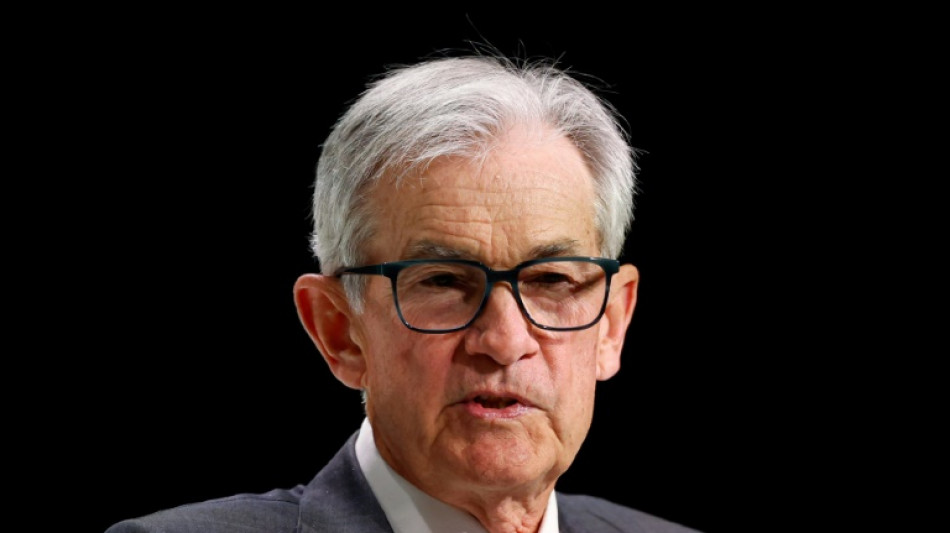
US Fed expected to pause cuts again and wait for clarity on tariffs / Photo: KAMIL KRZACZYNSKI - AFP/File

 Kenya's economy faces climate change risks: World Bank

 US astronaut to take her 3-year-old's cuddly rabbit into space

 Storm-battered Portugal votes in presidential election run-off

 De Beers sale drags in diamond doldrums

 Pakistan's capital picks concrete over trees, angering residents

 Chile's climate summit chief to lead plastic pollution treaty talks

 Opinions of Zuckerberg hang over social media addiction trial jury selection
 Dow surges above 50,000 for first time as US stocks regain mojo

 EU nations back chemical recycling for plastic bottles
 Stocks rebound though tech stocks still suffer
 German exports to US plunge as tariffs exact heavy cost

 'Mona's Eyes': how an obscure French art historian swept the globe

 Russian pensioners turn to soup kitchen as war economy stutters

 Toyota names new CEO, hikes profit forecasts

 Japan to restart world's biggest nuclear plant
 Undercover probe finds Australian pubs short-pouring beer
 Amazon shares plunge as AI costs climb

 Carney scraps Canada EV sales mandate, affirms auto sector's future is electric

 Carney scraps Canada EV sales mandate

 Mining giant Rio Tinto abandons Glencore merger bid
 ECB warns of stronger euro impact, holds rates

 ECB holds interest rates as strong euro causes jitters

 Wind turbine maker Vestas sees record revenue in 2025

 Germany claws back 59 mn euros from Amazon over price controls

 Stock markets drop amid tech concerns before rate calls

The US Federal Reserve is widely expected to extend a recent pause in rate cuts this week as it waits to see how President Donald Trump's stop-start tariff rollout affects the health of the world's largest economy.
Trump has imposed steep levies on China, and lower "baseline" levies of 10 percent on goods from most other countries, along with 25 percent duties on specific items like steel, automobiles and aluminum.
The president has also paused higher duties on dozens of other trading partners until July to give them time to renegotiate existing arrangements with the United States.
Most economists expect the tariffs introduced since January to push up prices and cool economic growth -- at least in the short run -- potentially keeping the Fed on hold for longer.
"The Fed has to be very focused on maintaining inflation so that it doesn't start moving back up in a more persistent way," said Loretta Mester, who recently stepped down after a decade as president of the Cleveland Fed.
"That would undermine all the work that was done over the last three years of getting inflation down," she told AFP.
- 'Good place to be' -
The Fed has held its key interest rate at between 4.25 percent and 4.50 percent since December, as it continues its plan to bring inflation to the bank's long-term target of two percent, with another eye firmly fixed on keeping unemployment under control.
Recent data points to inflation hitting that target ahead of the introduction of Trump's "Liberation Day" tariffs, while unemployment has remained relatively stable, hugging close to historic lows.
At the same time, various "softer" data points such as consumer confidence surveys have pointed to a sharp decline in optimism about the health of the US economy -- and growing concerns about inflation.
"Whether the economy enters a recession or not, it's hard to say at this point," said Mester, now an adjunct professor of finance at the Wharton School of the University of Pennsylvania.
"I think the committee remains in good condition here, and most likely they'll remain on hold at this meeting," said Jim Bullard, the long-serving former president of the St. Louis Fed.
"I think it's a good place for them to be while there's a lot of turbulence in the trade war," added Bullard, now dean of the Daniels School of Business at Purdue University.
Financial markets overwhelmingly expect the Fed to announce another rate cut pause on Wednesday, according to data from CME Group.
- Pushing back rate cuts -
US hiring data for April published last week came in better than expected, lowering anxiety about the health of the labor market -- and reducing pressure on the Fed's rate-setting committee to reach for rate cuts.
Economists at several large banks including Goldman Sachs and Barclays subsequently delayed their expectations for rate cuts from June to July.
"Cutting in late July allows the committee to see more data on the evolution of the labor market, and should benefit from resolving uncertainty about tariffs and fiscal policy," economists at Barclays wrote in a note to clients published Friday.
Other analysts see rate cuts happening even later, depending on the effects of the tariffs.
The rise in longer-run inflation expectations in the survey data points to growing concerns that tariff-related price pressures could become embedded in the US economy, even as the market-based measures have remained close to the two percent target.
"I would be sort of in the camp (saying) prove to me that they're (tariffs are) not going to be inflationary," Mester said, adding it would be "unwise" to assume that inflation expectations were stable given the recent survey data.
But Bullard from Purdue took a different view, stressing the stability of the market-based measures.
"I haven't liked the survey-based measures of inflation expectations, because they seem to be partly about inflation, but partly about many other issues, maybe, including politics," he said.
"This is a moment where you might want to look through the survey-based measures that are talking about very extreme levels of inflation that don't seem likely to develop near-term," he added.
M.Anderson--CPN