Trump's tariffs bite at quiet US ports / Photo: Robyn Beck - AFP

 Kenya's economy faces climate change risks: World Bank
 'Send Help' repeats as N.America box office champ

 UK foreign office to review pay-off to Epstein-linked US envoy
 French police arrest five over crypto-linked magistrate kidnapping

 What's at stake for Indian agriculture in Trump's trade deal?

 Neglected killer: kala-azar disease surges in Kenya

 Spain, Portugal face fresh storms, torrential rain

 Crypto firm accidentally sends $40 bn in bitcoin to users
 Danone expands recall of infant formula batches in Europe
 Why bitcoin is losing its luster after stratospheric rise

 Digital euro delay could leave Europe vulnerable, ECB warns
 Stellantis takes massive hit for 'overestimation' of EV shift

 In Dakar fishing village, surfing entices girls back to school

 As Estonia schools phase out Russian, many families struggle

 Bangladesh Islamist leader seeks power in post-uprising vote
 UK royal finances in spotlight after Andrew's downfall
 New Zealand deputy PM defends claims colonisation good for Maori

 Deadly storm sparks floods in Spain, raises calls to postpone Portugal vote
 Lower pollution during Covid boosted methane: study
 Record January window for transfers despite drop in spending

 Davos forum opens probe into CEO Brende's Epstein links
 Greece aims to cut queues at ancient sites with new portal
 What does Iran want from talks with the US?
 Bitcoin under $70,000 for first time since Trump's election

 Germany claws back 70 mn euros from Amazon over price controls
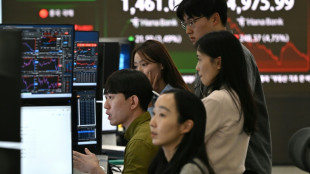
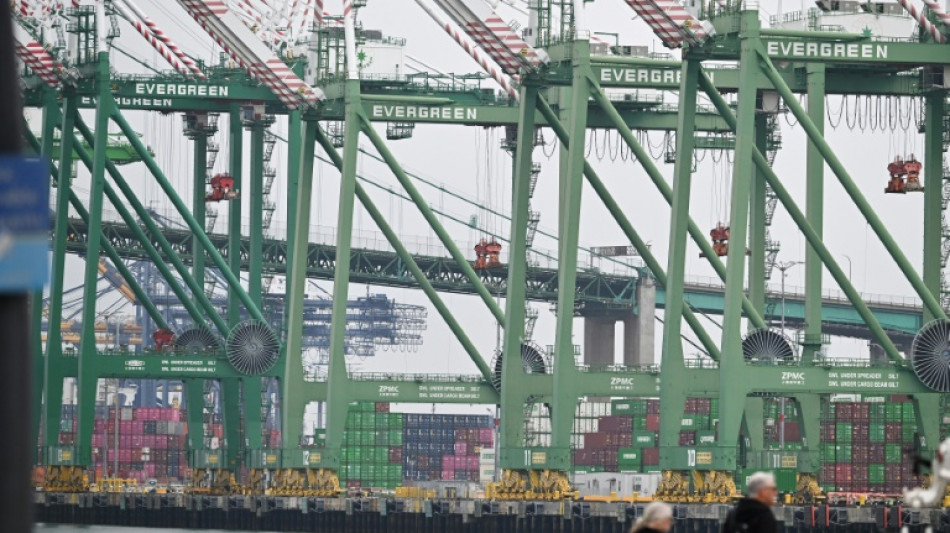
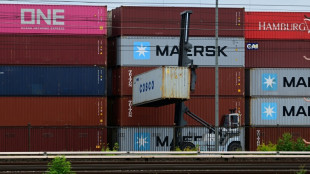
At the Port of Los Angeles, the frenetic choreography of cranes unloading containers from Asia has slowed to a tiptoe, and the noise of the busiest docks in the US is quieting.
"You could hear a pin drop, it's very unusual," Port Director Gene Seroka told AFP.
By this unofficial barometer, the American economy faces slowdown under US President Donald Trump amid his trade war with China.
Along with the next-door Port of Long Beach, the area represents the biggest gateway in the United States for goods from China and the rest of Asia.
That has made it among the first victims to a burgeoning crisis threatening to disrupt the lives of millions of Americans.
Trump's on-again-off-again tariffs -- and the retaliation launched by other countries -- has cowed importers, whose usual orders for furniture, toys, and clothing have dwindled.
For the week of May 4, the Port of Los Angeles will receive up to 35 percent less cargo compared with the same period last year, Seroka said.
The Port of Long Beach says for the entire month of May it is expecting a 30 percent drop in imports.
Dozens of ships have cancelled their voyages to these ports.
"Many retailers and manufacturers alike have hit the pause button, stopping all shipments from China," said Seroka.
The Asian manufacturing giant is the hardest hit by Trump's tariffs, with levies as high as 145 percent on some goods. Sales of Chinese goods to the US last year totaled more than $500 billion, according to Beijing.
And while sales may not be going up this year, prices undoubtedly will.
"Effectively, the cost of a product made in China now is two and a half times more expensive than it was just last month," said Seroka.
- Empty shelves -
Trump last month announced a range of differing tariffs against nearly all countries in the world -- including an island populated mostly by penguins -- using a formula that baffled economists.
He reversed course a few days later and left a blanket 10 percent rate against most of the planet.
That extra cost, which is paid by the importer of a product, not by the seller, will affect trade across the United States.
"This is not just a West Coast issue," warned Long Beach Port Director Mario Cordero.
"It affects every port, whether it's in the East or in the Gulf" of Mexico, which Trump has decreed should be known as the Gulf of America.
At the start of the year, Long Beach and Los Angeles saw American companies scurry to get ahead of tariffs that Trump promised on the campaign trail.
Cargo volumes surged as they tried to build up as much untaxed inventory as possible.
But as the tariffs begin to bite, they will undoubtedly hold buying to eat into that inventory.
Without a reversal from the White House that would re-open the trade spigot, that could mean shortages that consumers will start to notice, and soon, according to Seroka.
"American importers, especially in the retail sector, are telling me that they have about five to seven weeks of normal inventory on hand today," he said.
"If this trade dispute goes on for any length of time, we'll likely see fewer selections on store shelves and online buying platforms.
"The impact on American consumers will be less choice and higher prices," he said.
"The American consumer is going to get hit right in the wallet."
- 'We're angry at Donald Trump' -
For Antonio Montalbo, one of the 900,000 logistics workers in Southern California, the ordeal has already begun.
As the owner of a small trucking company, he needs to replace the starter on one of his vehicles; the part, made in China, now costs twice as much.
Trump has "created a hostile environment at the port for the drivers," says the 37-year-old.
"We're angry at Donald Trump. He needs to go check out the country a little bit, because he has a lot of angry truck drivers.
"It seems like he doesn't care about the public or the working class."
Between skyrocketing maintenance costs and the fall-off in work, he estimates he could be laying off staff within six months.
Montalbo says he voted for Trump last November because he was fed up with inflation, and trusted him to fix the economy.
"I thought that he was a businessman.
"Now we have something worse than inflation, called tariffs."
P.Schmidt--CPN