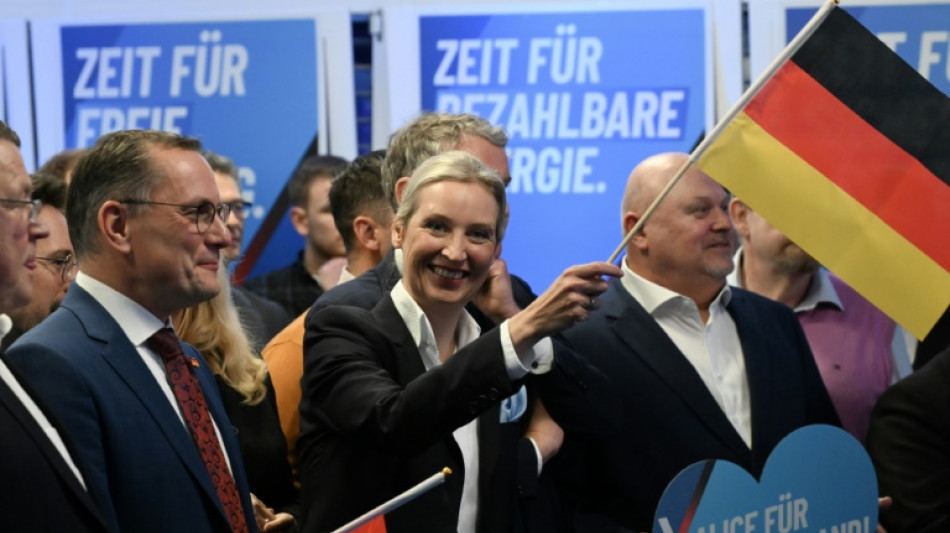
Germany move against far-right AfD sets off US quarrel / Photo: RALF HIRSCHBERGER - AFP/File

 Kenya's economy faces climate change risks: World Bank
 'Send Help' repeats as N.America box office champ

 UK foreign office to review pay-off to Epstein-linked US envoy
 French police arrest five over crypto-linked magistrate kidnapping
 What's at stake for Indian agriculture in Trump's trade deal?

 Neglected killer: kala-azar disease surges in Kenya

 Spain, Portugal face fresh storms, torrential rain

 Crypto firm accidentally sends $40 bn in bitcoin to users
 Danone expands recall of infant formula batches in Europe

 Why bitcoin is losing its luster after stratospheric rise

 Digital euro delay could leave Europe vulnerable, ECB warns
 Stellantis takes massive hit for 'overestimation' of EV shift

 In Dakar fishing village, surfing entices girls back to school
 As Estonia schools phase out Russian, many families struggle

 Bangladesh Islamist leader seeks power in post-uprising vote
 UK royal finances in spotlight after Andrew's downfall
 New Zealand deputy PM defends claims colonisation good for Maori

 Deadly storm sparks floods in Spain, raises calls to postpone Portugal vote
 Lower pollution during Covid boosted methane: study
 Record January window for transfers despite drop in spending

 Davos forum opens probe into CEO Brende's Epstein links
 Greece aims to cut queues at ancient sites with new portal
 What does Iran want from talks with the US?

 Bitcoin under $70,000 for first time since Trump's election

 Germany claws back 70 mn euros from Amazon over price controls
Germany's domestic intelligence service on Friday designated the far-right AfD party as an extremist group, setting off a diplomatic spat with the United States.
The BfV intelligence agency, which had already designated several local branches of the anti-immigrant Alternative for Germany (AfD) as right-wing extremists, said it moved against the entire party due to its attempts to "undermine the free, democratic" order in Germany.
The classification gives authorities greater powers to monitor the party by lowering the barriers for such steps as intercepting telephone calls and deploying undercover agents.
The conservative US administration quickly condemned the move.
US Vice President JD Vance on Friday accused Germany of rebuilding a "Berlin Wall".
"The West tore down the Berlin Wall together. And it has been rebuilt -- not by the Soviets or the Russians, but by the German establishment," Vance, who in February defiantly met the AfD leader in Munich, wrote on X. He said the AfD was "the most popular party in Germany".
US Secretary of State Marco Rubio called it "tyranny in disguise" and said "Germany should reverse course". President Donald Trump's billionaire advisor Elon Musk has also previously defended the AfD.
The German foreign ministry took the unusual step of replying directly to Rubio on X to say: "This is democracy."
The ministry said that the "decision is the result of a thorough and independent investigation to protect our constitution" and could be appealed.
"We have learnt from our history that right-wing extremism needs to be stopped," the ministry said.
The AfD slammed the move as a "heavy blow" to democracy, just months after they came second in a national election. It vowed to mount a legal challenge.
The designation revived calls to ban the party in Germany ahead of conservative Friedrich Merz becoming chancellor next Tuesday, leading a coalition with the centre-left Social Democrats (SPD).
The SPD's Lars Klingbeil, set to become vice-chancellor and finance minister in the coalition, said the government would consider banning the AfD.
"They want a different country, they want to destroy our democracy. And we must take that very seriously," he told Bild newspaper. He added however that no hasty decision would be made.
Incoming interior minister Alexander Dobrindt said the spy agency's move "inevitably means there will be further observation of the AfD".
AfD co-leaders Alice Weidel and Tino Chrupalla charged in a statement that the party was "being publicly discredited and criminalised", and that the decision was "clearly politically motivated".
The intelligence agency said the AfD "aims to exclude certain population groups from equal participation in society".
In particular, the AfD does not consider German citizens with a migrant background from countries with large Muslim populations to be "equal members of the German people", it added.
- Welter of controversies -
The party, founded in 2013, has surged in popularity by capitalising on fears over migration while Germany has suffered from a recession.
It won more than 20 percent of the vote in February's election, a record result and behind only the centre-right CDU/CSU bloc of Merz.
Recent opinion polls have put the party neck-and-neck or even slightly ahead of the CDU/CSU alliance.
In a country still haunted by its Nazi past in World War II, establishment parties have vowed not to govern with or work with the AfD.
Merz breached this so-called "firewall" during the election campaign by relying on its support to pass a parliamentary motion demanding tougher immigration measures. That sparked widespread anger and nationwide protests.
He has since insisted he will not work with the AfD.
The AfD during the election campaign won the backing of tech billionaire Musk who said only the AfD could "save Germany", appeared by video at one of their rallies and hosted an interview with Weidel on his platform X.
On Friday he said banning the AfD "would be an extreme attack on democracy".
The party has faced frequent controversies. One leading member has been convicted for using a banned Nazi slogan and others have been criticised for downplaying Nazi atrocities.
It has also faced allegations of close ties to Russia. This week a former aide to an AfD European Parliament lawmaker was charged over suspected spying for China.
AfD supporter Manuela Spitzwieser, a 54-year-old cleaner from the western city of Duisburg, also believed that the BfV action was politically motivated as the AfD was ahead in opinion polls.
She told AFP that if the party was banned there would be civil unrest "like they had in France with the yellow vests... or we would found a new party which would go through the roof at the next election."
Ng.A.Adebayo--CPN