Trump signals relief on auto tariffs as industry awaits details / Photo: BILL PUGLIANO - GETTY IMAGES NORTH AMERICA/AFP/File

 Kenya's economy faces climate change risks: World Bank

 Arguments to begin in key US social media addiction trial
 'Send Help' repeats as N.America box office champ

 UK foreign office to review pay-off to Epstein-linked US envoy
 French police arrest five over crypto-linked magistrate kidnapping
 What's at stake for Indian agriculture in Trump's trade deal?

 Neglected killer: kala-azar disease surges in Kenya

 Spain, Portugal face fresh storms, torrential rain

 Crypto firm accidentally sends $40 bn in bitcoin to users
 Danone expands recall of infant formula batches in Europe
 Why bitcoin is losing its luster after stratospheric rise

 Digital euro delay could leave Europe vulnerable, ECB warns
 Stellantis takes massive hit for 'overestimation' of EV shift

 In Dakar fishing village, surfing entices girls back to school

 As Estonia schools phase out Russian, many families struggle
 Bangladesh Islamist leader seeks power in post-uprising vote
 UK royal finances in spotlight after Andrew's downfall
 New Zealand deputy PM defends claims colonisation good for Maori

 Deadly storm sparks floods in Spain, raises calls to postpone Portugal vote
 Lower pollution during Covid boosted methane: study
 Record January window for transfers despite drop in spending
 Davos forum opens probe into CEO Brende's Epstein links
 Greece aims to cut queues at ancient sites with new portal
 What does Iran want from talks with the US?
 Bitcoin under $70,000 for first time since Trump's election

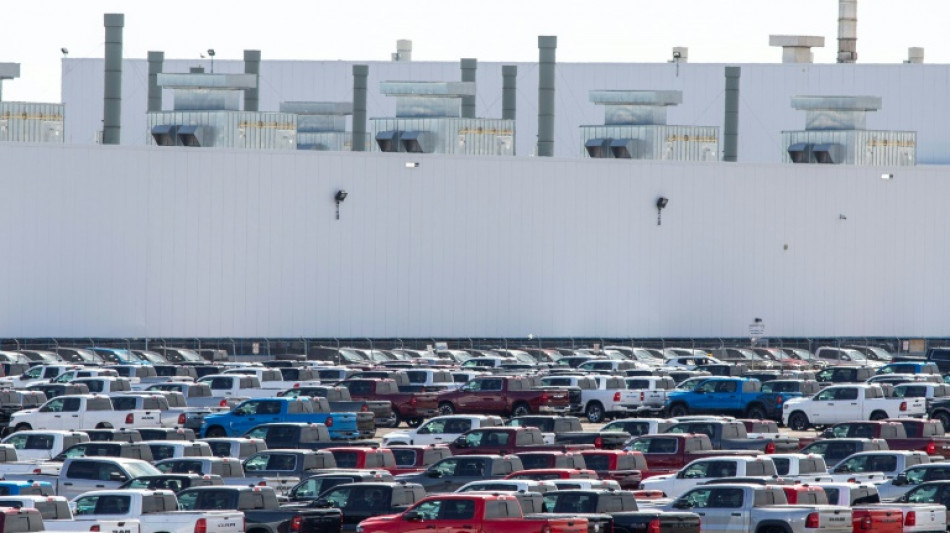
The White House said Tuesday it will soften tariffs on automakers, sparking optimism in Detroit whose car manufacturing industry has been on tenterhooks awaiting details on President Donald Trump's fast-evolving policy.
The measures, which include a guarantee that a carmaker wouldn't face multiple tariffs on the same vehicle, are designed to prod US and foreign companies to expand or build new factories to support domestic manufacturing.
Automakers have been among the hardest-hit sectors by Trump's multi-pronged assault on free trade. The announcement of relief is being timed in parallel with a visit by the president later Tuesday to the Detroit area to celebrate his 100th day in office.
"The president will sign the executive order on auto tariffs later today," White House Press Secretary Karoline Leavitt told reporters.
Analysts have warned that the myriad levies could result in higher prices, denting US car sales and threatening jobs.
But Trump, who has slammed free trade deals from his first presidential campaign in 2016, has embraced tariffs as necessary to spur more auto manufacturing in the United States.
But the administration determined that some relief was needed to give companies enough time to move supply chains to the country, a senior Commerce Department official said in a briefing.
"You're going to see a massive resurgence of domestic auto manufacturing," the official said.
- Grace period -
Besides a 25 percent tariff on finished imported cars, the industry has also been affected by Trump's 25 percent tariff on steel and aluminum. Automakers are also set to face new tariffs on foreign auto parts expected to take effect on May 3.
Trump's new policy includes a guarantee that a company wouldn't face both a 25 percent levy for an imported vehicle and 25 percent on steel or aluminum; the importer would pay the higher of the two levies, but not both, a Commerce official said.
The other change is that companies that import parts for vehicles assembled in the United States would be able to offset 15 percent of the vehicles list price in the first year and 10 percent in the second year.
That modification is designed to give companies two years to move supply chains to the United States.
Automakers told the Trump administration there would be "dramatic increases in production... as the payoff to America" from a two-year grace period, a Commerce official said.
Roughly half the cars sold in the United States are assembled within the country, with another 25 percent coming from Mexico and Canada and the remainder from a broader swath of nations including Germany, Japan and South Korea.
Automakers have already announced some investment decisions in light of the tariffs.
But analysts have cautioned that Trump's approach will not incentivize multi-billion-dollar investments if the industry does not believe the tariffs will last throughout Trump's administration and beyond.
General Motors said earlier this month that it plans to boost truck production at its plant in Fort Wayne, Indiana.
GM is looking at other actions "we could implement quickly, efficiently and with low near-term costs," Chief Financial Officer Paul Jacobson said Monday.
Jacobson declined to comment on GM's plans for South Korea, where it builds a number of low-cost vehicles that have become popular with US consumers focused on price.
Ford CEO Jim Farley said the company "welcomes and appreciates these decisions by President Trump, which will help mitigate the impact of tariffs on automakers, suppliers and consumers," according to a statement.
"Ford sees policies that encourage exports and ensure affordable supply chains to promote more domestic growth as essential," said Farley, who estimated that US factories could build four million more cars annually, supporting hundreds of thousands of new jobs.
Nissan, Honda and Volvo have been among the foreign automakers that have announced steps to boost investment in the United States.
X.Wong--CPN