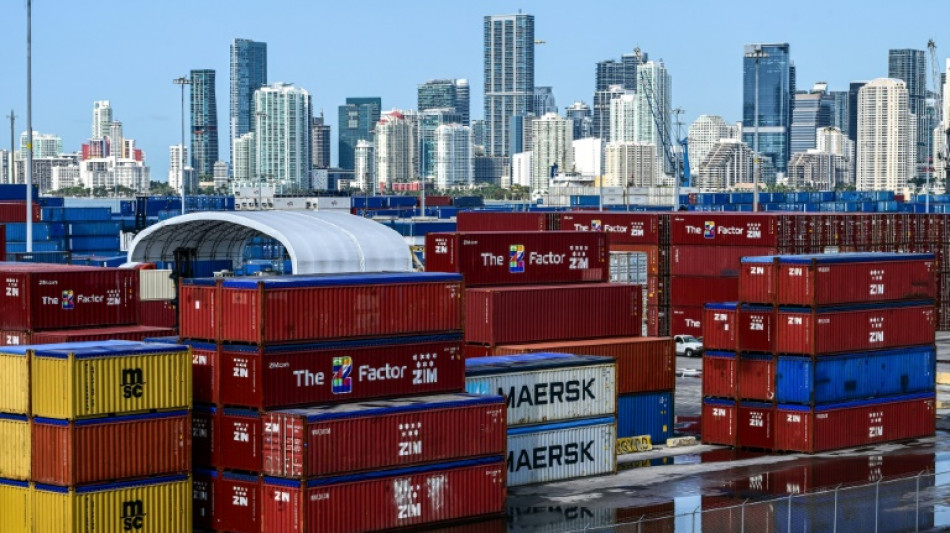
Trump trade war pushes firms to consider stockpiling / Photo: Giorgio VIERA - AFP

 Kenya's economy faces climate change risks: World Bank
 Japan's Takaichi may struggle to soothe voters and markets

 Arguments to begin in key US social media addiction trial
 'Send Help' repeats as N.America box office champ

 UK foreign office to review pay-off to Epstein-linked US envoy

 French police arrest five over crypto-linked magistrate kidnapping
 What's at stake for Indian agriculture in Trump's trade deal?

 Neglected killer: kala-azar disease surges in Kenya

 Spain, Portugal face fresh storms, torrential rain

 Crypto firm accidentally sends $40 bn in bitcoin to users
 Danone expands recall of infant formula batches in Europe
 Why bitcoin is losing its luster after stratospheric rise

 Digital euro delay could leave Europe vulnerable, ECB warns
 Stellantis takes massive hit for 'overestimation' of EV shift

 In Dakar fishing village, surfing entices girls back to school

 As Estonia schools phase out Russian, many families struggle
 Bangladesh Islamist leader seeks power in post-uprising vote
 UK royal finances in spotlight after Andrew's downfall

 New Zealand deputy PM defends claims colonisation good for Maori
 Deadly storm sparks floods in Spain, raises calls to postpone Portugal vote
 Lower pollution during Covid boosted methane: study
 Record January window for transfers despite drop in spending
 Davos forum opens probe into CEO Brende's Epstein links
 Greece aims to cut queues at ancient sites with new portal
 What does Iran want from talks with the US?
Stockpiling is the reflex response by firms to the imposition of tariffs, but with the rapidly-changing position of the Trump administration, companies are finding that it isn't so straightforward this time around.
Whether it's the luxury, electronics or pharmaceutical sectors, US President Donald Trump's unpredictability complicates the calculations of firms.
Some companies didn't wait for Trump's April 2 announcement of massive "reciprocal" trade tariffs: they had already begun shipping more of their goods to the United States.
In the end, Trump backed down quickly on the "reciprocal" tariffs, pausing them for 90 days except for China.
That still left the global 10 percent tariff in place, as well as the 25 percent tariffs on European steel, aluminium and cars.
French cosmetics firm Clarins didn't hesitate and stepped up shipments to the United States at the beginning of the year.
"We've built up three months of stocks, which represents $2 million in goods," said Lionel Uzan, the head of Clarins's US operations.
With all of its products made in France, Clarins had few other options to mitigate the tariffs.
- Discreet stockpiling -
Even if they don't all acknowledge it so openly, firms in many different sectors are stockpiling their products in the United States.
In March, exports of Swiss watches to the United States jumped nearly 14 percent compared to the same month last year.
More striking is Ireland, which plays host to a number of international pharmaceutical firms.
Its exports to the United States jumped 210 percent in February to nearly 13 billion euros ($14.8 billion), with 90 percent of those being pharmaceutical products and chemical ingredients.
Fermob, a French manufacturer of metal garden furniture that sells around 10 percent of its products in the United States, said it began planning for US tariffs once the result of the presidential election became known in November.
It stepped up production in January and February.
"We've sent around 30 percent of our extra stock to the United States," said the company's chief executive, Baptiste Reybier.
That extra production has benefitted transportation firms.
Lufthansa Cargo said it has seen in recent weeks "an increase in demand for shipments to the United States".
The trade war "has incited companies to accelerate certain stages in their supply chains", it told AFP.
"A similar trend was seen for the delivery of cars from the EU to the United States," it said.
The phenomenon also concerns US-made goods.
The Japanese newspaper Nikkei reported recently that Chinese tech firms were snapping up billions of dollars of artificial intelligence chips made by US firm Nvidia in anticipation of Washington imposing export restrictions.
- 'Short-term approach' -
Stockpiling is not a solution, however, said analysts.
Matt Jochim, a partner at consulting firm McKinsey who helps companies with supply chain issues, called stockpiling "a very short-term opportunistic" move.
He said the practice has limits as tariffs are constantly changing and it isn't always practicable.
"In a lot of the electronics space, it's also hard to do, because the technology changes so quickly, you don't want to get stuck with inventory of chipsets or devices that are the prior version," he said.
Fermob said it was taking a measured approach to stockpiling.
"Otherwise you're replacing one risk with another," the manufacturer's Reybier said.
"You have to finance stocks and there is also the risk of not having sent the right product."
Having a local subsidiary with warehouses also helped, Reybier added.
"It's too early to say whether we should have sent more or not."
St.Ch.Baker--CPN