India and Pakistan's Kashmir fallout hits economy too / Photo: Arun SANKAR - AFP

 Kenya's economy faces climate change risks: World Bank

 Japan's Takaichi may struggle to soothe voters and markets

 Arguments to begin in key US social media addiction trial
 'Send Help' repeats as N.America box office champ

 UK foreign office to review pay-off to Epstein-linked US envoy

 French police arrest five over crypto-linked magistrate kidnapping
 What's at stake for Indian agriculture in Trump's trade deal?

 Neglected killer: kala-azar disease surges in Kenya

 Spain, Portugal face fresh storms, torrential rain

 Crypto firm accidentally sends $40 bn in bitcoin to users

 Danone expands recall of infant formula batches in Europe

 Why bitcoin is losing its luster after stratospheric rise

 Digital euro delay could leave Europe vulnerable, ECB warns

 Stellantis takes massive hit for 'overestimation' of EV shift

 In Dakar fishing village, surfing entices girls back to school

 As Estonia schools phase out Russian, many families struggle

 Bangladesh Islamist leader seeks power in post-uprising vote

 UK royal finances in spotlight after Andrew's downfall

 New Zealand deputy PM defends claims colonisation good for Maori

 Deadly storm sparks floods in Spain, raises calls to postpone Portugal vote
 Lower pollution during Covid boosted methane: study
 Record January window for transfers despite drop in spending

 Davos forum opens probe into CEO Brende's Epstein links
 Greece aims to cut queues at ancient sites with new portal
 What does Iran want from talks with the US?

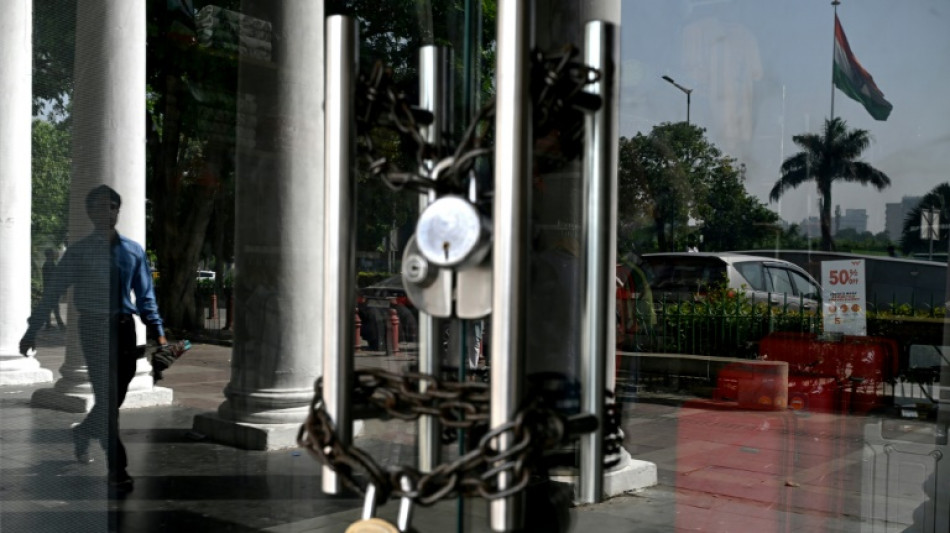
Rapidly deteriorating relations between India and Pakistan over a deadly shooting in Kashmir are starting to have small but prickly economic consequences for both nations.
The killing of 26 men on Tuesday in Indian-administered Kashmir, the deadliest attack on civilians in the Himalayan region in a quarter of a century, triggered public outrage across the world's most populous country.
India has unveiled a series of mostly symbolic diplomatic measures against Pakistan, after accusing its regional rival of supporting "cross-border terrorism".
Islamabad, which rejected the allegations, responded Thursday with similar tit-for-tat measures -- but upped the ante by halting trade with New Delhi and closing its airspace to Indian airlines.
Experts say that while the retaliatory moves will not have an immediate or far-reaching impact, it will likely result in longer and more expensive flights for Indians, while forcing Pakistan to increase pharmaceutical imports from other countries.
Pakistan's decision to close its airspace to carriers from its neighbour will see journeys from India to Central Asia, Europe and North America take up to two hours longer.
"We are currently looking at, on average, an extra 60 minutes to 120 minutes for flights depending on where they go," Sanjay Lazar, aviation expert and CEO of Avialaz Consultants, told AFP.
- 'Sabre rattle' -
Pakistan's move is expected to hurt Air India, owned by Indian conglomerate Tata Group, the most.
Air India said that some flights to North America, Europe and the Middle East will have to take an "alternative extended route".
And the extra flying time may eventually make flights more expensive.
"There is extra fuel burn, because you're taking a more circuitous route," Lazar said.
"And if you add an extra stop on the route, then you incur additional crew and landing costs too."
Airfares could rise if restrictions continue beyond six months, though airlines are unlikely to hike up fares immediately to avoid the risk of "not appearing patriotic enough", he added.
Mark D Martin, of Martin Consulting, said ticket prices could rise by more than 35 percent to Middle East destinations and by over 45 percent to Europe.
"It's always the airline business that gets impacted when India and Pakistan spar and sabre rattle," Martin said.
"Let's hope better sense prevails, and this situation deescalates, as this will have an earning impact on airline financials."
Indian government data shows that when Islamabad closed its airspace in 2019 -- after New Delhi hit it with airstrikes in response to an attack in Kashmir -- domestic airlines saw a financial cost of nearly 5.5 billion rupees ($64.3 million) during the nearly five-month-long shutdown.
- Third country trade -
But analysts say Pakistan's decision to halt trade is unlikely to have a major impact, as regular diplomatic flare-ups between the two nations over decades have prevented close economic ties.
India exported less than $450 million in goods to Pakistan between April 2024 and January 2025, a tiny fraction of its overall shipments.
Key items included pharmaceutical products worth over $110 million, and sugar worth over $85 million.
"Imports from Pakistan were negligible -- just $0.42 million, limited to niche items like figs, basil and rosemary herbs," Ajay Srivastava of Global Trade Research Initiative, a New Delhi-based think tank, said in a briefing note.
But Islamabad also said Thursday it had suspended "all trade with India" including "to and from any third country through Pakistan".
It is not immediately clear how this would impact indirect trade through countries such as the United Arab Emirates or Singapore.
Indirect trade is far higher, totalling around $10 billion, according to Srivastava.
"Informal sources say that Pakistan imports several Indian products this way, including chemicals, pharmaceuticals, cotton and yarn," he said.
"On the other hand, India may receive Himalayan pink salt and dry fruits such as dates, apricots, and almonds from Pakistan, also routed through third countries."
X.Wong--CPN