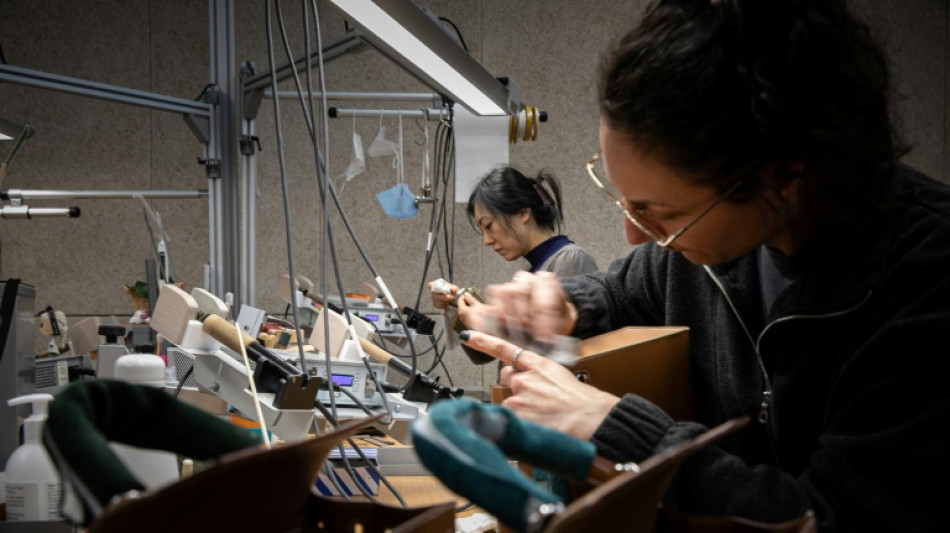
TikTok videos exploit trade war to sell fake luxury goods / Photo: Lou BENOIST - AFP

 Kenya's economy faces climate change risks: World Bank

 Japan's Takaichi may struggle to soothe voters and markets

 Arguments to begin in key US social media addiction trial
 'Send Help' repeats as N.America box office champ

 UK foreign office to review pay-off to Epstein-linked US envoy
 French police arrest five over crypto-linked magistrate kidnapping
 What's at stake for Indian agriculture in Trump's trade deal?

 Neglected killer: kala-azar disease surges in Kenya

 Spain, Portugal face fresh storms, torrential rain

 Crypto firm accidentally sends $40 bn in bitcoin to users
 Danone expands recall of infant formula batches in Europe
 Why bitcoin is losing its luster after stratospheric rise

 Digital euro delay could leave Europe vulnerable, ECB warns
 Stellantis takes massive hit for 'overestimation' of EV shift

 In Dakar fishing village, surfing entices girls back to school

 As Estonia schools phase out Russian, many families struggle
 Bangladesh Islamist leader seeks power in post-uprising vote

 UK royal finances in spotlight after Andrew's downfall
 New Zealand deputy PM defends claims colonisation good for Maori

 Deadly storm sparks floods in Spain, raises calls to postpone Portugal vote
 Lower pollution during Covid boosted methane: study
 Record January window for transfers despite drop in spending
 Davos forum opens probe into CEO Brende's Epstein links
 Greece aims to cut queues at ancient sites with new portal
 What does Iran want from talks with the US?
TikTok abounds with viral videos accusing prestigious brands of secretly manufacturing luxury goods in China so they can be sold at cut prices.
But while these "revelations" are spurious, behind them lurks a well-oiled machine for selling counterfeit goods that is making the most of the confusion surrounding trade tariffs.
Chinese content creators who portray themselves as workers or subcontractors in the luxury goods business claim that Beijing has lifted confidentiality clauses on local subcontractors as a way to respond to the huge hike in customs duties imposed on China by US President Donald Trump.
They say this Chinese decision, of which AFP has found no trace, authorises them to reveal the hidden underbelly of luxury goods manufacturing in China.
They encourage Western consumers to buy directly from the websites selling these goods, which bear no logos or labels but are said to be of the same quality and design as the expensive originals.
The prices are alluring too, dropping from $38,000 for a luxury bag to $1,400.
Brands targeted -- which include Hermes, Chanel and Louis Vuitton, whose goods are produced in Europe and the United States according to their websites -- declined to respond to AFP questions about the claims made in these viral videos.
But for Jacques Carles, head of the French Luxury and Design Centre, a management consultancy, the notion that luxury brands would manufacture goods in China is simply "absurd".
"It would be suicidal. If there was evidence -- and there isn't -- it would be the end. These brands aren't stupid," he told AFP.
While the TikTokers point to the skill of the Chinese workers, presented as the little hands behind the big luxury names, "these counterfeit workshops absolutely do not respect all the required stages in the manufacturing process", he said.
- 'Creating doubt' -
Carles cited the example of Hermes's Birkin bag, which requires "hundreds of hours of work" to produce.
He said the internet clip makers were, "by creating doubt", actually looking to "open up an opportunity... to shift their stocks" of counterfeit goods.
"It's a viral campaign that's spread on social networks (and) is difficult to counter," he said.
Luxury brands chose to remain silent and "treat the phenomenon with scorn", which was a mistake in his view, he added.
The accusation that luxury goods officially manufactured in Europe were in reality being secretly made in China "does not make any sense", concurred Michel Phan, professor of luxury marketing at emlyon business school in France.
He rejected the argument made on TikTok that this was a Chinese retort to US trade tariffs.
"Hurting European luxury brands will not change anything (for) the US government because they are not related to those brands," he said.
"All the videos online mentioning that luxury brands manufactured their products in China and then put the 'Made in France' label before selling them are nonsense.
"It is illegal to do so and no brand will take the risk to get caught (sic) doing it."
The e-commerce department at China's trade ministry said in a statement: "Any misleading marketing, infringement, or counterfeit activities" by entities posing as subconstractors for established brands "will be promptly referred to law enforcement agencies for investigation and action."
- 'I'm such a sucker' -
Comments on the viral clips, portrayed as coming from internet users rather than the video creators themselves, seem to show that the message resonates.
"I'm so annoyed. I paid top price!" said one in a video comment.
"I'm such a sucker," said another.
Some leave comments asking for the names of "suppliers of luxury goods" in China from whom they can buy the coveted items on the cheap.
Meanwhile, Chinese vendors are also selling counterfeit luxury goods directly on TikTok, with links to their websites. These TikTok live reels garner hundreds of views each.
They show row upon row of shelves full of luxury items, all numbered.
"DHL delivery. Products identical to those in stores. The only difference is the price," says one, using an AI-generated voice in French.
Internet users are invited to scan a QR code or click on a link to complete their purchase via WhatsApp or PayPal.
AFP has found a score of similar live feeds, released simultaneously in English and French, suggesting that the main targets are internet users in Europe and the United States.
China is regularly accused of being the world's top producer of counterfeit goods.
Some estimates suggest 70 to 80 percent of all fakes are manufactured there.
In European Union states and a number of other countries there are hefty penalties for purchasing counterfeits.
In France, that could mean a three-year prison term and a fine of 300,000 euros ($340,600).
Customs authorities may also confiscate counterfeit goods and fine the purchaser the equivalent of the items' true value.
The European Union Intellectual Property Office (EUIPO) says counterfeiting costs European industry 16 billion euros a year, with the clothes, cosmetics and toy sectors being the worst affected.
Y.Tengku--CPN