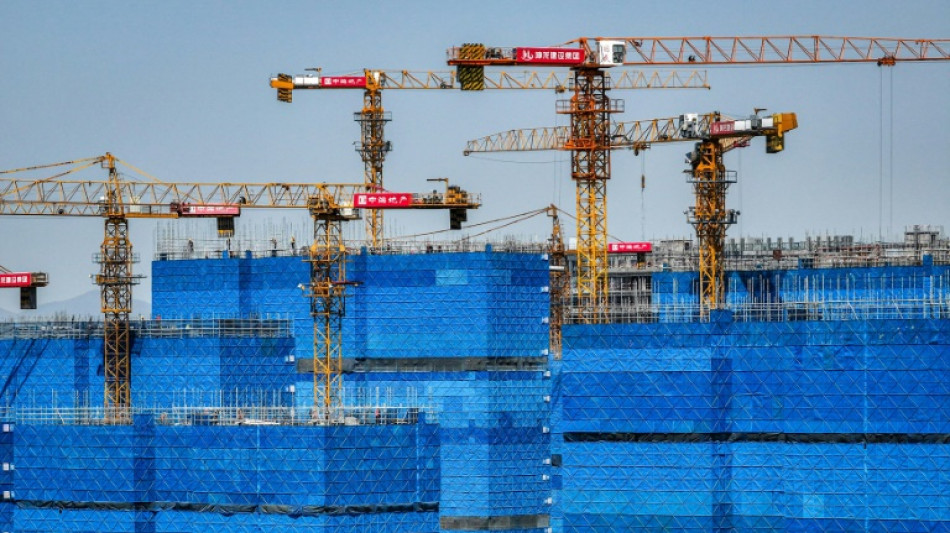
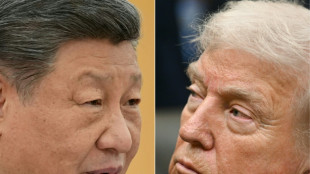
China's top leaders pledge economic support as trade war rages / Photo: STR - AFP

 Kenya's economy faces climate change risks: World Bank
 Japan's Takaichi may struggle to soothe voters and markets

 Arguments to begin in key US social media addiction trial
 'Send Help' repeats as N.America box office champ

 UK foreign office to review pay-off to Epstein-linked US envoy
 French police arrest five over crypto-linked magistrate kidnapping

 What's at stake for Indian agriculture in Trump's trade deal?

 Neglected killer: kala-azar disease surges in Kenya

 Spain, Portugal face fresh storms, torrential rain

 Crypto firm accidentally sends $40 bn in bitcoin to users
 Danone expands recall of infant formula batches in Europe
 Why bitcoin is losing its luster after stratospheric rise

 Digital euro delay could leave Europe vulnerable, ECB warns
 Stellantis takes massive hit for 'overestimation' of EV shift

 In Dakar fishing village, surfing entices girls back to school

 As Estonia schools phase out Russian, many families struggle

 Bangladesh Islamist leader seeks power in post-uprising vote
 UK royal finances in spotlight after Andrew's downfall

 New Zealand deputy PM defends claims colonisation good for Maori

 Deadly storm sparks floods in Spain, raises calls to postpone Portugal vote
 Lower pollution during Covid boosted methane: study
 Record January window for transfers despite drop in spending

 Davos forum opens probe into CEO Brende's Epstein links
 Greece aims to cut queues at ancient sites with new portal
 What does Iran want from talks with the US?

China's top leaders pledged on Friday to step up support for the economy and oppose "unilateral bullying" in global trade in a veiled rebuke of hefty tariffs imposed by US President Donald Trump.
The world's two largest economies are engaged in a high-stakes trade war that has spooked markets and spurred major manufacturers to reconsider supply chains.
Leaders at a gathering of the Chinese Communist Party's top decision-making body focused on economic work, which was attended by President Xi Jinping, acknowledged that "the impact of external shocks is increasing", state news agency Xinhua reported.
They also said they would seek to "work with the international community to actively uphold multilateralism and oppose unilateral bullying practices", it said.
The brutal trade war comes as China's economy strains under the weight of longstanding woes in the property sector and reluctance by consumers to pull out their wallets.
Leaders at the Politburo meeting discussed a range of domestic economic issues, emphasising the need to "enhance the role of consumption in stimulating economic growth", according to Xinhua.
They also called for action to increase incomes and "vigorously develop service consumption", as well as the implementation of key rate cuts at "appropriate times".
The readout of the meeting "shows the government is ready to launch new policies when the economy is affected by the external shock", Zhiwei Zhang, President and Chief Economist of Pinpoint Asset Management, wrote in a note.
However, Zhang noted "it seems Beijing is not in a rush to launch a large stimulus at this stage".
"It takes time to monitor and evaluate the timing and the size of the trade shock," he added.
Experts say the Chinese economy will need to depend more on domestic consumption in order to sustain growth through coming years.
Beijing is targeting annual growth this year of five percent, although economists consider that goal to be ambitious.
- 'Extreme scenario' -
China achieved record exports last year, providing a key source of economic activity as domestic challenges in the property sector and deflationary pressure persisted.
But the global trading system is now under great pressure, with Trump having hit most trading partners with 10 percent tariffs since reclaiming office in January.
China has received the worst of Trump's trade blitz, with many of its products now facing a 145 percent tariff. Beijing has responded with new 125 percent tariffs of its own on US goods.
There have been competing claims in recent days about potential trade talks that could see an easing of the sky-high tariffs that have unleashed chaos on the global economy.
A spokesman for Beijing's commerce ministry said on Thursday that "there are currently no economic and trade negotiations between China and the United States".
But hours later, asked about the state of negotiations with Beijing, Trump maintained: "We've been meeting with China."
Chinese financial news outlet Caijing reported on Friday that Beijing was considering the exemption of certain US semiconductor products from recent additional tariffs, citing sources familiar with the matter.
Beijing's commerce ministry did not immediately respond to an AFP request to confirm the reports.
China also said on Friday it was necessary to enhance "extreme scenario thinking" as the trade war deepens.
"It is essential to... enhance both bottom-line thinking and extreme scenario thinking, with a strong focus on preventing and defusing trade risks," a commerce ministry statement said.
The Politburo meeting's emphasis on innovation shows that China is preparing for a "deepening decoupling with the United States", Yue Su, Principal Economist at the Economist Intelligence Unit, told AFP.
The tone of the meeting "reflects growing concern over downside risks, as the government appears increasingly willing to factor potential negative shocks into its policy planning", Su said.
T.Morelli--CPN