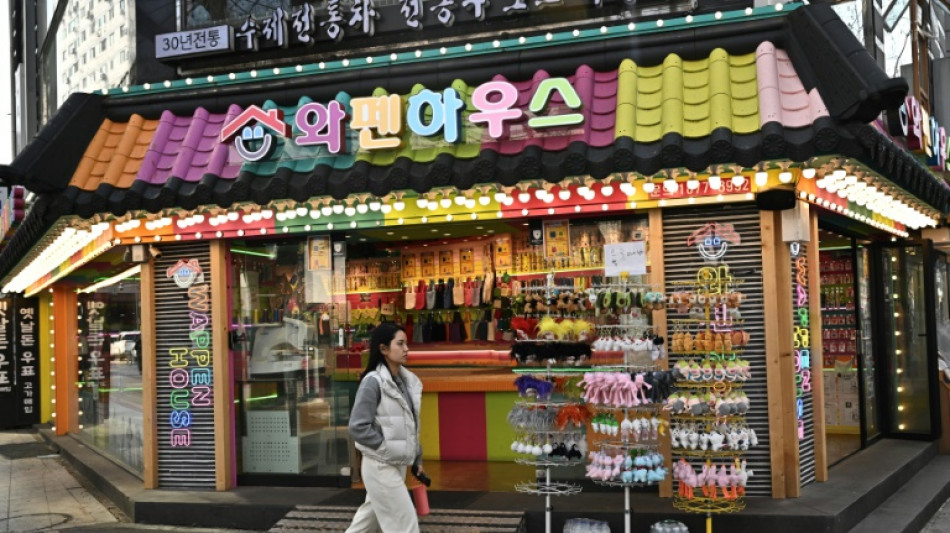
S. Korea's economy shrinks in first quarter as trade war hits exports
/ Photo: Pedro PARDO - AFP/File

 Kenya's economy faces climate change risks: World Bank

 Japan restarts world's biggest nuclear plant again
 'Want to go home': Indonesian crew abandoned off Africa demand wages
 Trump says China's Xi to visit US 'toward the end of the year'

 US astronaut to take her 3-year-old's cuddly rabbit into space

 Storm-battered Portugal votes in presidential election run-off

 De Beers sale drags in diamond doldrums
 Pakistan's capital picks concrete over trees, angering residents
 Chile's climate summit chief to lead plastic pollution treaty talks
 Opinions of Zuckerberg hang over social media addiction trial jury selection
 Dow surges above 50,000 for first time as US stocks regain mojo

 EU nations back chemical recycling for plastic bottles
 Stocks rebound though tech stocks still suffer
 German exports to US plunge as tariffs exact heavy cost

 'Mona's Eyes': how an obscure French art historian swept the globe
 Russian pensioners turn to soup kitchen as war economy stutters
 Toyota names new CEO, hikes profit forecasts
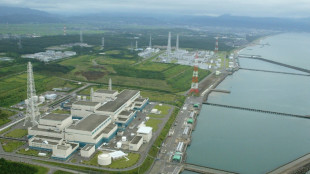 Japan to restart world's biggest nuclear plant
 Undercover probe finds Australian pubs short-pouring beer
 Amazon shares plunge as AI costs climb
 Carney scraps Canada EV sales mandate, affirms auto sector's future is electric
 Carney scraps Canada EV sales mandate

 Mining giant Rio Tinto abandons Glencore merger bid
 ECB warns of stronger euro impact, holds rates

 ECB holds interest rates as strong euro causes jitters

South Korea's economy unexpectedly contracted 0.1 percent in the first three months of this year, the country's central bank said Thursday, as the Asian export giant reels from months of political chaos and heightened trade tensions.
US President Donald Trump's threatened 25 percent "reciprocal" tariffs on export-dependent South Korea have rattled Asia's fourth-largest economy, sending Seoul-listed shares tumbling and pushing the currency to its weakest level since 2009.
The country is also still emerging from a political crisis triggered by former president Yoon Suk Yeol's December attempt to suspend civilian rule, which culminated in his impeachment and removal from office this month.
"Real gross domestic product (GDP) fell by 0.1 percent compared to the same period last year," the central bank said, adding that it contracted by 0.2 percent from the previous quarter.
"Two developments hit confidence and the economy -- fallout from former President Yoon Suk Yeol's failed martial law attempt and worries about shifts in US trade policies," said Hyosung Kwon, an economist at Bloomberg Economics.
"Looking ahead, we see the economy rebounding in the second quarter of this year, helped by easing political uncertainty at home. But the recovery will likely remain fragile as elevated US tariffs weigh on external demand," Kwon added.
- Dented exports -
The country's economy expanded 1.3 precent in the first quarter of last year but grew less than expected in the fourth quarter, as the fallout from Yoon's declaration of martial law hit consumer confidence and domestic demand.
According to the Korea Customs Service, as of mid-April, the country's exports had dropped by more than 5 percent compared to the previous year, with declines reported in nine out of the country's ten major export categories excluding semiconductors.
The sharpest fall was in exports to the United States, which plunged by more than 14 percent.
The International Monetary Fund this week sharply revised down its growth forecast for South Korea for the year, cutting it from 2.0 percent to 1.0 percent.
"The South Korean economy is facing structural burdens of high inflation and a weak won-dollar exchange rate, and under this dual pressure, a slowdown in growth is becoming increasingly evident," Kim Dae-jong, a professor at Sejong University, told AFP.
Bank of Korea governor Rhee Chang-yong said last week the country's annual growth rate is now "expected to fall short of the 1.5 percent forecast made in February".
"The tightening of tariff policies, which is much stronger than initially projected, will likely further weigh on growth prospects," he told reporters in a press conference.
He added that "political uncertainty has dragged on longer than expected, delaying the recovery of economic sentiment."
Sluggish domestic demand, along with factors such as large-scale wildfires which tore through swaths of the country's southeast in late March, had also contributed to the downturn, Rhee said.
Addressing parliament, acting president Han Duck-soo underlined "significant" challenges by South Korea.
"Unprecedented US-driven tariff policies have created a level of uncertainty that is causing rapid and unpredictable shifts in the global economic landscape," Han told the National Assembly.
US tariffs on steel and automobiles, as well as broader levies imposed by Trump on other goods, are expected to "place considerable strain on Korean industries and businesses," added Han.
T.Morelli--CPN