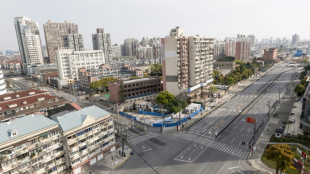
China's manufacturing backbone feels Trump trade war pinch / Photo: JADE GAO - AFP

 Kenya's economy faces climate change risks: World Bank

 Iran steps up arrests while remaining positive on US talks

 EU warns Meta it must open up WhatsApp to rival AI chatbots
 Japan's Takaichi may struggle to soothe voters and markets

 Arguments to begin in key US social media addiction trial
 'Send Help' repeats as N.America box office champ

 UK foreign office to review pay-off to Epstein-linked US envoy

 French police arrest five over crypto-linked magistrate kidnapping
 What's at stake for Indian agriculture in Trump's trade deal?

 Neglected killer: kala-azar disease surges in Kenya

 Spain, Portugal face fresh storms, torrential rain

 Crypto firm accidentally sends $40 bn in bitcoin to users
 Danone expands recall of infant formula batches in Europe
 Why bitcoin is losing its luster after stratospheric rise

 Digital euro delay could leave Europe vulnerable, ECB warns
 Stellantis takes massive hit for 'overestimation' of EV shift

 In Dakar fishing village, surfing entices girls back to school

 As Estonia schools phase out Russian, many families struggle
 Bangladesh Islamist leader seeks power in post-uprising vote
 UK royal finances in spotlight after Andrew's downfall

 New Zealand deputy PM defends claims colonisation good for Maori

 Deadly storm sparks floods in Spain, raises calls to postpone Portugal vote
 Lower pollution during Covid boosted methane: study
 Record January window for transfers despite drop in spending

 Davos forum opens probe into CEO Brende's Epstein links
| SCS | 0.12% | 16.14 | $ | |
| RBGPF | 0.12% | 82.5 | $ | |
| CMSC | -0.05% | 23.56 | $ | |
| AZN | -1.53% | 190.13 | $ | |
| GSK | -2.41% | 58.81 | $ | |
| RIO | 2.9% | 96.195 | $ | |
| NGG | -0.43% | 87.68 | $ | |
| RELX | -0.24% | 29.31 | $ | |
| CMSD | 0% | 23.95 | $ | |
| BTI | -2.97% | 60.99 | $ | |
| RYCEF | 2.65% | 17.34 | $ | |
| BCC | -0.91% | 90.21 | $ | |
| BCE | 1.92% | 25.57 | $ | |
| BP | 0.45% | 39.185 | $ | |
| JRI | -1.53% | 12.775 | $ | |
| VOD | 2.14% | 15.44 | $ |
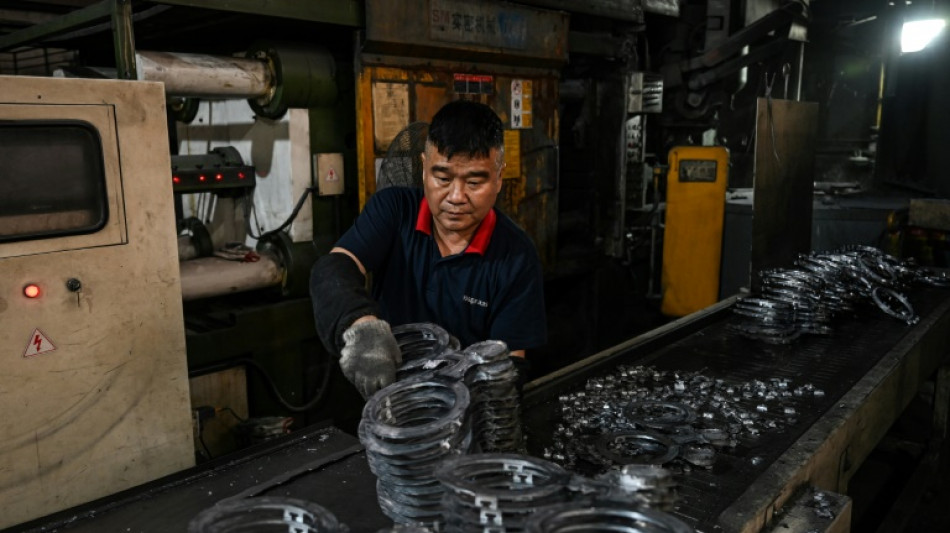
Sky-high tariffs imposed on China by US President Donald Trump have triggered a slump in factory orders, manufacturers told AFP this week -- with some fearing business may never return.
China's vast southern province of Guangdong, crisscrossed with factories making everything from clothing to electronics, has long been the country's biggest manufacturing hub.
For decades, it has churned out products for the insatiable American consumer base, offering low prices few can compete with and serving as a key driver in China's meteoric rise to global economic superpower status.
But Trump's drive to bring manufacturing back to the United States and launch of a brutal trade war with China now threatens to upend that -- adding to the country's already grim economic outlook.
Xiao Junyi, a clothing factory owner in the province's largest city of Guangzhou, told AFP that the US market had accounted for between 20 to 30 percent of orders.
But after the tariffs were announced, "we were genuinely affected," he said.
"Our sales and orders clearly declined."
Many of his factory's products are sold to consumers in the United States via Temu, the low-cost overseas e-commerce platform operated by Chinese retail giant PDD Holdings.
In response to the US tariffs -- now 145 percent for most products and as much as 245 percent on others -- Temu issued a notice saying there will be reduced advertising in the US market going forward, Xiao said.
The 24-year-old factory owner said he was hoping to find other markets for his clothes.
"Aside from the United States, we can do business with the whole world," he said.
But he admitted it was "really unlikely" that other countries would replace the US market.
"The United States is a truly developed country, and the order volume is bigger."
- 'Boundless competition' -
Nearby, businesspeople from across the globe convened for the opening phase of the Canton Fair -- a colossal trade show held every spring and autumn.
The event serves as an opportunity for merchants from around the world to meet face-to-face with Chinese manufacturers and assess their products up close, establishing new supply arrangements or shoring up old contacts.
But buyers from the United States this year were few and far between.
Those that were there declined to comment when asked by AFP which products they were interested in -- or if the tariff war would complicate business.
One Chinese firm keen to make contacts was Wosen Lighting Technology, a supplier to US e-commerce juggernaut Amazon.
"It's a new round in the trade war," Andy Lin, the firm's business development manager, told AFP at one of its factories in nearby Zhongshan.
"It becomes a case where you add tariffs and I also add tariffs -- then it turns into a boundless competition," said Lin.
"This situation won't be able to last long, because after all, it has very real impacts on all countries," she added.
"I think it will especially affect the lives of the American people."
- 'Manufacturing powerhouse' -
The downturn in shipments to the United States could also affect the local manufacturing industry, for which Wosen provides several hundred jobs.
Nevertheless, factories visited by AFP this week in Guangdong were buzzing with activity as workers sat at production lines, the air filled with the clanging and whirring of conveyor belts.
Many manufacturers admitted the heightened trade war with the United States will cause turbulence for businesses.
But they hoped that would encourage them to find new customers in other countries.
The tariffs are also likely to cause pain among American consumers, with US Federal Reserve boss Jerome Powell warning this week that they may increase inflation in the country.
As for China's reciprocal tariffs on US goods, Lin said she was not concerned about it affecting her lifestyle -- she is used to buying things on local e-commerce platforms from Chinese manufacturers.
"They can all basically be produced domestically," said Lin.
"After all, China is a manufacturing powerhouse. If you are not looking for certain special products, the impact will be small."
H.Meyer--CPN