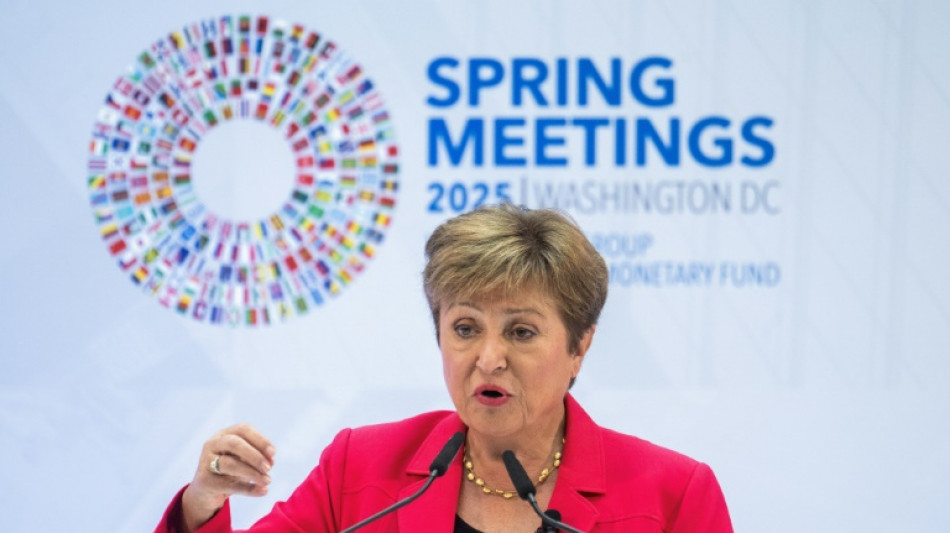
World economy likely to avoid recession despite tariffs: IMF chief / Photo: Jim WATSON - AFP

 Kenya's economy faces climate change risks: World Bank

 Iran steps up arrests while remaining positive on US talks
 EU warns Meta it must open up WhatsApp to rival AI chatbots
 Japan's Takaichi may struggle to soothe voters and markets

 Arguments to begin in key US social media addiction trial
 'Send Help' repeats as N.America box office champ

 UK foreign office to review pay-off to Epstein-linked US envoy
 French police arrest five over crypto-linked magistrate kidnapping

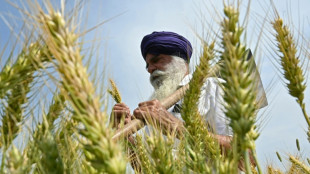 What's at stake for Indian agriculture in Trump's trade deal?
 Neglected killer: kala-azar disease surges in Kenya

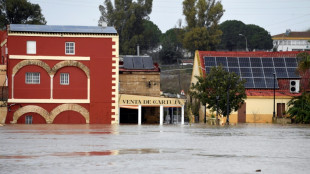 Spain, Portugal face fresh storms, torrential rain

 Crypto firm accidentally sends $40 bn in bitcoin to users
 Danone expands recall of infant formula batches in Europe
 Why bitcoin is losing its luster after stratospheric rise

 Digital euro delay could leave Europe vulnerable, ECB warns
 Stellantis takes massive hit for 'overestimation' of EV shift

 In Dakar fishing village, surfing entices girls back to school

 As Estonia schools phase out Russian, many families struggle

 Bangladesh Islamist leader seeks power in post-uprising vote
 UK royal finances in spotlight after Andrew's downfall

 New Zealand deputy PM defends claims colonisation good for Maori

 Deadly storm sparks floods in Spain, raises calls to postpone Portugal vote
 Lower pollution during Covid boosted methane: study
 Record January window for transfers despite drop in spending
 Davos forum opens probe into CEO Brende's Epstein links
| SCS | 0.12% | 16.14 | $ | |
| RBGPF | 0.12% | 82.5 | $ | |
| CMSC | -0.05% | 23.56 | $ | |
| AZN | -1.53% | 190.13 | $ | |
| GSK | -2.41% | 58.81 | $ | |
| RIO | 2.9% | 96.195 | $ | |
| NGG | -0.43% | 87.68 | $ | |
| RELX | -0.24% | 29.31 | $ | |
| CMSD | 0% | 23.95 | $ | |
| BTI | -2.97% | 60.99 | $ | |
| RYCEF | 2.65% | 17.34 | $ | |
| BCC | -0.91% | 90.21 | $ | |
| BCE | 1.92% | 25.57 | $ | |
| BP | 0.45% | 39.185 | $ | |
| JRI | -1.53% | 12.775 | $ | |
| VOD | 2.14% | 15.44 | $ |
The global economy is likely to avoid a recession despite the hit to growth from US President Donald Trump's tariff rollout, the head of the International Monetary Fund said Thursday.
The stop-start US tariff plans have fueled levels of market volatility unseen since the Covid-19 pandemic, and most economists expect the imposition of new import levies will stifle growth and push up inflation, at least in the short term.
Trade disruptions "incur costs," IMF Managing Director Kristalina Georgieva told reporters in Washington on Thursday, adding that the Fund now expects "notable" cuts to growth -- but no recession.
People live in a world of "sudden and sweeping shifts," she said, in a nod to the recent market volatility.
"It is a call to respond wisely," she added.
Her speech came ahead of next week's Spring Meetings -- a gathering of global financial leaders co-hosted by the IMF and the World Bank in the US capital.
Her remarks suggest the IMF will use its upcoming World Economic Report, to be published on Tuesday, to pare back its previous forecast for global growth to hit 3.3 percent in 2025 and 2026.
- 'Perceptions matter' -
Georgieva said the current tariff tensions would likely have three major consequences for the global economy, with smaller advanced economies and most emerging markets likely to be more heavily affected due to their reliance on trade for growth.
"First, uncertainty is costly," she said, adding that it becomes difficult for business to make plans if they do not know how much their inputs will cost in the future.
"Second, rising trade barriers hit growth upfront," she said, noting that "tariffs, like all taxes, raise revenue at the expense of reducing and shifting activity."
"Third observation: protectionism erodes productivity over the long run, especially in smaller economies," she said.
Georgieva called on all countries "to put their own houses in order" by -- among other things -- gradually adjusting their fiscal policies to lower debt levels when necessary, and by maintaining an "agile and credible" monetary policy with a "strong commitment" to central bank independence.
"Perceptions matter as much as reality," she said, calling on world leaders to improve citizens' perceptions of the economy amid plunging consumer confidence -- especially in the United States.
- 'More level playing field' -
Countries should also prioritize tackling internal and external macroeconomic imbalances, Georgieva said.
For China, the IMF has recommended to Beijing that it enact policies "to boost chronically low private consumption," and move the Asian giant away from its current state-supported, export-driven model of growth, she said.
The United States, she added, must work to put rapidly rising government debt "on a declining path."
And for the European Union, the focus should remain on improving competitiveness "by deepening the single market," she said.
Georgieva -- who leads an organization that has long championed free trade, privatization and more open economies -- called on the largest countries to chart a path through the current trade uncertainty.
"In trade policy, the goal must be to secure a settlement among the largest players that preserves openness and delivers a more level playing field," she said.
The aim, she added, should be "to restart a global trend toward lower tariff rates while also reducing nontariff barriers and distortions."
"We need a more resilient world economy, not a drift to division," she added. "And, to facilitate the transition, policies must allow private agents time to adjust and deliver."
O.Ignatyev--CPN