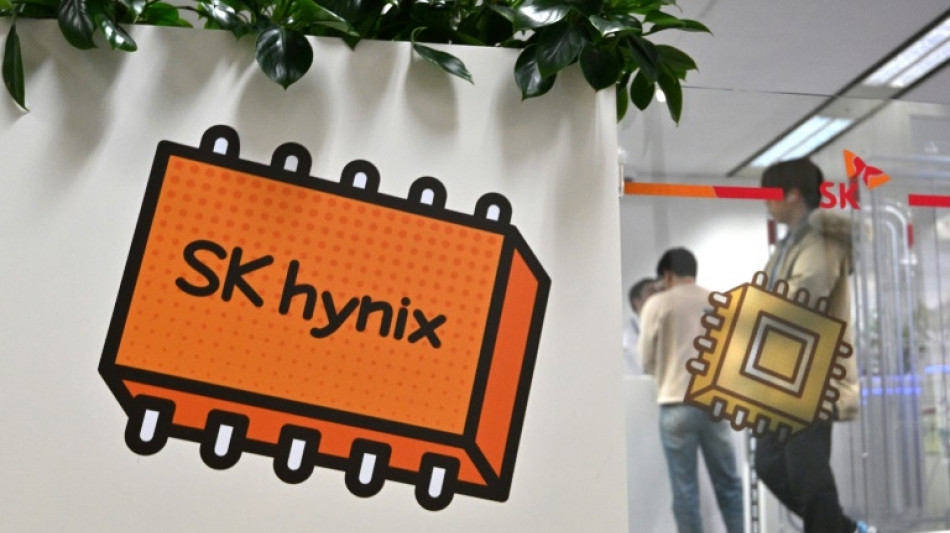
S. Korea plans extra $4.9 bn help for chips amid US tariff anxiety / Photo: Jung Yeon-je - AFP/File

 Kenya's economy faces climate change risks: World Bank

 Meta, Google face jury in landmark US addiction trial
 Some striking NY nurses reach deal with employers
 EU chief backs Made-in-Europe push for 'strategic' sectors

 Iran steps up arrests while remaining positive on US talks
 EU warns Meta it must open up WhatsApp to rival AI chatbots
 Japan's Takaichi may struggle to soothe voters and markets

 Arguments to begin in key US social media addiction trial
 'Send Help' repeats as N.America box office champ
 UK foreign office to review pay-off to Epstein-linked US envoy
 French police arrest five over crypto-linked magistrate kidnapping
 What's at stake for Indian agriculture in Trump's trade deal?

 Neglected killer: kala-azar disease surges in Kenya

 Spain, Portugal face fresh storms, torrential rain

 Crypto firm accidentally sends $40 bn in bitcoin to users
 Danone expands recall of infant formula batches in Europe
 Why bitcoin is losing its luster after stratospheric rise
 Digital euro delay could leave Europe vulnerable, ECB warns
 Stellantis takes massive hit for 'overestimation' of EV shift

 In Dakar fishing village, surfing entices girls back to school

 As Estonia schools phase out Russian, many families struggle
 Bangladesh Islamist leader seeks power in post-uprising vote
 UK royal finances in spotlight after Andrew's downfall
 New Zealand deputy PM defends claims colonisation good for Maori
 Deadly storm sparks floods in Spain, raises calls to postpone Portugal vote
South Korea on Tuesday announced plans to invest almost $5 billion extra in the country's semiconductor industry, citing "growing uncertainty" over US tariffs.
The country is a major exporter to the United States and its powerhouse chip and auto industries would suffer a hefty hit from President Donald Trump's threatened 25 percent levies.
Concerns about the sector have hammered the Seoul-listed shares of the world's largest memory chip maker Samsung, and largest memory chip supplier SK Hynix.
Officials have now stepped up to provide more cover for the economically crucial industry by announcing an extra $4.9 billion will be pumped into it through 2026.
"An aggressive fiscal investment plan has been devised to help local firms navigate mounting challenges in the global semiconductor race," the finance ministry said in a press release.
It warned "growing uncertainty" following rounds of US tariff threats had left the sector clamouring for government support.
"To foster a dynamic, private sector-led ecosystem for semiconductor innovation and growth, the government will increase its investment in the sector from 26 trillion won ($18.2 billion) to 33 trillion won," the ministry said.
Trump announced on his April 2 "Liberation Day" sweeping tariffs on its global trading partners, including the 25 percent on South Korean goods, before backtracking and suspending their implementation for 90 days.
Even so, "duties targeting specific sectors such as semiconductors and pharmaceuticals, remain on the horizon", finance minister Choi Sang-mok said during a meeting.
"This grace period offers a crucial window to strengthen the competitiveness of South Korean companies amid intensifying global trade tensions," he added.
"The government plans to expand support for the semiconductor industry, allocating 33 trillion won, with over 4 trillion won in fiscal spending set to be injected through 2026," he said.
The package includes funding for infrastructure development, including underground transmission lines at semiconductor clusters that are currently being built.
"The government will boldly support investment by semiconductor companies," said Choi, adding that the package included securing talent for the industry.
The investment is part of a large revised supplementary budget proposal of 12 trillion won ($8.4 billion), and is required to be passed by the National Assembly.
- Talks next week -
The tariffs announcement has rocked global markets, with investors uncertain over whether they are a negotiating tactic or permanent US position.
Trump has insisted he will not back down until he has reduced or even wiped out US trade deficits -- while simultaneously signalling that he is ready to negotiate.
The US trade deficit with South Korea was $66 billion in goods last year.
Seoul last week unveiled a $2 billion emergency support package to help carmakers weather the storm.
South Korea's auto-related exports to the United States total-ed $42.9 billion last year, according to officials.
Still, analysts said that for now, South Korea should not be too worried about its chips sector.
"Unlike automobiles, which are already subject to tariffs, semiconductors are unique in that the United States lacks viable substitutes," Kim Dae-jong, a professor at Sejong University, told AFP.
"Our companies are building large-scale semiconductor plants in the US, contributing to local job creation, a point that will likely be emphasised," Kim added.
"Behind-the-scenes negotiations will likely continue, and there is a chance they could conclude on a positive note. There also remains the possibility that tariffs will be adjusted item by item in the future."
Trump last week spoke to South Korean Prime Minister Han Duck-soo, who is acting as president since Yoon Suk Yeol was removed from office for attempting to subvert civilian rule.
US Treasury Secretary Scott Bessent said Monday that trade talks with South Korea would take place next week.
T.Morelli--CPN