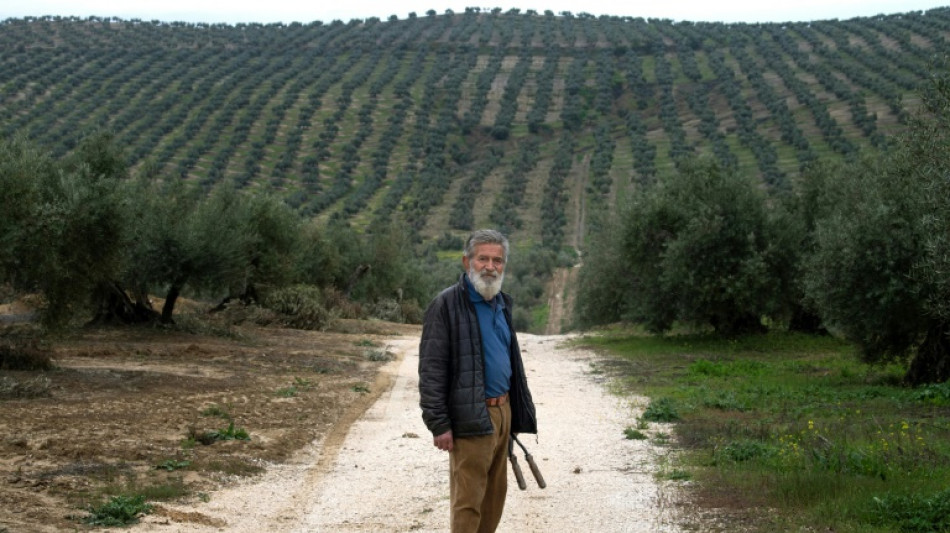
Solar park boom threatens Spain's centuries-old olive trees / Photo: CRISTINA QUICLER - AFP

 Kenya's economy faces climate change risks: World Bank

 Meta, Google face jury in landmark US addiction trial

 Some striking NY nurses reach deal with employers

 EU chief backs Made-in-Europe push for 'strategic' sectors

 Iran steps up arrests while remaining positive on US talks

 EU warns Meta it must open up WhatsApp to rival AI chatbots
 Japan's Takaichi may struggle to soothe voters and markets

 Arguments to begin in key US social media addiction trial

 'Send Help' repeats as N.America box office champ

 UK foreign office to review pay-off to Epstein-linked US envoy

 French police arrest five over crypto-linked magistrate kidnapping

 What's at stake for Indian agriculture in Trump's trade deal?
 Neglected killer: kala-azar disease surges in Kenya

 Spain, Portugal face fresh storms, torrential rain

 Crypto firm accidentally sends $40 bn in bitcoin to users

 Danone expands recall of infant formula batches in Europe

 Why bitcoin is losing its luster after stratospheric rise

 Digital euro delay could leave Europe vulnerable, ECB warns

 Stellantis takes massive hit for 'overestimation' of EV shift

 In Dakar fishing village, surfing entices girls back to school

 As Estonia schools phase out Russian, many families struggle

 Bangladesh Islamist leader seeks power in post-uprising vote
 UK royal finances in spotlight after Andrew's downfall

 New Zealand deputy PM defends claims colonisation good for Maori

 Deadly storm sparks floods in Spain, raises calls to postpone Portugal vote

At his farm in southern Spain, Francisco Campos looked worriedly at a green sea of centuries-old olive trees that he fears will face the axe to make way for a proposed solar park.
"Cutting down olive trees to install solar panels is a crime," the 64-year-old farmer told AFP in Lopera, a town of whitewashed buildings with 3,600 residents in the sunny southern region of Andalusia, Spain's olive-growing heartland.
Spain is the world's top producer of olive oil, but the fertile agricultural land long used by olive producers is now in high demand from power firms looking to install solar farms.
And with nearly 3,000 hours of sunshine per year, Andalusia is one of the Spanish regions with the highest number of solar panels as a renewables boom makes the country a European leader in green energy.
Renewable energy firms such as Greenalia and FRV Arroyadas have requested permission to build multiple solar farms near Lopera, which farmers say will affect up to 1,000 hectares (2,500 acres) of property.
The businesses negotiated agreements to lease the bulk of the land required for their projects but encountered significant opposition from hundreds of small landowners.
This prompted the regional government of Andalusia to announce it will expropriate some land needed for the plants, declaring them to be in "the public interest".
"Is it in the public interest for them to take my land and give it to a company so that the company can profit? This has no benefit for us," said Campos.
"Our way of life is going to be destroyed," he added.
- 'From our ancestors' -
Campaigners predict that the eight solar projects planned for the area will require the removal of nearly 100,000 olive trees.
The regional government puts the figure significantly lower, at 13,000.
Local residents anticipated power companies would seek to install solar panels in the area, but they never imagined "they would come and take away your property," said Rafael Alcala, a spokesman for a platform that represents the solar plants' opponents.
In support of landowners impacted by the latest round of expropriations, dozens of farmers on tractors -- some holding signs that read "We don't want solar plants" -- gathered on a recent morning outside Lopera.
"These lands come from our ancestors. What am I going to leave to my children now?" Maria Josefa Palomo, a 67-year-old pensioner, said at the protest.
Losing 500 hectares of olive groves would wipe out more than two million euros ($2.3 million) in annual revenues, according to local olive oil cooperative La Loperana.
Campaigners say 5,000 olive trees have already been uprooted from land belonging to a farmer in Lopera who signed an agreement with one of the firms behind a solar park. More could follow.
In an effort to stop the projects, opponents have filed lawsuits against the regional government and the companies involved.
- 'Until the end' -
Spain generated a record 56.8 percent of its electricity last year from renewable sources such as wind and solar, according to grid operator Red Electrica.
Leveraging on its sunny plains, windy hillsides and fast-flowing rivers, Spain intends to raise the share of renewable-generated electricity to 81 percent of the total by 2030 as part of efforts to reduce its greenhouse gas emissions.
The regional government has defended the renewables projects, saying less than one percent of the land they use in the region had to be expropriated from reluctant landowners.
Spanish solar industry group UNEF, which represents more than 800 companies, says the projects boost tax revenues in rural communities.
They generate "significant amounts" that can be used to improve public services, said UNEF head Jose Donoso.
Solar park opponents in Lopera disagree and vow to continue their fight.
"Until the end. Nobody is going to take what is ours away from us," said Juan Cantera, a 28-year-old farmer.
"Olive oil is everything in Lopera".
L.K.Baumgartner--CPN