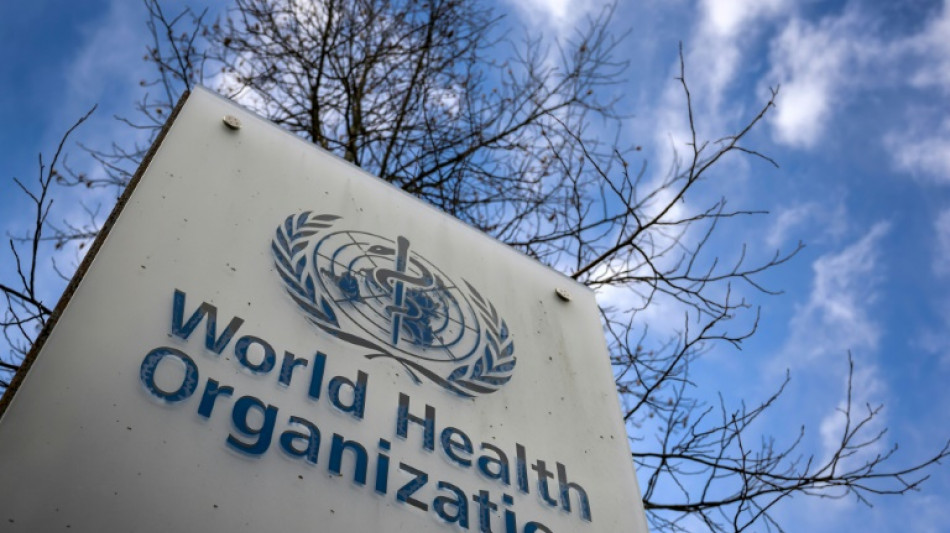
Accord reached 'in principle' over tackling future pandemics: negotiating body / Photo: Fabrice COFFRINI - AFP

 Kenya's economy faces climate change risks: World Bank

 Three missing employees of Canadian miner found dead in Mexico

 Epstein accomplice Maxwell seeks Trump clemency before testimony

 Emergency measures kick in as Cuban fuel supplies dwindle under US pressure

 AI chatbots give bad health advice, research finds
 Bank of France governor Francois Villeroy de Galhau to step down in June

 Japan restarts world's biggest nuclear plant again
 'Want to go home': Indonesian crew abandoned off Africa demand wages

 Trump says China's Xi to visit US 'toward the end of the year'

 US astronaut to take her 3-year-old's cuddly rabbit into space

 Storm-battered Portugal votes in presidential election run-off

 De Beers sale drags in diamond doldrums
 Pakistan's capital picks concrete over trees, angering residents
 Chile's climate summit chief to lead plastic pollution treaty talks
 Opinions of Zuckerberg hang over social media addiction trial jury selection

 Dow surges above 50,000 for first time as US stocks regain mojo

 EU nations back chemical recycling for plastic bottles
 Stocks rebound though tech stocks still suffer
 German exports to US plunge as tariffs exact heavy cost

 'Mona's Eyes': how an obscure French art historian swept the globe

 Russian pensioners turn to soup kitchen as war economy stutters

 Toyota names new CEO, hikes profit forecasts

 Japan to restart world's biggest nuclear plant
 Undercover probe finds Australian pubs short-pouring beer
 Amazon shares plunge as AI costs climb
WHO members on Saturday reached agreement over how to tackle future pandemics after three years of discussions, the co-chair of the negotiating body told AFP.
"We have an accord in principle" and the final version will have to be okayed by the various member states, Anne-Claire Amprou, who is also French ambassador for world health, said.
Amprou said delegates would meet on Tuesday in Geneva to put the finishing touches to a landmark text on pandemic prevention, preparedness and response and give it their definitive seal of agreement.
The text will then require the final seal of approval from all World Health Organization members at the World Health Assembly in Geneva at the end of May.
The approval came after a marathon discussion session stretching for almost 24 hours after which delegates broke into enthusiastic applause lasting several minutes.
"This is a very good signal. You are part of an incredible history in the making," said WHO director-general, Tedros Adhanom Ghebreyesus.
"This is a good gift to our children and our grandchildren," said Tedros, who remained ensconced with delegates throughout the night as they thrashed out an agreement.
Several sources told AFP one of the main sticking points as delegates inched their way towards an accord was paragraph 11 of a text extending to some 30 pages on defining technology transfer for production of health products related to pandemics, particularly to benefit developing countries.
Latin American countries are also pushing for facilitation of the transfer.
The issue had been a bone of contention in poorer countries during the Covid-19 pandemic as they saw rich nations hoard vaccine doses and other tests.
Several countries where the pharmaceutical industry is a major economic player oppose the idea of mandatory transfers and have insisted on it being voluntary.
- 'Very constructive and positive' -
According to one delegate, this point has been resolved. But the latest version of the text was as of Saturday morning not available.
For Amprou, "we had to negotiate this week with all the member states in a very constructive and positive manner. There is a real desire to reach an agreement that truly makes a difference and helps prevent, prepare for, and respond to pandemics."
Only experience will tell if the text as proposed can come through the acid test of another pandemic which Tedros has been at regular pains to insist will emerge at some point, we know not when.
The text comes with the traditional multilateral approach for responding to global crises in crisis after US President Donald Trump slashed the international aid programme of what had been by far the world's biggest donor nation.
The United States were absent from the negotiations, after Trump said on his return to the White House that his country will leave the WHO, a move experts say will heighten risks to the global health risk surveillance system.
It was in December 2021, two years after the start of Covid, which killed millions across the globe and brought the world economy to its knees, that WHO members decided a text was of paramount importance.
- 'Lot of upside' -
However, Saturday's text lacks lustre compared with the scale of WHO member states' initial ambitions, James Packard Love, executive director of the Knowledge Ecology international NGO, which has been keenly following the talks, told AFP.
For Love "the initial proposals were put forward by the Secretary were quite ambitious (but) that's not the case now.
"As the negotiations have dragged on, the trade people have come in, the industry, people have come in. And some people ask me, is the agreement so weak now that it's not worth doing? Will it actually change anything that goes through?
"And I tell people that I think there's a lot of upside for getting an agreement."
Michelle Childs, head of policy advocacy at the Drugs for Neglected Diseases Initiative (DNDi), an NGO, told AFP Friday. "The pandemic agreement will not be perfect; it is a product of compromise, and not all ambitions will be met.
"But it will create a crucial new baseline to build on to save lives during the next global health emergency. It is a floor, not a ceiling."
Warning signs of health risks remain, notably H5N1 bird flu, a virus which continues to infect new species, raising fears of eventual transmission between humans.
Another fear is measles outbreaks in 58 countries resulting from insufficient vaccination rates due to mistrust of vaccines caused by misinformation, as well as mpox which is wreaking havoc in Africa.
M.Anderson--CPN