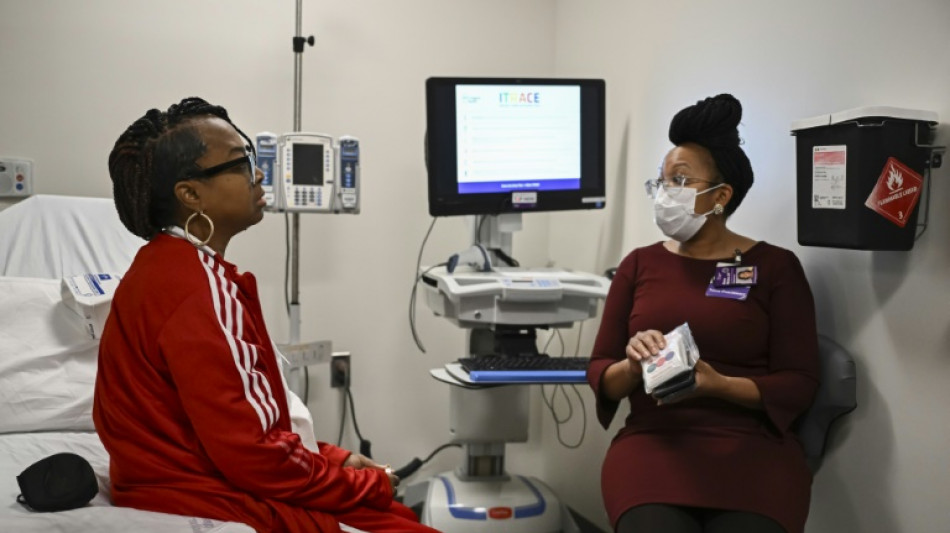
Pig kidney removed from US transplant patient, but she set record / Photo: ANGELA WEISS - AFP/File

 Kenya's economy faces climate change risks: World Bank

 Three missing employees of Canadian miner found dead in Mexico

 Epstein accomplice Maxwell seeks Trump clemency before testimony

 Emergency measures kick in as Cuban fuel supplies dwindle under US pressure

 AI chatbots give bad health advice, research finds

 Bank of France governor Francois Villeroy de Galhau to step down in June

 Japan restarts world's biggest nuclear plant again

 'Want to go home': Indonesian crew abandoned off Africa demand wages

 Trump says China's Xi to visit US 'toward the end of the year'

 US astronaut to take her 3-year-old's cuddly rabbit into space

 Storm-battered Portugal votes in presidential election run-off

 De Beers sale drags in diamond doldrums

 Pakistan's capital picks concrete over trees, angering residents

 Chile's climate summit chief to lead plastic pollution treaty talks

 Opinions of Zuckerberg hang over social media addiction trial jury selection

 Dow surges above 50,000 for first time as US stocks regain mojo

 EU nations back chemical recycling for plastic bottles

 Stocks rebound though tech stocks still suffer

 German exports to US plunge as tariffs exact heavy cost

 'Mona's Eyes': how an obscure French art historian swept the globe

 Russian pensioners turn to soup kitchen as war economy stutters

 Toyota names new CEO, hikes profit forecasts

 Japan to restart world's biggest nuclear plant

 Undercover probe finds Australian pubs short-pouring beer

 Amazon shares plunge as AI costs climb

Doctors have had to remove the pig kidney implanted in an American woman after her body rejected it, but her four months living with the animal's organ set a record, the hospital that performed the operation said Friday.
Towana Looney, a woman in her fifties from the southern state of Alabama, had received the genetically modified pig kidney on November 25 in New York.
The highly experimental procedure had fueled optimism that animal kidneys might prove a usable source amid a chronic shortage of available human kidneys.
Her body's eventual rejection of the transplant showed that the reliable use of animal organs remains a distant goal, but doctors took some hope since the pig kidney did its blood-filtering work for 130 days before the body began rejecting it.
A handful of patients had previously received pig kidneys, but none had survived more than two months.
Doctors said Looney, who is again receiving dialysis treatment, remains a candidate to receive a human kidney if one becomes available.
In a statement released by NYU Langone Hospital in New York, Looney expressed her gratitude for the care and support of her medical team there.
"For the first time since 2016, I enjoyed time with friends and family without planning around dialysis treatments," she said.
"Though the outcome is not what anyone wanted, I know a lot was learned from my 130 days with a pig kidney —- and that this can help and inspire many others."
In 1999, Looney had donated a kidney to her mother. After a pregnancy-related complication damaged her remaining kidney, she spent eight years on dialysis.
Doctors were unable to find a compatible human donor, and Looney -- her health deteriorating -- was ultimately cleared to receive a genetically modified pig kidney.
Though early results were encouraging, "in early April, she had a reduction in renal function due to acute rejection," said Robert Montgomery, the chair of surgery and director of the hospital's transplant institute.
He added: "What triggered the rejection episode after a long period of stability is being actively investigated, but it followed a lowering of her immunosuppression regimen to treat an infection unrelated to the pig kidney."
The treatment seeks to inhibit the body's immune system to prevent it from attacking the implanted organ, but it also weakens the body's ability to fight off external infections.
The decision to remove the pig kidney was taken jointly by Looney and her doctors, in order to preserve "future possibilities for transplantation."
Doctors said she recovered rapidly from the April 4 operation, was discharged from the hospital on the fifth day after surgery, and "is back home in Alabama doing well."
A.Zimmermann--CPN