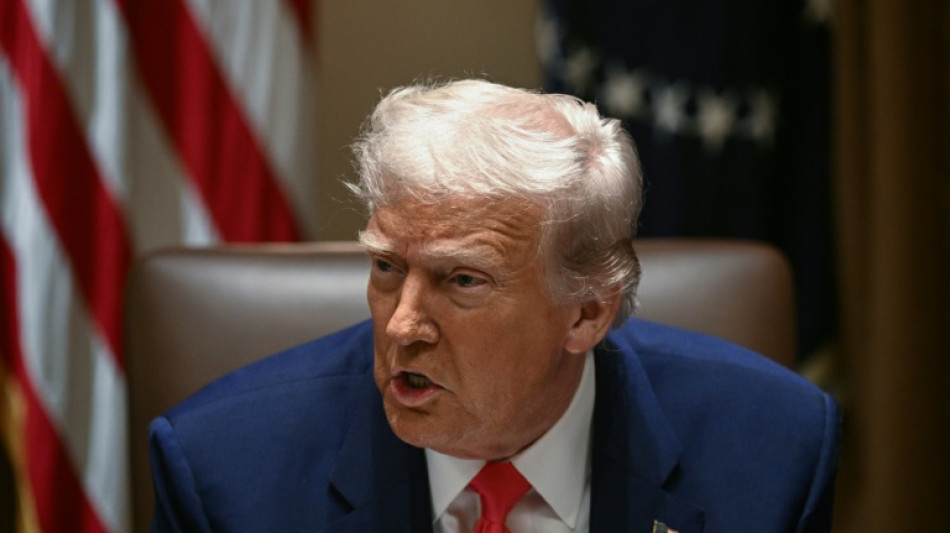
Despite Trump pause, overall US tariff rate at highest in a century / Photo: Brendan SMIALOWSKI - AFP/File

 Kenya's economy faces climate change risks: World Bank

 Asian markets extend gains as Tokyo enjoys another record day

 Jury told that Meta, Google 'engineered addiction' at landmark US trial

 Meta, Google face jury in landmark US addiction trial

 Some striking NY nurses reach deal with employers

 EU chief backs Made-in-Europe push for 'strategic' sectors

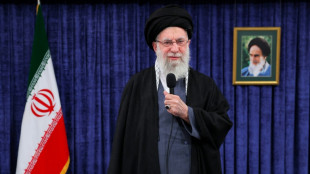 Iran steps up arrests while remaining positive on US talks

 EU warns Meta it must open up WhatsApp to rival AI chatbots

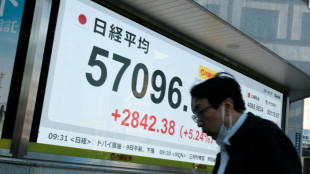 Japan's Takaichi may struggle to soothe voters and markets

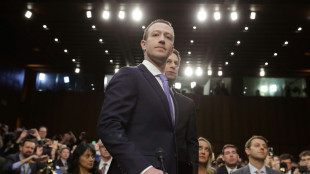 Arguments to begin in key US social media addiction trial
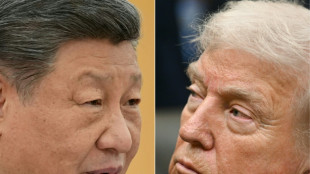
 'Send Help' repeats as N.America box office champ

 UK foreign office to review pay-off to Epstein-linked US envoy

 French police arrest five over crypto-linked magistrate kidnapping

 What's at stake for Indian agriculture in Trump's trade deal?

 Neglected killer: kala-azar disease surges in Kenya

 Spain, Portugal face fresh storms, torrential rain

 Crypto firm accidentally sends $40 bn in bitcoin to users
 Danone expands recall of infant formula batches in Europe

 Why bitcoin is losing its luster after stratospheric rise

 Digital euro delay could leave Europe vulnerable, ECB warns
 Stellantis takes massive hit for 'overestimation' of EV shift

 In Dakar fishing village, surfing entices girls back to school

 As Estonia schools phase out Russian, many families struggle

 Bangladesh Islamist leader seeks power in post-uprising vote

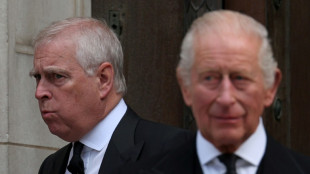 UK royal finances in spotlight after Andrew's downfall

US President Donald Trump's delay of steeper tariffs may have won brief respite on Wall Street, but analysts say his actions -- which hit China especially hard -- already bring the average US effective tariff rate to its highest in over a century.
Besides imposing sweeping new 10 percent tariffs on goods from most US trading partners, Trump has also unleashed steep duties on imports of steel, aluminum and autos since his White House return.
But on Wednesday, he backed off even higher rates on dozens of economies, including the European Union and Asian manufacturing hub Vietnam, following a sharp sell-off in US government bond markets -- though he doubled down on action against China.
Many goods from the world's second biggest economy now face levies of at least 145 percent -- the total additional figure Trump has imposed this year.
"The newly imposed tariffs now affect $2.4 trillion of US imports, or nearly 75 percent," said Erica York of the Tax Foundation.
"Compared to Trump's first term, this is a massive escalation, as his first tariffs affected about $380 billion of US imports or 15 percent," she told AFP.
- 'Highest since 1903' -
Researchers from the Budget Lab at Yale University estimate that "consumers face an overall average effective tariff rate of 27 percent, the highest since 1903."
"This is only slightly different from where the effective rate was before the late-April 9 announcement," they added.
Even after accounting for consumption shifts, the average tariff rate will be 18.5 percent, the Budget Lab anticipates. This would be the highest since 1933.
Thibault Denamiel, a fellow at the Center for Strategic and International Studies (CSIS), estimates that the US tariff rate was 2.4 percent in December 2024 -- a figure which now stands north of 20 percent.
"That's mostly due to the fact that we still have a 125 percent tariff rate on China," he said, referring to the latest duty Trump imposed on Chinese goods.
The 125 percent tariff, which took effect Thursday, coupled with an earlier 20 percent over China's alleged role in the fentanyl supply chain, putting Trump's new tariffs targeting China this year to 145 percent.
Even a much lower tariff would significantly impact the world's biggest economy, Denamiel said, noting that China is the United States' third most important trading partner.
Analysts have also pointed out that Trump's actions marked the biggest tariff increase since the Smoot-Hawley Act of 1930, which deepened the Great Depression.
- Shrinking imports -
Trump has claimed the United States was "taking in almost $2 billion a day" from tariffs.
He has referred to them as a means to raise government revenue, boost the country's industrial sectors and to pressure other governments on US priorities.
But experts warn that prohibitively high duties on China will likely cause US imports from the country to contract.
With Chinese tariffs reaching punitive levels, even conservative estimates suggest that China's share of imports "should shrink dramatically," said JPMorgan chief US economist Michael Feroli in a recent note.
If this were to happen, York of the Tax Foundation added that imports from China would end up generating "very little tariff revenue."
"Overall, we estimate the tariffs and announced retaliation will shrink US GDP by 1.0 percent," she said.
With Trump's latest actions, Feroli expects "the drag from trade policy is likely to be somewhat less than before, and thus the prospect of a recession is a closer call."
"However, we still think a contraction in real activity later this year is more likely than not," he added.
D.Goldberg--CPN