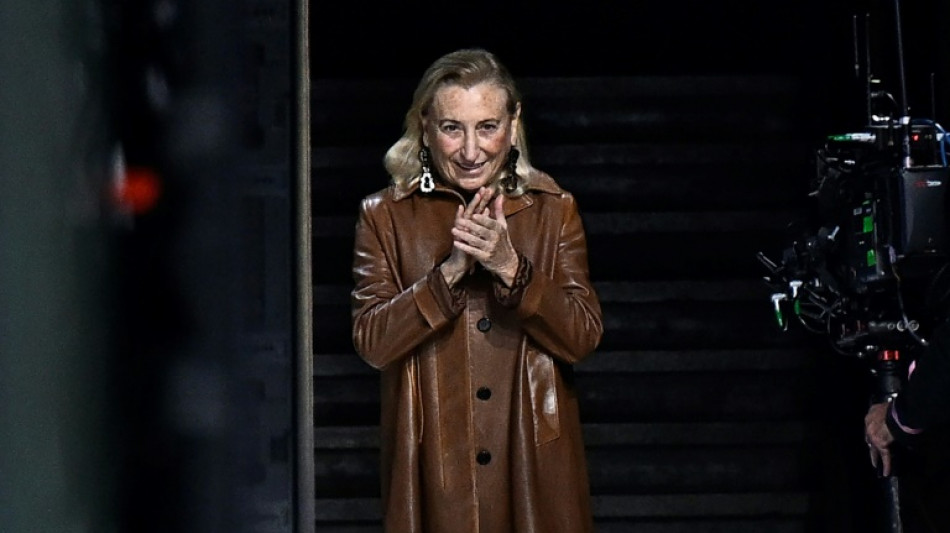
Miuccia Prada's path from activist to top designer / Photo: JULIEN DE ROSA - AFP/File

 Kenya's economy faces climate change risks: World Bank
 Asian markets extend gains as Tokyo enjoys another record day

 Jury told that Meta, Google 'engineered addiction' at landmark US trial

 Meta, Google face jury in landmark US addiction trial
 Some striking NY nurses reach deal with employers
 EU chief backs Made-in-Europe push for 'strategic' sectors

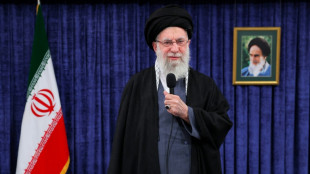 Iran steps up arrests while remaining positive on US talks
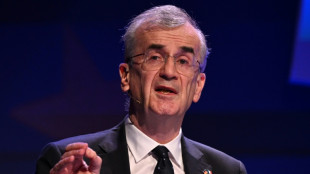
 EU warns Meta it must open up WhatsApp to rival AI chatbots

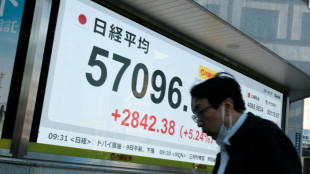 Japan's Takaichi may struggle to soothe voters and markets

 Arguments to begin in key US social media addiction trial
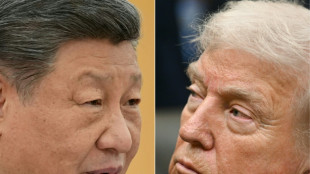
 'Send Help' repeats as N.America box office champ

 UK foreign office to review pay-off to Epstein-linked US envoy
 French police arrest five over crypto-linked magistrate kidnapping
 What's at stake for Indian agriculture in Trump's trade deal?

 Neglected killer: kala-azar disease surges in Kenya

 Spain, Portugal face fresh storms, torrential rain

 Crypto firm accidentally sends $40 bn in bitcoin to users

 Danone expands recall of infant formula batches in Europe

 Why bitcoin is losing its luster after stratospheric rise

 Digital euro delay could leave Europe vulnerable, ECB warns

 Stellantis takes massive hit for 'overestimation' of EV shift
 In Dakar fishing village, surfing entices girls back to school

 As Estonia schools phase out Russian, many families struggle

 Bangladesh Islamist leader seeks power in post-uprising vote

 UK royal finances in spotlight after Andrew's downfall
As a student in the volatile May of 1968, Miuccia Prada took to the streets of Milan to demonstrate for women's rights wearing an Yves Saint Laurent suit.
Today, the 76-year-old reigns over a luxury goods empire worth more than five billion euros ($5.4 billion) a year, with her world about to expand further with the takeover of flamboyant rival Versace.
An avant-garde designer whose minimalist style belies its rebellious nature, Prada has imprinted her elegant and intellectual sensibility on the world of Italian fashion for decades.
As a young woman she wanted to become involved in politics, and took courses in mime and theatre.
But she shelved those dreams in the early 1970s to devote herself, along with her mother Luisa, to the leather goods boutique founded in 1913 by her grandfather, Mario Prada.
"In the 1970s, as a left-wing woman, I was ashamed to make handbags, and I was also ashamed because it was a profession that I liked very much," she said in 2022.
Born in Milan on May 10, 1948, into a bourgeois Catholic family, Prada has become one of the wealthiest and most influential women in the world, with a fortune estimated by Forbes magazine at 5.8 billion dollars.
A political science graduate and feminist activist who frequented Communist circles, she eventually devoted herself body and soul to turning around the family business, which had lost its lustre after the death of her grandfather in 1958.
- A monster of ambition -
In 1977, Prada found a perfect partner in Patrizio Bertelli, a Tuscan leather manufacturer she met at the Milan leather goods fair.
He helped her boost the finances of the boutique, over which she took control in 1978.
Nine years later, the business partners married.
"He was the one who wanted to do something big. I told him I wasn't ambitious. He replied: 'You're a monster of ambition'. He was right," she said.
It was the starting point for Prada's irresistible rise.
In the early 1980s, the designer broke new ground by creating a collection of black nylon bags with a silky effect, which became all the rage.
She would go on 40 years later to champion nylon thread made from recycled plastic recovered from the oceans.
The brand began growing, with boutiques springing up first in New York and Madrid, then London, Paris and Tokyo.
Ironically, her first women's ready-to-wear show in Milan in 1988, all in black and white, was not well received, with critics considering it too austere.
But her minimalist luxury, with its clean lines and somber colours, eventually made its mark, winning over an international audience.
- Breaking the codes -
Federica Trotta Mureau, editor-in-chief of the Italian magazine Mia Le Journal, told AFP that in tapping her fascination with art, architecture and philosophy, Prada "created a free universe, a sort of experiment without rules... aimed at breaking the codes of fashion".
Prada says she has long worn vintage garments, while speaking out against fast fashion, where quick production cycles churn out low-priced items that are often soon disposed of.
Her signature garment has always been the skirt, with its infinite variations.
Prada refuses to see women as "just beautiful figures": "I don't tend to make super sexy clothes. I try to be creative in a way that can be worn, that can be useful."
A men's collection was rolled out in 1993, the same year that saw the launch of the Miu Miu brand appealing to younger customers -- and borrowing the designer's nickname.
Sales of Miu Miu doubled in 2024, enabling Prada to weather the global luxury crisis unscathed.
C.Peyronnet--CPN