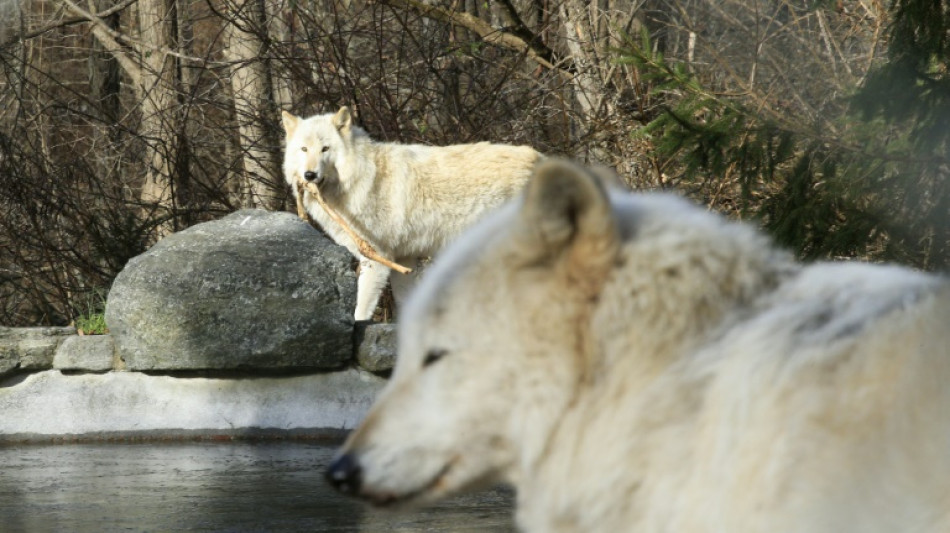
US court reinstates gray wolf endangered species protections

 Lights out in Laos as electricity exports surge

 Steven Strogatz weighs AI mathematics advances and their consequences for researchers

 Anthropic boss calls for AI slowdown, Altman and Musk agree

 French IT giant Capgemini sells subsidiary after row over ICE links

 Quebec Brokerage Qubit Insurance Announces New Data on Coverage Shortfalls as Rebuilding Costs Rise

 Lady Gaga welcomes first child with fiance: US media

 Bhutan business bets on hazelnuts for farming future

 'Widow's Bay' and 'The Pitt' are favorites for Emmys night

 Coastal erosion forces cancellation of California music festival

 Argentina's Dirty War rears its head in Venice film

 UK lawmakers throw out bill to legalise assisted dying

 US inflation steady in August, fueling Fed rate hike expectations

 New York marks 25th anniversary of 9/11 attacks

 Nepal flood reconstruction bill to be $4.78 bn: foreign ministry

 JUMO and Standard Bank launch Social Finance Framework to scale inclusive finance in Africa

 Doomsday tech: could AI really kill us all?

 French comedy show 'Call my agent' makes film comeback

 It's all coming back: Celine Dion fans gear up for Paris return

 Researchers eye AI revolution in natural disaster forecasts

 US braces for inflation report that may push Fed to hike rates

 Musk threatens legal action over documentary

 Latin America fact-check group asks Meta not to replace verification practice

 AI Risks to Enter 60–80% of Liability and Cyber Insurance Underwriting by 2028, ScienceSoft Predicts

 Tribal Launches Campfire, Letting Business and Technical Teams Build on Salesforce Together

 Stocks fall as fresh oil surge fans inflation fears

A US court has struck down a Trump-era decision to remove federal protections for gray wolves across much of the country, in a move hailed by conservationists who said the listing was vital for the species' recovery.
A 26-page ruling issued Thursday by Judge Jeffrey White in a case brought by wildlife groups found the Fish and Wildlife Service (FWS) had erred in its October 2020 decision to remove the apex predators from the Endangered Species Act (ESA), where they were first listed in the 1970s.
Though the decision to delist gray wolves across most of the lower-48 states was taken by the administration of former president Donald Trump, Joe Biden's government had continued to defend the move in court.
"It really is a win for wolves across the country," Collette Adkins of the Center for Biological Diversity, told AFP.
"And I hope it finally convinces the Fish and Wildlife Service to really focus on recovering wolves instead of prematurely removing their protections."
A quarter million gray wolves -- long a symbol of the free spirit of the American wilderness -- once roamed from coast to coast before the arrival of European settlers and eradication campaigns that endured into the 20th Century.
At the time of the decision to de-list them, the wolves had recovered from a low of 1,000 to around 6,000 -- but hundreds were subsequently legally killed, either through hunting or conflicts with livestock operators.
In one egregious example, hunters in Wisconsin killed over 218 wolves in less than three days in February 2021, using packs of dogs, snares and leg-hold traps -- well beyond the state's own limit of killing 119 wolves.
The 2020 decision to remove the species' protections had been opposed by 1.8 million Americans in public comments, as well as hundreds of scientists, veterinary professionals, and the iconic conservationist Jane Goodall.
Even the researchers commissioned by the FWS to carry out a review of the science found it did not support de-listing.
"Both under Democratic and Republican administrations, there has been this year-to-year desire to just be done recovering wolves," said Adkins.
"It's been frustrating because the Endangered Species Act envisions a recovery of these animals so that they can fulfill their ecosystem role," she added.
Research has confirmed the wolf's importance in thinning over-browsing herds of elk, which in turn prevents destruction of habitat, for example. And a recent study from Wisconsin found that wolves kept deer away from roads, reducing collisions between deer and cars.
Adkins said she was hopeful of a change in policy after interior secretary Deb Haaland this week penned an op-ed in USA Today criticizing some western States in the northern Rocky mountain range, which have stepped up hunting campaigns in recent months.
The gray wolves of the northern Rockies haven't been covered by the Endangered Species Act since a 2011 Congressional act, but Halaand wrote she could reinstate federal protections specifically for them if necessary.
A.Agostinelli--CPN