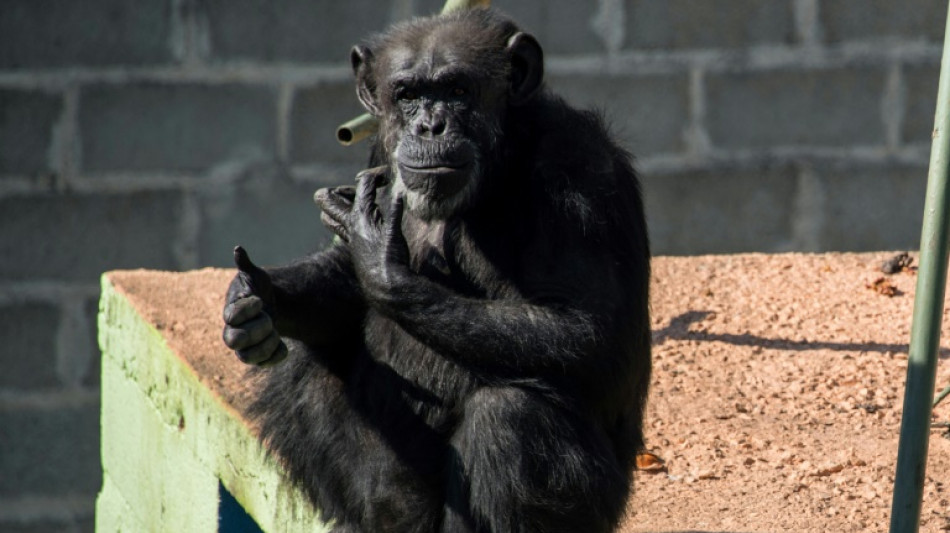
Swiss region votes on giving primates fundamental rights

 Lights out in Laos as electricity exports surge

 Steven Strogatz weighs AI mathematics advances and their consequences for researchers

 Anthropic boss calls for AI slowdown, Altman and Musk agree

 French IT giant Capgemini sells subsidiary after row over ICE links

 Quebec Brokerage Qubit Insurance Announces New Data on Coverage Shortfalls as Rebuilding Costs Rise

 Lady Gaga welcomes first child with fiance: US media

 Bhutan business bets on hazelnuts for farming future

 'Widow's Bay' and 'The Pitt' are favorites for Emmys night

 Coastal erosion forces cancellation of California music festival

 Argentina's Dirty War rears its head in Venice film

 UK lawmakers throw out bill to legalise assisted dying

 US inflation steady in August, fueling Fed rate hike expectations

 New York marks 25th anniversary of 9/11 attacks

 Nepal flood reconstruction bill to be $4.78 bn: foreign ministry

 JUMO and Standard Bank launch Social Finance Framework to scale inclusive finance in Africa

 Doomsday tech: could AI really kill us all?

 French comedy show 'Call my agent' makes film comeback

 It's all coming back: Celine Dion fans gear up for Paris return

 Researchers eye AI revolution in natural disaster forecasts

 US braces for inflation report that may push Fed to hike rates

 Musk threatens legal action over documentary

 Latin America fact-check group asks Meta not to replace verification practice

 AI Risks to Enter 60–80% of Liability and Cyber Insurance Underwriting by 2028, ScienceSoft Predicts

 Tribal Launches Campfire, Letting Business and Technical Teams Build on Salesforce Together

 Stocks fall as fresh oil surge fans inflation fears

A northern Swiss region will vote Sunday on whether non-human primates should enjoy some of the same basic fundamental rights as their human cousins.
The vote in the Basel-Stadt canton, which is home to the city of the same name and to one of Europe's best-known zoos, is being keenly followed by animal rights activists.
- Giving primates 'integrity' -
Triggered by the campaign group Sentience under Switzerland's direct democracy system, the regional vote concerns whether to give primates the right to life and the right to "mental and physical integrity".
"This will mark the first time worldwide that people can vote on fundamental rights for non-human animals," the group claims.
Basel-based Sentience says primates are highly intelligent and maintain an active social life, and feel pain, grief and compassion.
However, they cannot defend themselves against interventions in their lives -- so humans need to take responsibility and grant them rights, says Sentience.
The group says some 150 primates live in the canton, which borders France and Germany.
- Legal challenge -
In 2020, Switzerland's Supreme Court deemed a public vote on the topic was valid, rejecting an appeal.
It found that the proposal would not extend fundamental rights to animals -- but instead introduce specific rights for non-human primates.
However, it said the proposal would only bind the cantonal and municipal authorities in Switzerland's third-biggest city, and "not directly private persons".
The impact on private research institutions, and on Basel Zoo -- in the hands of family shareholders -- would therefore be limited.
And, according to the court, the local authorities and their public bodies do not have any primates.
- Establishing the law -
The vote is "a statement of intent so that primates live in better conditions," said Pedro Pozas, the Spanish director of the Great Apes Project, an international movement which demands a set of rights.
Animal defenders say the vote is highly symbolic. Its scope could be very wide, said Steven Wise, a US lawyer specialising in animal rights.
The vote "would give certain rights to primates, which would have to be litigated out as to what rights those are", he told AFP.
Wise said the proposal raises several questions, including who would plead a primate's case in court if its rights were violated?
If the vote goes through, Swiss courts would meanwhile not be the first to hear such cases.
In 2017 in Argentina, a court granted a female chimpanzee the right not to be imprisoned without trial, under habeas corpus. It was the first chimpanzee in the world to benefit from this right.
Wise said the animal rights movement was trying to "break through the barrier" limiting the extent to which rights can be applied.
He compared the situation to previous battles to extend rights among humans, citing children, women or racial minorities.
Pozas said the United Nations should also make a declaration on the rights of great apes.
- Euthanasia question -
While the proposed new law would only concern primates kept by public bodies, Basel Zoo board member Olivier Pagan fears a spillover effect on their primates.
"If the initiative was adopted, the scrutiny of their well-being and safety would no longer be the responsibility of experienced biologists, veterinarians and experienced caregivers, but of a mediator... or even unqualified lawyers," he said.
When a primate is in serious pain, it might not be possible to end its suffering, under the right to life clause.
Zoo veterinarian Fabia Wyss said: "If the initiative is adopted and if I decide to put the animal to sleep, I put myself beyond the law."
"But by letting an animal suffer unnecessarily, I am also equally culpable."
S.F.Lacroix--CPN