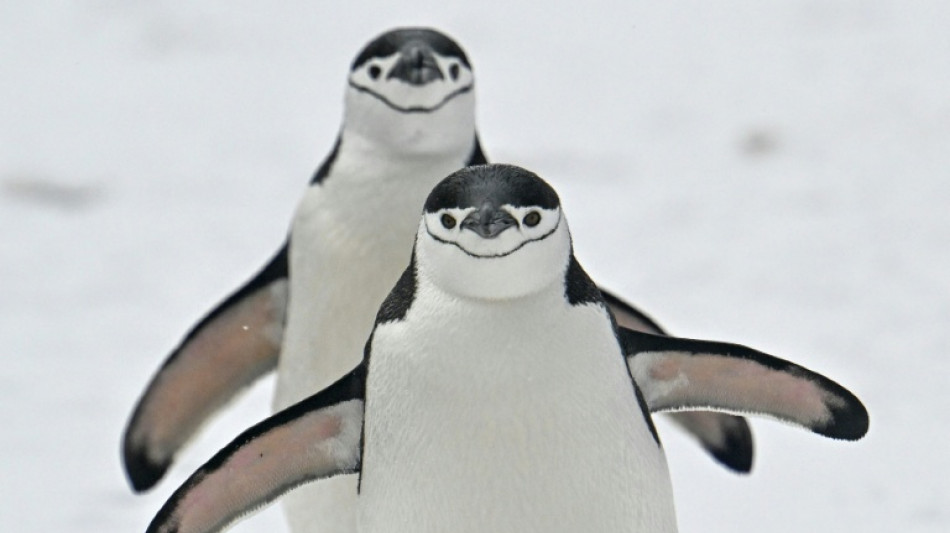
Climate change strips island's title of largest penguin colony: study / Photo: JUAN BARRETO - AFP/File

 The British historian helping the French rediscover de Gaulle

 Gas, health care, utilities: high costs squeeze US midterm voters

 As species decline, green turtles offer glimmer of hope
 Microsoft pushes AI vision with new, expensive Surface laptop

 French PM denies police ordered to confront student protesters

 Climate change strips island's title of largest penguin colony: study

 From 1800s to modern pharma: a Nobel-winning chemistry quest

 HSBC 'consults' over UK unit job cuts amid AI adoption

 Guinea caps bottled water prices after sachets banned

 Stocks slide as oil climbs on Mideast flareup

 Kyiv 'cannot agree' to EU membership limiting food exports: minister

 Spotify expands audiobooks to more than 180 markets

 Germany factory production at highest level for 18 months

 Thailand floods death toll rises to 60 since mid-September

 Chip industry activists call for South Korea to recognise cancer cases

 Famine-scarred southern Madagascar braces for El Nino

 Oil rises and stocks fall as Hormuz worries flare

 For Turkish NGOs, COP31 offers rare space for action

 Africa launches own credit agency in bid for cheaper borrowing

 Australia touts new funds for Pacific infrastructure at Fiji 'pre-COP'

 Nobel winner Halzen says years of October 'misery' finally over

 Danish reservists practice war games to respond to 'aggression'

 i-payout Introduces a New Approach to Payments, Closing the Beneficiary Information Gap

 Neutrinos: space particles that change our view of universe

 Stocks climb as oil prices retreat

A remote island near Antarctica is no longer home to the world's largest penguin colony as climate-driven changes to ocean food chains likely devastated its once-thriving inhabitants, a new study said Wednesday.
Drone and satellite images showed that the volcanic island of Zavodovski lost more than 680,000 -- or two-thirds -- of its chinstrap penguins between 2011 and 2025, according to the British Antarctic Survey (BAS).
"That's a very rapid loss," Norman Ratcliffe, the lead author of the BAS study published in the journal Current Biology, told AFP.
The study's findings raise concerns that chinstrap populations across the South Sandwich Islands, which include Zavodovski and are home to 38 percent of the species, have fallen.
The researchers suggest that the "alarming declines" should lead to chinstrap penguins being redesignated as "endangered" by the International Union for Conservation of Nature (IUCN).
This would be a sharp downgrade from their "least concern" classification, which means they are not currently threatened with extinction.
Surveys in 2011 had concluded that chinstrap populations across the South Sandwich Islands were stable.
But their number on Zavodovski fell from around 1.09 million breeding individuals in January 2011 to 402,000 in 2025, or a 63 percent decline, according to the study.
The island is also home to a different species, macaroni penguins, whose population rose from around 338,000 in 2011 to 433,000 in 2025 -- and now outnumber chinstraps.
Together, chinstraps and macaronis now total more than 835,000 on Zavodovski.
The researchers said the Adelie penguins of Cape Adare, on the other side of Antarctica, are now the world's largest penguin colony, numbering more than one million as of 2018.
- Krill decline -
Zavodovski island's Mount Curry volcano erupted in 2016, sparking fears that it could wipe out its penguin population.
But the researchers found that the ash cloud was blown northeast over an area not inhabited by the flightless birds.
"The decline in chinstrap colony area was in progress prior to the eruption and continued at a constant rate thereafter," the study said.
"We don't think the volcano is implicated or it's not the main driver (of the population decline) because what we see is a linear decline in the chinstrap penguins," Ratcliffe told AFP.
Instead, the scientists linked the drop in chinstrap numbers to a reduction in the availability of krill -- the tiny shrimp-like creatures that are their main food source.
Warming ocean temperatures have pushed the crustaceans south toward colder waters, which chinstraps do not tolerate.
"We think that climate change operating through food webs is probably the main driver," Ratcliffe said.
The island's chinstrap population has been falling at a rate of seven percent per year.
Macaroni penguins have increased in number over the same period as they eat a wider range of prey than chinstraps. Their survival also supports the idea that the volcanic eruption was not a factor in the chinstrap's demise.
"The observed numerical shift from chinstraps to macaronis on Zavodovski represents the most striking change in penguin community composition that has been observed at a single location in Antarctica to date," the study said.
"The most plausible explanation for the observed patterns of population change is that a climate-induced regime shift has occurred that has been detrimental to the maritime Antarctic chinstraps but has favoured the subantarctic macaronis."
D.Avraham--CPN