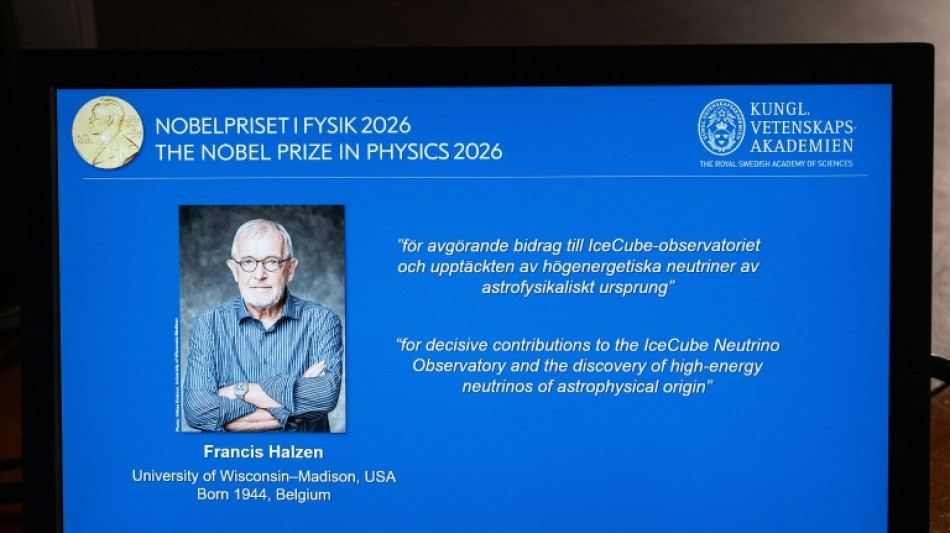
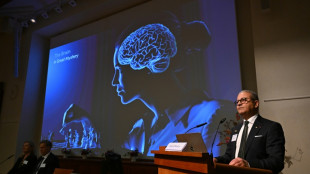
Nobel winner Halzen says years of October 'misery' finally over / Photo: Jonathan NACKSTRAND - AFP

 Nobel winner Halzen says years of October 'misery' finally over

 Danish reservists practice war games to respond to 'aggression'

 i-payout Introduces a New Approach to Payments, Closing the Beneficiary Information Gap

 Neutrinos: space particles that change our view of universe
 Stocks climb as oil prices retreat

 Vstock Transfer Names Securities Industry Veteran Erica Goodstein General Counsel and Chief Compliance Officer

 Four Indonesian seamen return home after Somali pirate ordeal

 IMF warns cost-of-living shocks cause 'lasting deterioration' in affordability

 STARTRADER Adds 20 Stock and ETF CFDs to Its 24/7 Trading Range
 7-Eleven exits India amid mounting competition

 South Korea warns of possible AI use in banking hacks

 Myanmar leader to visit Malaysia after migrant returns begin
 Yemen's Houthis say struck Riyadh airport, other Saudi sites

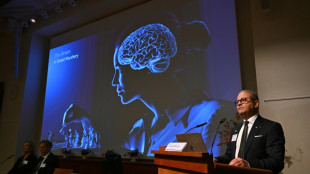
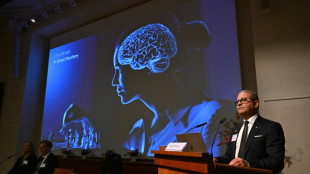
 American Nobel laureate in medicine hopes to illuminate the brain

 Grappling with 'homework scams,' US universities shun AI detectors
 Leaders visit Pacific atoll at frontline of climate change

 Leaders to visit Pacific atoll at frontline of climate change

 Switching on brain cells: the Nobel-winning science of optogenetics
 US-German trio wins medicine Nobel for illuminating the brain

 STARCARES Equips Seven Foster Homes for Children and Young People in Tanzania
 US-German trio win medicine Nobel for work on optogenetics
 Zuckerberg skewered again on screen in 'The Social Reckoning'

 EU, China to hold Beijing talks to avert trade war

 Rubio visits Iceland as US boosts Arctic presence

 Titan FX Launches Second “Dream Beyond Borders 2.0” Brand Commercial Featuring Keisuke Honda

Physicist Francis Halzen has an impressively long list of academic accolades -- but every October, as the Nobel Prize rolled around, his failure to bag the biggest award of them all left him "miserable," he admits.
"It's a great relief for me, because this was not totally unexpected," he told a press conference Tuesday at the University of Wisconsin–Madison, where he serves as a professor. He spoke by video from a hotel room in Italy where he was attending a scientific meeting.
"Around this time of the year, I always felt miserable because I didn't win the prize, and thought... it was terrible for my collaborators who deserved it so much, and that I disappointed the whole IceCube collaboration every October," he added. "So that problem is finally solved. I'm very grateful for it."
The 82-year-old is the brains behind the IceCube Neutrino Observatory, a telescope embedded in a cubic kilometer of Antarctic ice that detects neutrinos -- particles with almost no mass that seldom interact with other matter.
Every second, about 65 billion neutrinos from the Sun pass through your little fingernail. Those from deeper in space carry clues about cosmic mysteries, like the supermassive black holes at the heart of galaxies.
Halzen, who grew up in Belgium, paid rich tribute to the roughly 450 people across more than a dozen countries who have helped turn an idea he conceived in the late 1980s into reality.
"UW took incredible risks on this project," he said of his university. "We had several milestones we had to pass, and at each point, this project could have failed."
He also thanked the National Science Foundation (NSF) for taking a chance on the project, "which in retrospect amazes me, I am not sure this could happen today, but it happened, and we were very lucky."
President Donald Trump's administration has called for deep cuts to the NSF, the US agency that funds fundamental research, and directed it to focus on the administration's technology priorities.
Physicists before Halzen had suggested water could capture neutrinos from space: when a neutrino hits an atomic nucleus, it produces a charged particle that travels in the same direction and emits blue light, which can be detected because water is transparent.
Halzen's great leap was to use ice instead -- unlike liquid water, it isn't disturbed by living creatures, and its darkness is constant at great depth.
Making it work was a struggle, but the first neutrino images, captured by an R&D precursor to IceCube, were "the greatest excitement I ever felt about this project," he said. "It was just incredible. It was the fact that we could make this work."
IceCube has been fully operational since 2011 and has detected high-energy neutrinos from a distant galaxy in the direction of the constellation Orion, as well as from our own Milky Way.
As for the future, Halzen noted that whenever humanity has opened a new "window on the universe," predictions about what would follow have proven wrong.
"What this will bring is impossible to predict, but it has always been great in the past, and there is no reason not to think that it will be great again."
X.Wong--CPN