
-
 Leaders to visit Pacific atoll at frontline of climate change
-
'Reckless' AI firms can't control models, says whistleblower
-
 Switching on brain cells: the Nobel-winning science of optogenetics
-
Norway eyes partial ban of smart glasses
-
 US-German trio wins medicine Nobel for illuminating the brain
-
Two dead after ship catches fire, sinks in Black Sea
-
 STARCARES Equips Seven Foster Homes for Children and Young People in Tanzania
-
US-German trio wins medicine Nobel for work on optogenetics
-
 US-German trio win medicine Nobel for work on optogenetics
-
Hundreds of French high schools shut as protests persist
-
 Zuckerberg skewered again on screen in 'The Social Reckoning'
-
Sunken Silk Road city reveals Central Asia's lost history
-
 EU, China to hold Beijing talks to avert trade war
-
Research into weight-loss drugs tipped for Nobel as award week opens
-
 Rubio visits Iceland as US boosts Arctic presence
-
US Supreme Court hears bid to shut the door on climate suits

-
 Titan FX Launches Second “Dream Beyond Borders 2.0” Brand Commercial Featuring Keisuke Honda
-
Spy chief Clayton, the Trump loyalist tech bosses trust on AI

-
 Trump confirms national intelligence chief as new AI czar
-
Pro-Europe Latvian PM wins poll dominated by Russia, social worries
-
 Future of French far-right star in balance after antisemitism claims
-
亞歷克斯・博迪與南蘇丹共和國大使古姆・多米尼克・馬蒂奧克在柏林商討於布加勒斯特設立名譽領事館的可能性
-
 'Act before it's too late': Tokyo residents fight for more trees
-
Pre-COP host Tuvalu at frontline of climate change
-
 Hungary's dwindling paprika producers battle to save signature spice
-
Cornell president vows review in wake of alleged student gang rape
-
 What is fuelling French school protests?
-
Without lawyers, migrant children face deportation from the US

-
 Trump tariffs a mixed bag for US auto industry
-
AI needs safety layers like nuclear plants: ex-OpenAI engineer

-
 Storms, flooding cause chaos on Greek holiday island of Crete
-
#IAmJaneDoe: online support campaign in US university rape case
-
 Fresh protests to hit Spain after housing measures defeated
-
US regulator finds Boeing 737 MAX software bug 'not a safety concern'
-
 Widgets & Web Offers All-Inclusive Investor Relations Websites for Public Companies, IPOs and SPACs
-
Cornell rape case exposes sexual violence at US colleges
-
 Trump expected to name intel chief Clayton as AI czar: reports
-
Argentina unveils passports-for-investment scheme
-
 King Charles to evoke colonial 'darkest days' on Caribbean tour
-
Amazon vows $1 bn for data center towns, decries 'myths'
-
 Oil prices drop on G7 fuel release, US jobs data boosts stocks
-
NY governor vows to close loophole after alleged Cornell gang rape
-
 Russia 'tearing Kyiv apart', mayor says, as strikes paralyse traffic
-
NY attorney general tasked with investigating alleged Cornell gang rape
-
 US posts weak job growth data in September
-
Eurozone inflation hits three-year high at 3.8% in September

-
 Germany's crisis-hit rail operator looks to AI future
-
Macron urges G7 coordination as US presses Europe on diesel stocks

-
 Hundreds of French high schools shut as new violence erupts
-
Asian stocks hit as oil spike fans rate hike bets, eyes on US jobs
US-German trio wins medicine Nobel for work on optogenetics
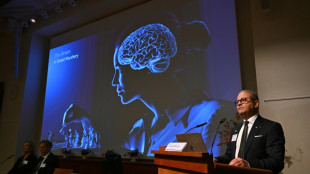
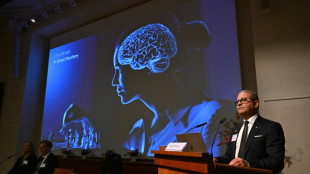
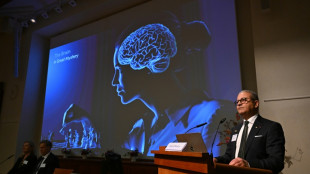
The Nobel medicine prize was awarded Monday to US psychiatrist and neurologist Karl Deisseroth and German scientists Peter Hegemann and Georg Nagel for their pioneering work in the field of optogenetics.
Optogenetics involves controlling nerve signals with light, and helps researchers understand how specific cell types contribute to behaviours like learning, fear, addiction and movement.
The trio were honoured "for their discovery of a molecular switch for nerve cells", the Nobel Assembly said.
Using light, researchers are now able to switch individual neural circuits on or off in a brain.
They have been able to reveal neural circuits governing specific memories, feelings, and behaviours relevant for neurological and psychiatric disorders.
In clinical medicine, the method is being used in attempts to restore sight in people with visual impairment, and may one day lead to treatments for disorders such as Parkinson's disease and epilepsy.
"Optogenetics provides opportunities for mapping the brain in a way that we could once only dream of," Per Svenningsson, chair of the Nobel committee, said in a statement.
"Optogenetics has fundamentally altered our understanding of the brain. Every day brings new discoveries, helping to solve one of humanity's great mysteries: how our incredible brain works," the Nobel Assembly said.
The secretary general of the assembly, Thomas Perlmann, told reporters he was able to reach the three laureates by phone to break the news.
"That was great to talk to them. I first called Deisseroth, he was very tired when he answered. He was definitely asleep, but he woke up," he said.
- Illumination -
In the early 2000s, Hegemann and Nagel were examining why a single-celled alga was able to swim toward a light source.
They discovered an algal protein with unique properties, called channelrhodopsin, found on the surface of the cell.
When illuminated by blue light, a channel opens through the protein.
Charged ions then flow into the cell, creating an electrical impulse. They found that any cell they put the protein in became light sensitive.
Deisseroth then introduced the gene for channelrhodopsin into nerve cells from rats.
By illuminating the cells with blue light, he was able to trigger a nerve signal.
He published his breakthrough in 2005, and two years later, made the light-controlled switch for nerve cells work in the brains of living mice.
In 2021, Deisseroth and Hegemann won the Lasker Prize for their work in the field, often considered a precursor to the Nobel.
Deisseroth, 54, is a professor at Stanford University in the US, while Hegemann, 71, is a neuroscience professor at Humboldt University of Berlin.
Nagel, 73, is a biophysics professor at the University of Wurzburg.
The Nobel prize for physics will be announced on Tuesday, followed by the chemistry prize on Wednesday and the literature prize on Thursday.
Some pundits have suggested that for literature, the Swedish Academy could follow up last year's award to Hungary's Laszlo Krasznahorkai with a woman writer, possibly from Central or Latin America.
Argentine author Samanta Schweblin, 48, could be one such pick, literary critic Lina Kalmteg told AFP.
- All eyes on peace -
Perhaps the most keenly anticipated award is that due on Friday, the peace prize -- the only Nobel to be awarded in Oslo.
This year, some experts have suggested the jury could choose a laureate who enjoys broad consensus, after last year's winner, Venezuelan opposition leader Maria Corina Machado, stirred controversy.
Among possible laureates this year are a joint prize to Save the Children and Mykola Kuleba, a Ukrainian children's rights activist campaigning for the return of Ukrainian children illegally taken to Russia from occupied territories.
Others include Sudan's Emergency Response Rooms (ERR), a vast network of volunteers risking their lives to help people facing the double threat of war and hunger, and the Committee to Protect Journalists (CPJ) after the deadliest year on record for the profession in 2025.
The economics prize wraps up the Nobel season on October 12.
This year's laureates will receive their prizes -- a diploma, a gold medal and a $1.2-million cheque -- on December 10, the anniversary of the death in 1896 of the prize's creator, scientist Alfred Nobel.
D.Avraham--CPN