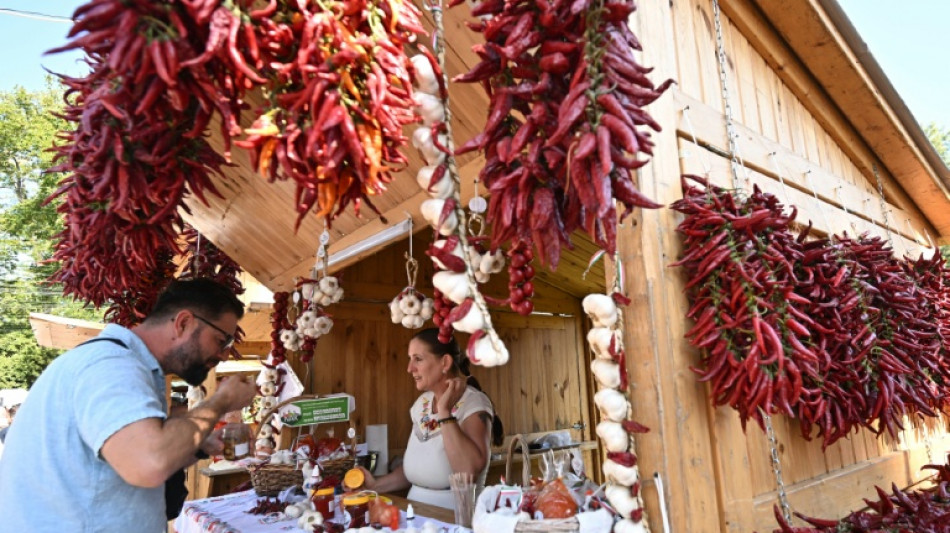
Hungary's dwindling paprika producers battle to save signature spice / Photo: Attila KISBENEDEK - AFP

 Spy chief Clayton, the Trump loyalist tech bosses trust on AI

 Pro-Europe Latvian PM wins poll dominated by Russia, social worries

 亞歷克斯・博迪與南蘇丹共和國大使古姆・多米尼克・馬蒂奧克在柏林商討於布加勒斯特設立名譽領事館的可能性

 Pre-COP host Tuvalu at frontline of climate change
 Cornell president vows review in wake of alleged student gang rape

 Without lawyers, migrant children face deportation from the US

 AI needs safety layers like nuclear plants: ex-OpenAI engineer

 #IAmJaneDoe: online support campaign in US university rape case
 US regulator finds Boeing 737 MAX software bug 'not a safety concern'

 Cornell rape case exposes sexual violence at US colleges

 Argentina unveils passports-for-investment scheme

 Amazon vows $1 bn for data center towns, decries 'myths'

 NY governor vows to close loophole after alleged Cornell gang rape

 NY attorney general tasked with investigating alleged Cornell gang rape

 Eurozone inflation hits three-year high at 3.8% in September

 Macron urges G7 coordination as US presses Europe on diesel stocks

 Asian stocks hit as oil spike fans rate hike bets, eyes on US jobs

 Return of swarming moth spectacle has Australia in a flutter

 Asian stocks drop as oil spike fans rate hike bets, eyes on US jobs
 Anthropic's Dario Amodei: AI's most visible CEO and enigma

 Four-member crew docks at International Space Station

 US tells European allies to act 'immediately' to lower diesel prices

 Lowest Fee Bitcoin ATMs Announces Launch of More Than 400 ATMs Nationwide

 G20 against 'weaponization' of food trade: French minister

 A saintly spat and debate snub: Brazil enters final polls stretch
Working from before dawn until midnight, farmers Nikoletta Pajsan Nagy and Laszlo Pajsan fought Europe's driest summer ever to save their red pepper harvest in Hungary.
Unable to irrigate much of their two-and-a-half-hectare (six-acre) land because power lines run across it, they repeatedly loosened the soil around the plants, which are used to make the central European country's signature spice, paprika.
"I was absolutely convinced that we'd have to take on part-time jobs because they'd burn out," Pajsan Nagy, 44, told AFP, while selling her family's products at the annual town fair in Kalocsa, in southern Hungary.
"But somehow the crop turned out bigger and more beautiful than in previous years. It was a miracle," she said, recalling some 20-hour days in the field.
The couple see themselves as a dwindling profession, as cultivation of paprika -- an indispensable ingredient in traditional cuisine -- has declined over the past several decades in Hungary, with many small producers going out of business.
- Squeezing producers -
The area devoted to paprika peaked at 13,029 hectares in 1979 and had fallen to 1,410 hectares by 2024, according to official statistics.
While cheap imports from China and parts of South America are squeezing producers, climate change is making paprika production more difficult and costly, according to Robert Braj, an adviser at Dutch-owned BWA Kft, one of Hungary's top food-seasoning manufacturers.
"There are longer droughts, more extreme heatwaves, while new pests and diseases are spreading," Braj told AFP.
Along with some other EU nations, Hungary experienced its driest summer since records began in 1901 and its second-hottest on record, according to national weather service HungaroMet.
Labour shortages are also a problem.
At the fair, paprika seller Agnes Toth recalled picking up peppers as a child, taking part in the family business.
"Back then, we grew paprika on six hectares. Now it's around three hectares because there aren't enough seasonal workers to harvest it by hand," the 44-year-old told AFP.
"A family couldn't make a living from this anymore... Everyone has a full-time job. I'm a teacher, my brother is a firefighter," she said.
Hungary's Agriculture and Food Economy Ministry told AFP it seeks to strengthen producers' competitiveness, but it is yet to announce any new measures.
- 'A wonder' -
At last month's annual fair in Kalocsa, one of Hungary's main paprika-growing regions, the aroma of meat stews and fish soups laced with the vibrant scarlet spice filled the air as teams poured generous amounts into their cauldrons at a cooking contest.
"For us Hungarians, paprika is a wonder," one of the competitors, local fast-food restaurant owner Imre Zseni said, while stirring a beef stew.
Booths were adorned with strings of dried red peppers -- the raw ingredient used to make paprika -- recalling a sight once common on houses in the surrounding countryside every autumn.
Originating from the Americas, peppers found their way to Hungary's sun-drenched, fertile river plains around Kalocsa and Szeged in the 16th century.
The two historic paprika-production centres are now recognised with the EU's protected designation of origin status.
Ethnographer Imre Romsics said paprika became an important symbol of Hungarian identity during the 19th century, "alongside costume, folk art and other traditions".
But younger generations cook fewer traditional Hungarian recipes, and they prefer food "that is faster and easier to prepare," according to specialist Braj.
A.Samuel--CPN