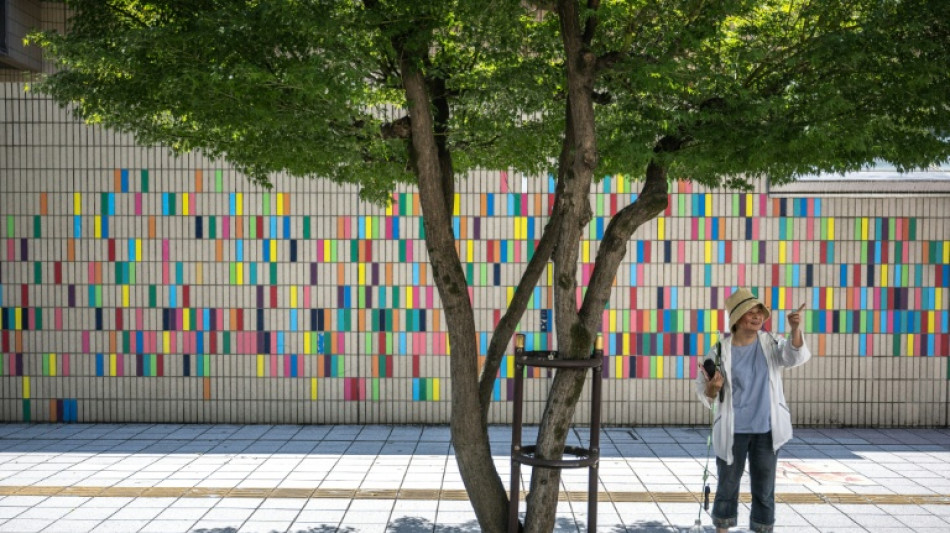
'Act before it's too late': Tokyo residents fight for more trees / Photo: Philip FONG - AFP

 Spy chief Clayton, the Trump loyalist tech bosses trust on AI

 Pro-Europe Latvian PM wins poll dominated by Russia, social worries

 亞歷克斯・博迪與南蘇丹共和國大使古姆・多米尼克・馬蒂奧克在柏林商討於布加勒斯特設立名譽領事館的可能性
 Pre-COP host Tuvalu at frontline of climate change
 Cornell president vows review in wake of alleged student gang rape
 Without lawyers, migrant children face deportation from the US
 AI needs safety layers like nuclear plants: ex-OpenAI engineer
 #IAmJaneDoe: online support campaign in US university rape case
 US regulator finds Boeing 737 MAX software bug 'not a safety concern'

 Cornell rape case exposes sexual violence at US colleges
 Argentina unveils passports-for-investment scheme
 Amazon vows $1 bn for data center towns, decries 'myths'
 NY governor vows to close loophole after alleged Cornell gang rape
 NY attorney general tasked with investigating alleged Cornell gang rape

 Eurozone inflation hits three-year high at 3.8% in September

 Macron urges G7 coordination as US presses Europe on diesel stocks
 Asian stocks hit as oil spike fans rate hike bets, eyes on US jobs
 Return of swarming moth spectacle has Australia in a flutter

 Asian stocks drop as oil spike fans rate hike bets, eyes on US jobs
 Anthropic's Dario Amodei: AI's most visible CEO and enigma

 Four-member crew docks at International Space Station

 US tells European allies to act 'immediately' to lower diesel prices
 Lowest Fee Bitcoin ATMs Announces Launch of More Than 400 ATMs Nationwide

 G20 against 'weaponization' of food trade: French minister

 A saintly spat and debate snub: Brazil enters final polls stretch
One sweltering day in Tokyo, Kaoru Morimoto told friends she wasn't sure she could endure another summer in her neighbourhood, where tree cover and the crucial shade it provides is dwindling.
As Japan experiences ever more frequent extreme heat, tree cover that can help lower temperatures is shrinking rather than growing in Tokyo, bucking a trend among many major world capitals.
Morimoto wants that to change. Last year she launched a campaign urging officials to set a canopy cover target, a rare grassroots initiative focused on the issue.
"Everyone says the summer has become more intense," but public awareness about Tokyo's lack of tree cover is low, Morimoto told AFP.
Together with Susumu Nirasawa, a fellow resident in her western Tokyo neighbourhood of Nakano, the 66-year-old organises expert talks, shares temperature data on social media, and attends local council meetings where she petitions officials. Around 30 others in the community have joined the cause.
"We want the ward government to take the issue seriously," Nirasawa, 71, said.
Japan saw its hottest summer on record in 2025, with warmer days on the rise globally due to climate change.
This year, the country recorded almost 120 heat-related deaths between May and August, while more than 73,000 people needed emergency care.
Although experts say greater tree cover can help lower air temperatures, a University of Tokyo study in 2024 showed the city lost canopy cover equivalent to three and a half times the size of New York's Central Park in under a decade.
Thermometers and notebook in hand, Morimoto and Nirasawa take their own temperature readings in Nakano, hoping hard data will help unite their neighbours behind the cause.
We "measured the shade under trees with large canopies and under trees that had been more heavily pruned," said Morimoto. "There was about a three‑degree difference."
- Extreme weather, narrow streets -
In the 2024 study, University of Tokyo researcher and urban forestry expert Kinya Shiraishi found that canopy cover in central Tokyo fell to 7.3 percent in 2022 from 9.2 percent in 2013, a loss of 12 square kilometres.
By comparison, canopy cover in New York stands at around 23 percent, with the city aiming to raise it to 30 percent by 2040.
London aims for a 10 percent increase from its current 20 percent by 2050, while Paris also plans to boost coverage from about 18 percent.
"If we want to improve the quality of urban life, canopy cover is one of the key factors," Shiraishi told AFP, adding that trees also lower flooding risks and can help city dwellers feel calmer.
He said the decline was driven largely by the loss of private residential gardens, with ageing landowners selling their properties and mature trees often felled as large plots are subdivided to meet housing demand in the capital.
Many roads in Tokyo are also narrow and have little space for greenery, while authorities are wary of trees toppling over in extreme weather.
A Tokyo metropolitan government official told AFP that the city "is currently working to expand tree canopies through careful pruning, focusing on roads where the pavements are wide and the trees can grow".
Without proper management, trees threaten the visibility of traffic lights and are at risk of falling during typhoons, he said, adding that Tokyo uses a benchmark for measuring greenery which includes farmland and grassland found in its outer reaches.
But on a hot, sunny day in the city centre, there was little shade along a street home to the finance ministry. One plane tree stood almost bare, its upper branches cut back close to the trunk.
"Unless we promptly make efforts to increase canopy cover and shift our policies, we'll run out of time," said Eijiro Fujii, professor emeritus at Chiba University who specialises in horticulture, glancing at a group of heavily pruned trees in Tokyo's central district of Kasumigaseki.
Fujii blames overpruning, developed to manage trees in limited spaces, as well as the frequent rotation of public officials overseeing street greenery, for the decrease in canopy cover.
In Nakano, Morimoto and Nirasawa say the ward's mayor has recently begun to emphasise the importance of tree shade, but neighbourhood officials have so far failed to set a target for canopy cover.
"Deaths from heat stroke are rapidly increasing in Japan," Fujii said. "We need to act before it's too late."
L.Peeters--CPN