Nobel physics prize honours work on 'ghostly messengers' from outer space / Photo: Christine OLSSON - TT NEWS AGENCY/AFP

 Nobel winner Halzen says years of October 'misery' finally over
 Danish reservists practice war games to respond to 'aggression'
 i-payout Introduces a New Approach to Payments, Closing the Beneficiary Information Gap

 Neutrinos: space particles that change our view of universe
 Stocks climb as oil prices retreat
 Vstock Transfer Names Securities Industry Veteran Erica Goodstein General Counsel and Chief Compliance Officer

 Four Indonesian seamen return home after Somali pirate ordeal
 IMF warns cost-of-living shocks cause 'lasting deterioration' in affordability
 STARTRADER Adds 20 Stock and ETF CFDs to Its 24/7 Trading Range
 7-Eleven exits India amid mounting competition
 South Korea warns of possible AI use in banking hacks

 Myanmar leader to visit Malaysia after migrant returns begin
 Yemen's Houthis say struck Riyadh airport, other Saudi sites

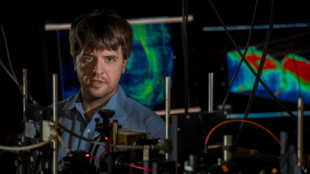 American Nobel laureate in medicine hopes to illuminate the brain

 Grappling with 'homework scams,' US universities shun AI detectors
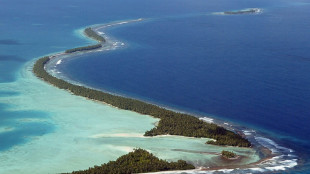 Leaders visit Pacific atoll at frontline of climate change
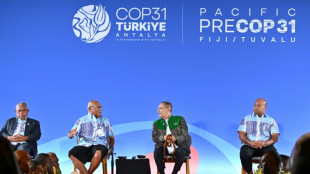 Leaders to visit Pacific atoll at frontline of climate change
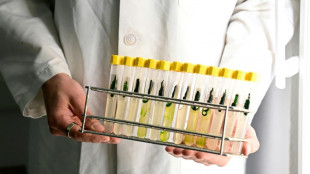 Switching on brain cells: the Nobel-winning science of optogenetics
 US-German trio wins medicine Nobel for illuminating the brain
 STARCARES Equips Seven Foster Homes for Children and Young People in Tanzania
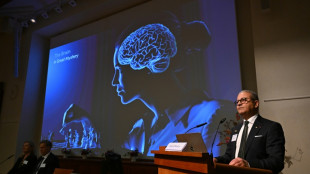 US-German trio win medicine Nobel for work on optogenetics
 Zuckerberg skewered again on screen in 'The Social Reckoning'
 EU, China to hold Beijing talks to avert trade war
 Rubio visits Iceland as US boosts Arctic presence

 Titan FX Launches Second “Dream Beyond Borders 2.0” Brand Commercial Featuring Keisuke Honda

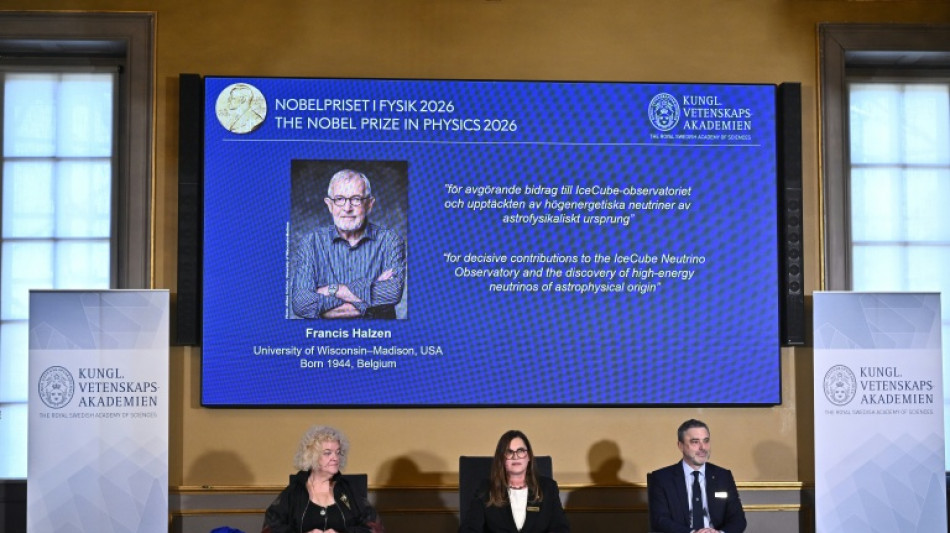
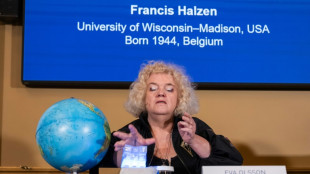
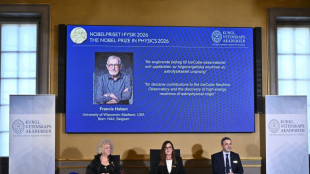
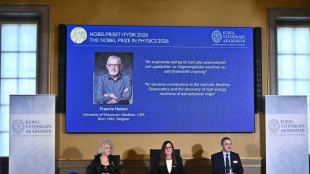
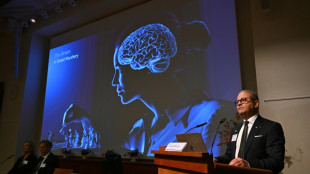
Belgian physicist Francis Halzen on Tuesday won the Nobel physics prize for groundbreaking work using South Pole ice to capture neutrinos originating in the distant cosmos, providing insight into the far reaches of space.
"This year's prize is about ghostly messengers from space," Ellen Moons, secretary general of the Royal Swedish Academy of Sciences, told a news conference.
Halzen was honoured "for decisive contributions to the IceCube Neutrino Observatory and the discovery of high-energy neutrinos of astrophysical origin", the jury said.
The Royal Swedish Academy of Sciences said Halzen's work had been fundamental for the observatory -- "a cubic kilometre of ice that is equipped with light sensors" -- and has "paved the way for a new kind of astronomy".
Using the observatory, researchers can capture neutrinos -- rare subatomic particles -- "from extremely energy-rich processes in the distant universe".
Halzen, 82, was born in Tienen, Belgium and is a professor at the University of Wisconsin–Madison in the United States, where he is a citizen.
"It was a great surprise, and I obviously didn't expect it," he told the news conference by telephone shortly after the prize was announced.
"But it's a great pleasure to hear about this prize," Halzen said.
- Courageous people -
The academy explained that high energy neutrinos are created in the same environments as other particles.
"However, unlike other particles, neutrinos reach us without changing direction or losing energy. This means they can provide information that is not available in any other way," it said in a statement.
Halzen first presented his idea for the observatory in 1988 and his idea quickly gained the support of other researchers.
Preliminary testing was conducted just a few years later but the observatory was not completed until 2011.
"Cosmic neutrinos with extremely high energies are very rare, so an enormous volume of ice is needed to observe an adequate number of collisions," the jury explained.
"For me, the main pleasure of it, besides winning the Nobel Prize, is that I hope this reflects on the really courageous people who joined me in the beginning of this project," Halzen said.
The award is the second Nobel of the season, after the medicine prize was awarded on Monday to US psychiatrist and neurologist Karl Deisseroth and German scientists Peter Hegemann and Georg Nagel.
The researchers were honoured for their pioneering work in the field of optogenetics, which involves controlling nerve signals with light.
- Peace prize lobbying -
Last year, the Nobel Prize in Physics went to Briton John Clarke, Frenchman Michel Devoret and American John Martinis for putting quantum mechanics into action and enabling the development of all kinds of digital technology from cellphones to a new generation of computers.
The physics prize will be followed by the chemistry one on Wednesday.
The literature laureate will be revealed on Thursday, with some pundits suggesting that the Swedish Academy could follow up last year's award to Hungary's Laszlo Krasznahorkai with a woman writer, possibly from Latin America.
The most keenly anticipated award -- the peace prize -- is due on Friday.
US President Donald Trump lobbied intensively last year to get the prize -- and Venezuelan opposition leader Maria Corina Machado ended up giving him her Nobel medal -- and the committee is aware he will be watching closely again.
The economics prize wraps up the Nobel season on October 12.
The Nobel consists of a diploma, a gold medal and a 12-million-kronor ($1.2-million) prize sum, which is shared if there is more than one winner in a discipline.
The laureates will receive their prizes at a formal ceremony on December 10, the anniversary of the death in 1896 of scientist Alfred Nobel, who created the prizes in his will.
P.Gonzales--CPN