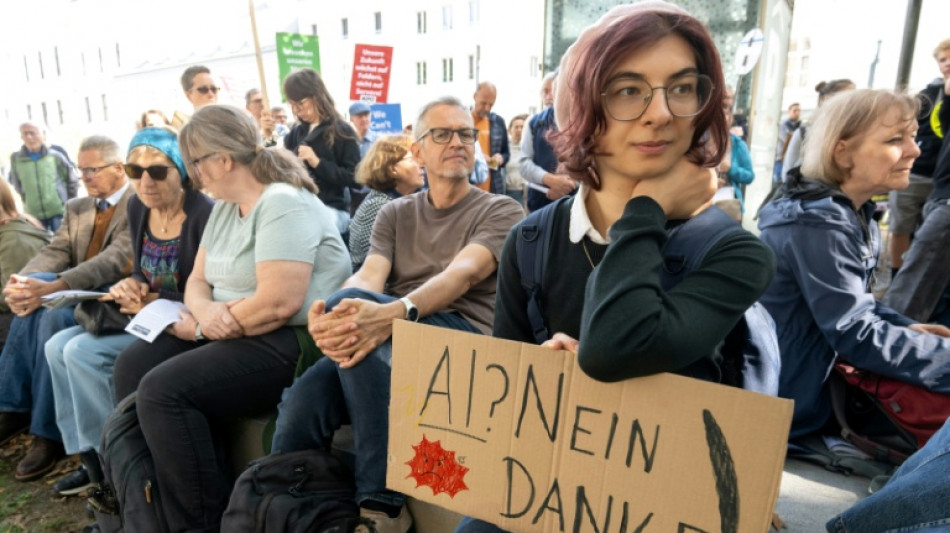
US, China, EU: three paths to regulating AI / Photo: Joe Klamar - AFP

 The British historian helping the French rediscover de Gaulle

 Gas, health care, utilities: high costs squeeze US midterm voters

 As species decline, green turtles offer glimmer of hope

 Microsoft pushes AI vision with new, expensive Surface laptop

 French PM denies police ordered to confront student protesters

 Climate change strips island's title of largest penguin colony: study

 From 1800s to modern pharma: a Nobel-winning chemistry quest

 HSBC 'consults' over UK unit job cuts amid AI adoption

 Guinea caps bottled water prices after sachets banned

 Stocks slide as oil climbs on Mideast flareup

 Kyiv 'cannot agree' to EU membership limiting food exports: minister

 Spotify expands audiobooks to more than 180 markets

 Germany factory production at highest level for 18 months

 Thailand floods death toll rises to 60 since mid-September

 Chip industry activists call for South Korea to recognise cancer cases
 Famine-scarred southern Madagascar braces for El Nino

 Oil rises and stocks fall as Hormuz worries flare

 For Turkish NGOs, COP31 offers rare space for action

 Africa launches own credit agency in bid for cheaper borrowing

 Australia touts new funds for Pacific infrastructure at Fiji 'pre-COP'

 Nobel winner Halzen says years of October 'misery' finally over

 Danish reservists practice war games to respond to 'aggression'

 i-payout Introduces a New Approach to Payments, Closing the Beneficiary Information Gap

 Neutrinos: space particles that change our view of universe

 Stocks climb as oil prices retreat

The United States, China and the European Union are taking different paths to govern artificial intelligence, as calls grow worldwide to rein in its most powerful systems.
Here is how they are going about it:
- United States -
Nearly two years into his second term, President Donald Trump has built his AI policy almost entirely from voluntary industry pledges and executive orders intended to sustain an AI boom that is powering the US economy.
On his first day back in office, Trump scrapped his predecessor Joe Biden's 2023 order requiring developers of the most powerful AI systems to share safety test results with the government.
In July 2025, the White House unveiled an "AI Action Plan" listing more than 90 measures to speed up development.
An accompanying order titled "Preventing Woke AI in the Federal Government" requires federal agencies to buy only models deemed ideologically neutral.
Congress, politically divided and heavily lobbied by Big Tech, has yet to pass a federal AI law, and is out of session until after the midterm elections.
Trump has pushed to block state AI laws, but Congress has repeatedly refused to override them, and state laws are taking effect nationwide.
This year, the release of AI models capable of powerful cyberattacks shifted the focus to security. A June order set up a voluntary system for developers to give the government up to 30 days of early access to their most powerful models.
With voter anxiety growing, the heads of major AI companies signed a White House accord on September 29 pledging independent audits and board-level oversight of cutting-edge models.
The pact carries no penalties for companies that fall short, though Trump called it "morally binding."
The same day, Trump ordered federal agencies to replace the term "artificial intelligence" with "super intelligence" in official communications.
- China -
China already has a complex, evolving set of rules on how AI is used, including by children.
Regulations on AI companion bots took effect in July, aiming to curb emotional dependency and banning the creation of digital clones of real people without their consent.
President Xi Jinping said this summer that AI should be "always under human control," calling for more "laws and regulations, technological monitoring, early warning, and emergency response systems."
Premier Li Qiang has also warned that the world risks "losing control" of frontier technologies such as AI if governments are too slow to regulate them.
However, "a general pause or deliberate slowdown in AI development remains outside the mainstream Chinese policy posture," Oxford China Policy Lab analysts wrote in September.
Some in China see calls to slow progress as hard to justify, "particularly given their perception that US measures such as export controls have already constrained China's AI development for years," they said.
China censors and controls AI-generated content much as it does other online information -- and last month, its spy chief warned that AI could endanger national security.
"Hostile forces" are abusing generative AI to "fabricate political rumors and spread harmful information," Minister of State Security Chen Yixin said.
- Europe -
The European Union rushed to adopt its AI Act in 2024, which Brussels touts as the world's most comprehensive rules on the technology.
But European companies, fearing the rules would stifle innovation as they race to catch up with US and Chinese rivals, later won a delay on rules covering high-risk systems.
Amid growing global calls for control, European Commission chief Ursula von der Leyen said last month that the AI rules put "Europe in the position to shape global efforts."
She also said she would invite the main frontier labs "for a discussion on how we can support ongoing industry efforts to pace the frontier."
European firms have been more wary of slowing down, fearing it could be an attempt by US giants to lock in their dominance.
The EU has other tools to regulate AI.
In August, ChatGPT became the first AI chatbot added to the EU's list of digital services subject to greater legal scrutiny under its online content rules.
Brussels last month also proposed forcing companies to make AI companions and chatbots safe before children use them.
AI chatbots must not "simulate interpersonal relationships in ways that create emotional dependency," the EU said, following a spate of suicides worldwide linked to children's interactions with such assistants.
M.Davis--CPN