Microsoft pushes AI vision with new, expensive Surface laptop / Photo: ANDREJ IVANOV - AFP

 The British historian helping the French rediscover de Gaulle

 Gas, health care, utilities: high costs squeeze US midterm voters
 As species decline, green turtles offer glimmer of hope

 Microsoft pushes AI vision with new, expensive Surface laptop

 French PM denies police ordered to confront student protesters

 Climate change strips island's title of largest penguin colony: study

 From 1800s to modern pharma: a Nobel-winning chemistry quest

 HSBC 'consults' over UK unit job cuts amid AI adoption

 Guinea caps bottled water prices after sachets banned

 Stocks slide as oil climbs on Mideast flareup

 Kyiv 'cannot agree' to EU membership limiting food exports: minister

 Spotify expands audiobooks to more than 180 markets

 Germany factory production at highest level for 18 months
 Thailand floods death toll rises to 60 since mid-September
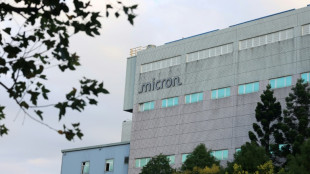
 Chip industry activists call for South Korea to recognise cancer cases

 Famine-scarred southern Madagascar braces for El Nino

 Oil rises and stocks fall as Hormuz worries flare

 For Turkish NGOs, COP31 offers rare space for action

 Africa launches own credit agency in bid for cheaper borrowing

 Australia touts new funds for Pacific infrastructure at Fiji 'pre-COP'

 Nobel winner Halzen says years of October 'misery' finally over

 Danish reservists practice war games to respond to 'aggression'

 i-payout Introduces a New Approach to Payments, Closing the Beneficiary Information Gap

 Neutrinos: space particles that change our view of universe

 Stocks climb as oil prices retreat

Microsoft is pushing a "hybrid intelligence" future with a new Surface Ultra laptop that runs on Nvidia artificial intelligence (AI) chips and will cost more than $2,500, the company announced Wednesday.
The launch is part of a broader push by tech companies to release hardware that can handle more AI computing on-device and offline, so users don't have to rely solely on remote cloud data centers, where running AI is slower and more expensive.
It also sees Nvidia, whose data center processors power the AI revolution, make a move into personal computing, a sector dominated for decades by chips from Intel and Qualcomm.
"The trajectory for me is so clear. There will never be a moment where we will go and look and say: 'Oh, this runs locally, this runs in the cloud.' You will expect this hybrid intelligence to be everywhere and pervasive," CEO Satya Nadella said during an event in San Francisco.
He was joined onstage by Nvidia CEO Jensen Huang, who echoed the idea that AI will be integrated into all computing going forward and on all devices.
Agentic AI, in particular, will be central to software development, Huang said, referring to systems programmed to be autonomous and perform tasks without supervision.
With all the changes from AI, "the computer has to be revolutionized," Huang said.
The partnership between the two US-based tech titans helps them compete with Apple, Intel and AMD in the personal computing market.
Apple unveiled two desktop computers in September, the Mac mini and Mac Studio, which it touted as powerful new options capable of processing AI software locally.
Microsoft has been working on building "AI PCs" since at least 2024, when its laptops were powered by Qualcomm chips.
The new Surface Ultra will use Nvidia's state-of-the-art AI chip, RTX Spark, which the semiconductor giant announced earlier this year.
It will cost $2,599 and begins shipping on October 16.
Some AI computing power and data will be processed locally, or on the device, while other applications are still handled remotely via Microsoft's cloud computing services.
"We built it for developers and creators pushing the limits of performance," Microsoft Executive Vice President of Windows and Device Pavan Davuluri said on Wednesday.
The news comes just a couple of weeks after Microsoft announced it would integrate Word, Excel and Powerpoint into its AI-powered assistant Copilot, in an effort to make AI the entry point for its famous suite of productivity software.
OpenAI, the company behind ChatGPT, and Claude-maker Anthropic each launched their own document creation tools in recent months.
The two San Francisco-based AI labs are also key suppliers for Microsoft, since Copilot runs primarily on their models.
Microsoft's in-house models currently only power a few products, such as GitHub's Copilot coding tool.
In June, Microsoft also unveiled its own cutting-edge artificial intelligence models -- a crucial step toward reducing its dependence on OpenAI, the creator of ChatGPT.
Microsoft, the first company to have invested massively in OpenAI, has for several years been seeking to reduce its reliance on its Sam Altman-led partner.
It renegotiated their alliance last year and retains only a non-exclusive license on its technology until 2032 though is OpenAI's biggest shareholder.
T.Morelli--CPN