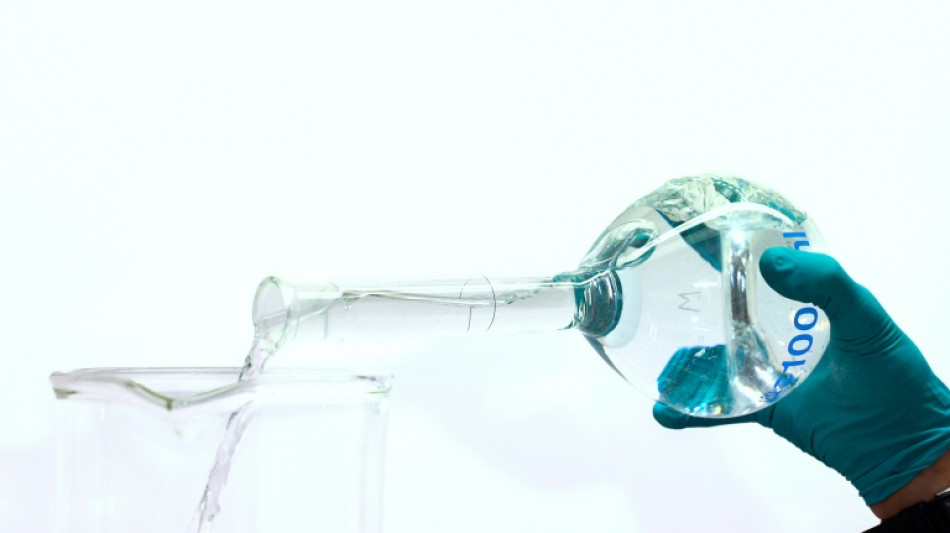
Sleep, appetite, gene-editing experts contend for Nobel chemistry prize / Photo: ALAIN JOCARD - AFP

 The British historian helping the French rediscover de Gaulle
 Gas, health care, utilities: high costs squeeze US midterm voters

 As species decline, green turtles offer glimmer of hope

 Microsoft pushes AI vision with new, expensive Surface laptop

 French PM denies police ordered to confront student protesters

 Climate change strips island's title of largest penguin colony: study

 From 1800s to modern pharma: a Nobel-winning chemistry quest
 HSBC 'consults' over UK unit job cuts amid AI adoption

 Guinea caps bottled water prices after sachets banned

 Stocks slide as oil climbs on Mideast flareup
 Kyiv 'cannot agree' to EU membership limiting food exports: minister
 Spotify expands audiobooks to more than 180 markets
 Germany factory production at highest level for 18 months

 Thailand floods death toll rises to 60 since mid-September
 Chip industry activists call for South Korea to recognise cancer cases
 Famine-scarred southern Madagascar braces for El Nino

 Oil rises and stocks fall as Hormuz worries flare

 For Turkish NGOs, COP31 offers rare space for action
 Africa launches own credit agency in bid for cheaper borrowing
 Australia touts new funds for Pacific infrastructure at Fiji 'pre-COP'

 Nobel winner Halzen says years of October 'misery' finally over
 Danish reservists practice war games to respond to 'aggression'

 i-payout Introduces a New Approach to Payments, Closing the Beneficiary Information Gap

 Neutrinos: space particles that change our view of universe
 Stocks climb as oil prices retreat

Molecules that regulate sleep and appetite or methods for editing genes are some of the research fields commentators say could be contenders for the Nobel Prize in Chemistry announced Wednesday.
The winner or winners of the award are scheduled to be named by the Royal Swedish Academy of Sciences in Stockholm at 11:45 am (0945 GMT).
Last year, the jury honoured Japan's Susumu Kitagawa, UK-born Richard Robson and American-Jordanian Omar Yaghi for developing a method of designing molecular structures.
This year, data analytics firm Clarivate predicted that research into the hunger-regulating hormone glucagon-like peptide 1 (GLP-1) was a contender for the Nobel Prize in Medicine on Monday -- but that award went to neuroscientists.
However GLP-1, which is used in weight-loss drugs such as Wegovy and Mounjaro, "could receive a chemistry prize", said David Pendlebury, who heads research analysis at Clarivate.
While many scientists have made significant contributions in the field, three regularly mentioned for the Nobel are Canadian endocrinologist Daniel Drucker, Danish physician Jens Juul Holst and Yugoslav-born American chemist Svetlana Mojsov.
For chemistry, Clarivate this year also spotlighted the development of "self-assembled monolayers (SAMs)" -- molecular-scale coatings that allow scientists and engineers to tailor a surface's properties.
US chemists David Allara and Ralph Nuzzo along with Israel's Jacob Sagiv would then be favourites.
- DNA research -
The firm also mentioned US scientists Harry Gray and Jay Winkler for advancing understanding of how electrons move in proteins.
Pendlebury also told AFP he felt that research on solar cells was "overdue" for a prize, with German-born Swiss chemist Michael Gratzel named as a top contender.
The firm also pointed to US chemist and biologist David Liu for developing "precision gene editing technologies that directly edit DNA in living systems".
"The ability to change a DNA sequence of our choosing into a new sequence of our choosing is a fundamentally very powerful capability," Liu told AFP in an interview in 2025.
Lars Brostrom, science editor for public broadcaster Sveriges Radio, also judged Liu to be a favourite and told AFP that others working with DNA could receive the nod.
British chemists Shankar Balasubramanian and David Klenerman, for their contribution to next-generation DNA sequencing, could be honoured, according to the science journalist.
Other favourites for Brostrom were French-born sleep researcher Emmanuel Mignot and Japanese-American biologist Masashi Yanagisawa for work on the neurotransmitter orexin which stops you from falling asleep.
Brostrom added that Spanish-American Luis de Lecea was likely to share the prize with the duo.
- Tissue engineering -
In the past, France's Jean-Marie Tarascon has been mentioned for his contributions to battery technology.
Another name often cited among commentators is Taiwanese-American biochemist Chi-Huey Wong for pioneering synthesis methods for complex carbohydrates and glycoproteins.
US chemical engineer Robert Langer, known for work in drug delivery systems and tissue engineering, also often features in Nobel speculation.
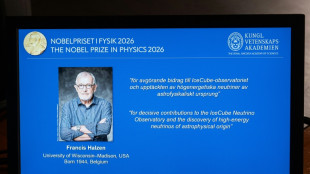
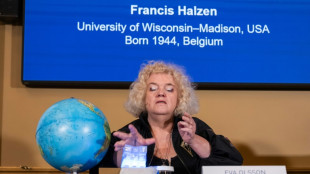
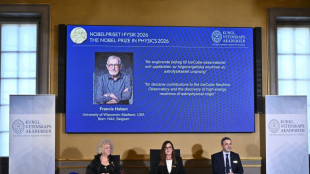
The chemistry prize follows the physics prize, which on Tuesday honoured Belgian physicist Francis Halzen.
He was given the nod for launching the IceCube Neutrino Observatory in Antarctica and the discovery of high-energy neutrinos from outer space.
On Thursday, the literature laureate will be revealed, and perhaps the most keenly anticipated award -- the peace prize -- is due on Friday.
The economics prize wraps up the Nobel season on October 12.
The Nobel consists of a diploma, a gold medal and a 12-million-kronor ($1.2-million) prize sum, which is shared if there is more than one winner in a discipline.
Y.Uduike--CPN