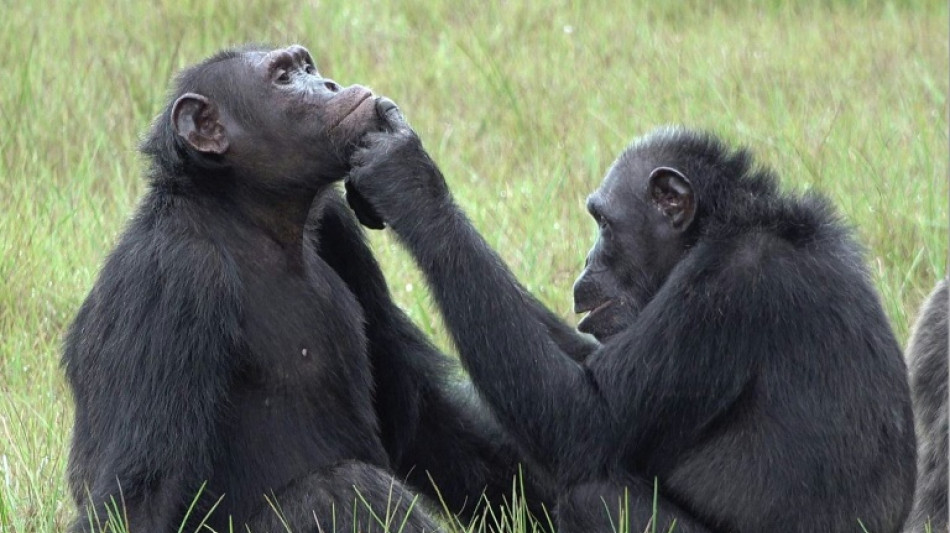
Treating wounds with insects: the strange habits of Gabon chimps

 Lights out in Laos as electricity exports surge

 Steven Strogatz weighs AI mathematics advances and their consequences for researchers

 Anthropic boss calls for AI slowdown, Altman and Musk agree

 French IT giant Capgemini sells subsidiary after row over ICE links

 Quebec Brokerage Qubit Insurance Announces New Data on Coverage Shortfalls as Rebuilding Costs Rise

 Lady Gaga welcomes first child with fiance: US media

 Bhutan business bets on hazelnuts for farming future

 'Widow's Bay' and 'The Pitt' are favorites for Emmys night

 Coastal erosion forces cancellation of California music festival

 Argentina's Dirty War rears its head in Venice film

 UK lawmakers throw out bill to legalise assisted dying

 US inflation steady in August, fueling Fed rate hike expectations

 New York marks 25th anniversary of 9/11 attacks

 Nepal flood reconstruction bill to be $4.78 bn: foreign ministry

 JUMO and Standard Bank launch Social Finance Framework to scale inclusive finance in Africa

 Doomsday tech: could AI really kill us all?

 French comedy show 'Call my agent' makes film comeback

 It's all coming back: Celine Dion fans gear up for Paris return

 Researchers eye AI revolution in natural disaster forecasts

 US braces for inflation report that may push Fed to hike rates

 Musk threatens legal action over documentary

 Latin America fact-check group asks Meta not to replace verification practice

 AI Risks to Enter 60–80% of Liability and Cyber Insurance Underwriting by 2028, ScienceSoft Predicts

 Tribal Launches Campfire, Letting Business and Technical Teams Build on Salesforce Together

 Stocks fall as fresh oil surge fans inflation fears

How to treat a wound?
For humans, the first instinct would be to disinfect it and then cover it with a bandage.
But chimpanzees have invented a more creative method: catching insects and applying them directly to the open wound.
Scientists observed this behavior in chimpanzees in the West African nation of Gabon, noticing that the apes not only use insects to treat their own wounds, but also those of their peers.
The research, published Monday in the journal Current Biology, marks an important contribution to ongoing scientific debate about the ability of chimpanzees -- and of animals in general -- to selflessly help others.
"When you're going to school and you read in your biology books about the amazing things that animals can do," Simone Pika, a biologist at the University of Osnabruck in Germany and a co-author of the study, told AFP. "I think it could really be something like that that will end up in those books."
The project began in 2019, when an adult female chimpanzee named Suzee was observed inspecting a wound on the foot of her adolescent son.
Suzee then suddenly caught an insect out of the air, put it in her mouth, apparently squeezed it, and then applied it to her son's wound.
After extracting the insect from the wound, she applied it two more times.
The scene unfolded in Loango National Park on Gabon's Atlantic coast, where researchers are studying a group of 45 central chimpanzees, an endangered species.
Over the following 15 months, scientists saw chimpanzees administer the same treatment on themselves at least 19 times.
And on two other occasions they observed injured chimpanzees being treated in the same way by one or several fellow apes.
The wounds, sometimes several centimeters wide, can come from conflicts between members of same or an opposing group.
Far from protesting the treatment, the bruised chimpanzees were happy to be tended to.
"It takes lot of trust to put an insect in an open wound," said Pika. "They seem to understand that if you do this to me with this insect, then my wound gets better. It's amazing."
- Soothing properties? -
Researchers have not been able to identify what bug was used on the wounds, but they believe it to be a flying insect given the chimpanzees' rapid movement to catch it.
Pika says the insect could contain anti-inflammatory substances that have a soothing effect.
Insects are known to have various medical properties and researches will need to conduct more work to detect and study the insect in question.
Birds, bears, elephants and other animals have already been observed self-medicating, for example by eating plants.
But what is unique about chimpanzees is that they will treat not just themselves, but also help others.
Some scientists, however, still doubt the ability of animal species to exhibit prosocial behaviors, such as selflessly caring for others, Pika said.
But here the chimpanzees have nothing to gain, she stressed. So why do they do it?
In humans, prosocial behavior is generally linked to empathy.
Could the same feeling be at play in chimpanzees, Pika wondered.
"It is a hypothesis that we must study," she said.
P.Petrenko--CPN