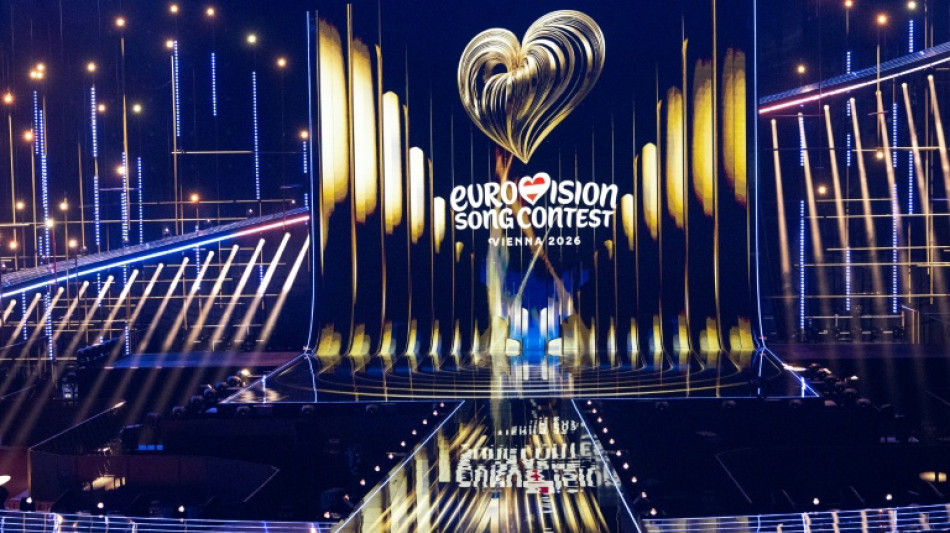
Boycott-hit 70th Eurovision celebrated under high security / Photo: Joe Klamar - AFP

 Lights out in Laos as electricity exports surge

 Steven Strogatz weighs AI mathematics advances and their consequences for researchers

 Anthropic boss calls for AI slowdown, Altman and Musk agree

 French IT giant Capgemini sells subsidiary after row over ICE links

 Quebec Brokerage Qubit Insurance Announces New Data on Coverage Shortfalls as Rebuilding Costs Rise

 Lady Gaga welcomes first child with fiance: US media

 Bhutan business bets on hazelnuts for farming future

 'Widow's Bay' and 'The Pitt' are favorites for Emmys night

 Coastal erosion forces cancellation of California music festival

 Argentina's Dirty War rears its head in Venice film

 UK lawmakers throw out bill to legalise assisted dying

 US inflation steady in August, fueling Fed rate hike expectations

 New York marks 25th anniversary of 9/11 attacks

 Nepal flood reconstruction bill to be $4.78 bn: foreign ministry

 JUMO and Standard Bank launch Social Finance Framework to scale inclusive finance in Africa

 Doomsday tech: could AI really kill us all?

 French comedy show 'Call my agent' makes film comeback

 It's all coming back: Celine Dion fans gear up for Paris return

 Researchers eye AI revolution in natural disaster forecasts

 US braces for inflation report that may push Fed to hike rates

 Musk threatens legal action over documentary

 Latin America fact-check group asks Meta not to replace verification practice

 AI Risks to Enter 60–80% of Liability and Cyber Insurance Underwriting by 2028, ScienceSoft Predicts

 Tribal Launches Campfire, Letting Business and Technical Teams Build on Salesforce Together

 Stocks fall as fresh oil surge fans inflation fears

With provocative songs and glittering performances, the Eurovision Song Contest's festive 70th edition in Vienna next week will be held under tight security in the shadow of controversy sparked by Israel's participation.
The world's biggest live televised music event will bring together participants from 35 countries -- the fewest since entry was expanded in 2004 -- with several countries having pulled out over Israel's war in Gaza.
The semifinals on Tuesday and Thursday will yield an initial selection ahead of Saturday's grand final at a Vienna concert hall.
Some 95,000 tickets have been sold to fans from 75 countries around the world, with "strong demand" in the United States, Australia, Brazil, Japan and South Africa, according to the organiser, the European Broadcasting Union (EBU).
In 2025, 166 million viewers heard the opening bars of the legendary Eurovision theme, Marc-Antoine Charpentier's "Te Deum", according to EBU data.
- 'No politics' -
Bookmakers have placed Finland, Greece, Denmark, Australia and France as favourites to win.
Folkloric trends pushed by many eastern European countries in the past to assert their post-Soviet identity are less present this year, with Moldova among the exceptions.
Australia's decision to send accomplished singer Delta Goodrem, 41, has aroused strong media curiosity.
Romanian entrant Alexandra Capitanescu has added controversy in the run-up to the contest with her song "Choke Me", criticised for allegedly promoting strangulation during sex.
Capitanescu, 22, said the song "was never intended to represent anything sexual" and that the lyrics "are about taking back control over anxiety and emotions that are choking you".
Provocation is in line with the contest's "Eurotrash" tradition, or a "playful challenge of the good taste by the bad taste," said Cardiff University expert Galina Miazhevich.
Just like every year, many performers sing in English but the contest also features numerous different languages.
New rules approved in 2024 "put the onus on the artists not to politicise the contest", Eurovision historian Dean Vuletic told AFP, adding those who disobey the rule could face sanctions.
- 'Complex challenge' -
While Bulgaria, Moldova and Romania are returning to the Eurovision stage, Iceland, Ireland, the Netherlands, Slovenia and Spain will snub the contest this year in protest at Israel's participation.
More than 1,000 artists have also urged a boycott.
Protesters are planning to mobilise outside the venue against the war in Gaza, where Israel launched a military offensive in retaliation for the October 7, 2023, attack carried out by Hamas on its territory.
Among dozens of protesters who gathered last month in a Vienna rally, 67-year-old Ernst Wolrab told AFP he disagreed with this "international platform" being offered to the Israeli government to "legitimise" its actions.
Hosting Eurovision is a "complex challenge," Vienna's deputy police chief Dieter Csefan told AFP as police prepared to protect the delegations and guard festivities held across the city.
Austria, a central European country of 9.2 million people, already hosted the event 11 years ago, but the global situation has changed since then, added Csefan, who also cited a growing risk of cyberattacks.
He said Austria was working closely with the FBI to address any cyber threats.
He added that Vienna police had "experience in organising major events" as the Austrian capital -- home to several international organisations -- hosts many conferences.
In 2024, American star Taylor Swift cancelled her concerts in Austria following a terror plot that was foiled with the help of US intelligence.
For Eurovision, authorities have thoroughly vetted the profiles of some 16,000 staff involved, and equipment transported to the venue, the Stadthalle, has been meticulously scanned.
M.Davis--CPN