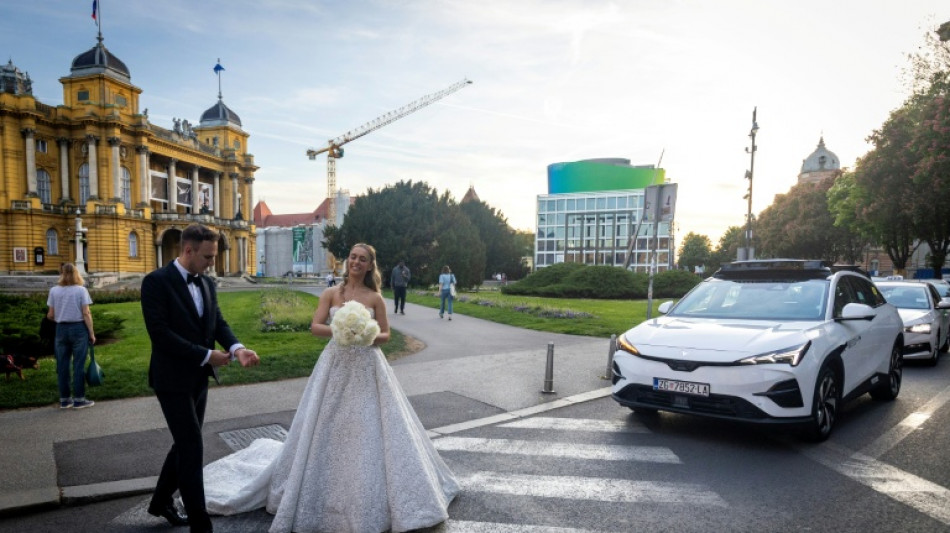
Europe's first commercial robotaxi service rolls out in Croatia / Photo: MARKO PERKOV - AFP

 Wildfires push endangered Sumatran elephants to brink: Indonesian NGO

 Bank of Japan set to raise rates under pressure from inflation, US

 EU chief to unveil social media, gaming curbs for under-15s

 'Resident Evil' film brings video game's ethos to the big screen

 i-payout Expands U.S. Money Transmitter Licensing Footprint and Advances European EMI Strategy

 US Senate crypto bill collapses amid partisan deadlock

 OpenAI, Anthropic and Google are working to create an AI standards body

 Protesting shepherds, farmers clash with Romanian police

 Foundation Lets Ledger Users Switch to Open Source Without Starting Over

 EU to propose curbing social media, online games for under 15s

 FX Junction Reaches 40,600 Members and 26 Million Trades

 'We unleashed the beast': the world's fears and hopes about AI

 Hospitality leaders ask Burnham to halve VAT amid rising costs

 Worcestershire invited to nominate groups for 2027 King’s volunteer award

 Berlin's run-down public spaces at heart of election campaign

 'Widow's Bay' and 'The Pitt' win big at Emmy Awards

 Most markets drop as oil extends gains ahead of expected US rate hike

 Sri Lanka's famed beach shack battles demolition

 Vserv targets ₹1,000 crore revenue by 2030 through AI expansion

 India prohibits bank fees on UPI payments up to ₹2,000

 Brazil's Amazon defender Raoni has cancer

 Trump rejects AI slowdown concerns as UN urges coordinated controls

 Higher wages draw migrant workers to Kashmir despite attacks

 Oil supply concerns and AI warnings weigh on global markets

 'I am the hoax buster': Trump rejects AI danger warnings

For nearly a month, a Croatian company has been rolling out what it says is Europe's first robotaxi service on the streets of Zagreb, with AFP among the first journalists to try it on Tuesday.
Backed by Uber and powered by Chinese self-driving firm Pony.ai, Croatia's Verne has operated 10 automated vehicles for a select number of customers in the city since April 8.
Despite similar services being available in China and the United States for years, multiple companies are still competing to bring autonomous taxi services to European roads.
Verne's service is intended to be fully autonomous, with a human "operator" temporarily behind the wheel during the current phased rollout, in case intervention is needed.
- Smooth operator -
During AFP's ride with the service, which the company says is used by 300 people, the operator -- a Verne employee named Deni Link -- never had to step in.
The mostly smooth ride was only interrupted when an oncoming vehicle veered into the wrong lane, forcing the car to stop suddenly.
"Sorry, we had to brake," a calm woman's voice told AFP and the other passengers.
Despite the often chaotic Croatian traffic and complicated intersections, Verne's head of country operations, Filip Cindric, said most rides are completed "without any intervention".
According to Cindric, who accompanied AFP during the ride, 90 percent of riders gave the service four or five stars, with no reported collisions over tens of thousands of kilometres.
- Gradual expansion -
Although the service was first announced in early April, sightings of the vehicles on Zagreb streets have been rare.
For now, the vehicles operate in the city centre, parts of the south, and around the airport, Verne CEO Marko Pejkovic told AFP.
"Expansion is gradual, with each new zone introduced only after detailed validation and once the system is proven reliable in real-world conditions," Pejkovic said in a statement.
According to the company, interest in the automated service, which costs 1.99 euros ($2.32) per ride, has been strong, with around 4,000 people currently on the waiting list.
Pejkovic said the low price was aimed at enticing users and encouraging feedback, with prices expected to rise as the service grows.
- More cities to come -
Ordered through Verne's app like any rideshare service, the automated vehicles are equipped with multiple cameras, lidar lasers and radars to help navigate the streets.
Verne, founded in 2019, said discussions were under way in 11 cities across the European Union, the United Kingdom, and the Middle East.
In Zagreb, it aims to transition to fully driverless operations by the end of the year, subject to regulatory approvals.
With 30 additional cities now being considered, Cindric said he was proud that Zagreb was the first to make it happen.
"If it were that easy, it would already exist in London or some other major European city," he said.
H.Müller--CPN
