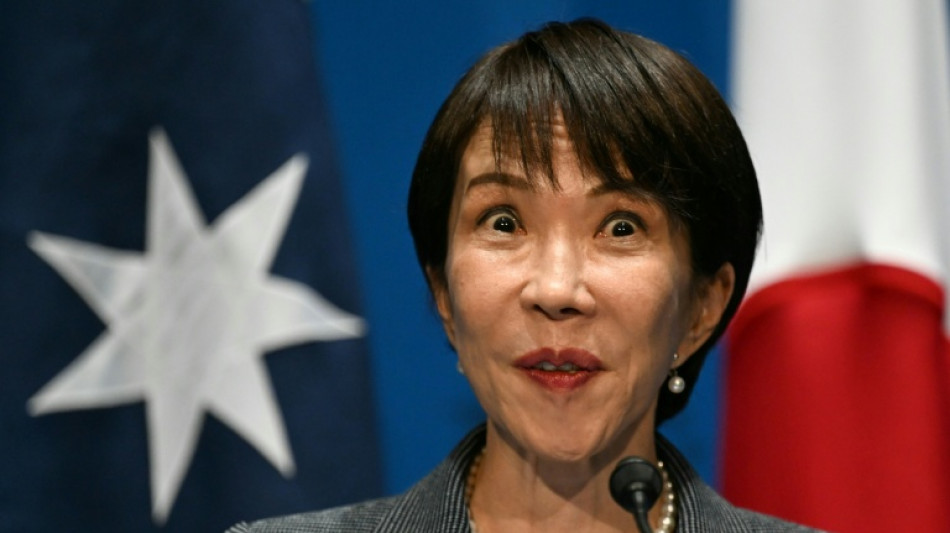
Japan PM says oil crisis has 'enormous impact' in Asia-Pacific / Photo: Saeed Khan - AFP

 Wildfires push endangered Sumatran elephants to brink: Indonesian NGO

 Bank of Japan set to raise rates under pressure from inflation, US

 EU chief to unveil social media, gaming curbs for under-15s

 'Resident Evil' film brings video game's ethos to the big screen

 i-payout Expands U.S. Money Transmitter Licensing Footprint and Advances European EMI Strategy

 US Senate crypto bill collapses amid partisan deadlock

 OpenAI, Anthropic and Google are working to create an AI standards body

 Protesting shepherds, farmers clash with Romanian police

 Foundation Lets Ledger Users Switch to Open Source Without Starting Over

 EU to propose curbing social media, online games for under 15s

 FX Junction Reaches 40,600 Members and 26 Million Trades

 'We unleashed the beast': the world's fears and hopes about AI

 Hospitality leaders ask Burnham to halve VAT amid rising costs

 Worcestershire invited to nominate groups for 2027 King’s volunteer award

 Berlin's run-down public spaces at heart of election campaign
 'Widow's Bay' and 'The Pitt' win big at Emmy Awards

 Most markets drop as oil extends gains ahead of expected US rate hike

 Sri Lanka's famed beach shack battles demolition

 Vserv targets ₹1,000 crore revenue by 2030 through AI expansion

 India prohibits bank fees on UPI payments up to ₹2,000

 Brazil's Amazon defender Raoni has cancer

 Trump rejects AI slowdown concerns as UN urges coordinated controls

 Higher wages draw migrant workers to Kashmir despite attacks

 Oil supply concerns and AI warnings weigh on global markets

 'I am the hoax buster': Trump rejects AI danger warnings

A global oil supply squeeze is inflicting an "enormous impact" on the Asia-Pacific region, Japan Prime Minister Sanae Takaichi said Monday.
Speaking in Canberra after talks with Australian Prime Minister Anthony Albanese, she said the two countries would respond urgently to secure stable energy supplies.
Roughly one-fifth of the world's oil normally flows through the Strait of Hormuz, where shipping has been throttled by Iran since it was attacked by the United States and Israel.
Eighty percent of that oil is destined for Asia, according to the International Energy Agency.
"The effective closure of the Strait of Hormuz has been inflicting enormous impact on the Indo-Pacific," the Japanese leader told journalists.
"We affirmed that Japan and Australia will closely communicate with each other in responding with a sense of urgency."
The two countries aim to strengthen autonomy and resilience to secure stable supplies of energy, Takaichi said.
Australia is the biggest supplier of liquefied natural gas to Japan, which in turn is a source for about seven percent of Australia's diesel.
- 'Global shocks' -
The two countries issued a string of statements vowing to work together on energy, the economy, defence, and critical minerals.
"These agreements are to the benefit of both of our people," Albanese said.
"For Australians, it will mean we are less vulnerable to global shocks like we are seeing right now because of conflict in the Middle East."
Japan's government has said it is also keen to ensure a stable supply of critical minerals, essential for semiconductors, electric vehicle batteries and weapons systems.
Australia has touted its abundant critical minerals as a way to loosen China's grip over global supplies of rare earths.
Australia and Japan have strengthened their defence ties, too, striking a Aus$10 billion (US$6 billion) deal last year for Japan to to provide Mogami-class stealth warships to the Australian navy.
In a foreign policy address delivered in Vietnam at the weekend, Takaichi promised to do more to ensure a "free and open Indo-Pacific" -- a strategy that has rankled China.
Japan aimed to build its resilience, she said, notably strengthening its supply chains for energy and critical minerals, and enhancing security cooperation.
First articulated a decade ago by Takaichi's mentor Shinzo Abe, the idea of a "free and open" Indo-Pacific has since been embraced by multiple US partners and allies seeking to curb China's influence in the region.
A.Leibowitz--CPN

