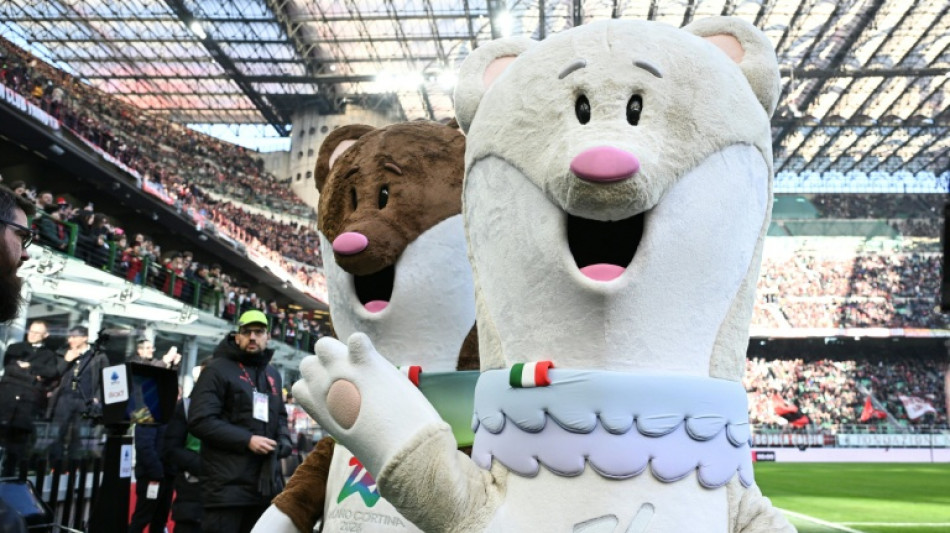
Cuddly Olympics mascot facing life or death struggle in the wild / Photo: Piero CRUCIATTI - AFP

 AI 'warning shots' focus Beijing on national security risks

 Philippine tribe in limbo over US-led tech hub

 Saudi-led coalition says Houthis fired ballistic missile at Riyadh

 Cuba works to restore power after another blackout

 Brigitte Bardot widower slams sale of star's belongings

 Indonesia accepts Malaysia's help to tackle wildfires

 Nvidia, OpenAI CEOs to attend Xi dinner at White House

 Cuba hit with seventh major blackout of the year

 Nigeria miners struggled to breathe in cell before 37 died: survivors

 Warren Buffett steps down as Berkshire Hathaway chairman

 Isolated Syrian-Druze city blames Damascus for shortages

 Kerry James Marshall: American 'blackness' painter celebrated in Europe

 Infantino 'must go', says German FA vice-president

 Japan's busiest rail station tests robot bins

 Backpackers fret over Australian visa crackdown

 Bank of Japan hikes rates to 31-year high to battle inflation

 AI doomsday warnings unlikely to slow IPOs but questions linger

 In Brazil's Amazon, the hunt for oil fuels hopes and fears

 Baby orangutans in India expose 'frightening' scale of trafficking

 Oversight Board blasts 'inadequate' Meta safeguards for AI deepfakes

 Harry makes first public appearance since return to UK

 Princess Diana's brother makes new explosive claims against Charles

 Trump admin overhauls key protection for endangered species

 Mbappe draws political fire over Ceuta t-shirt controversy

 Third malaria death in Germany from outbreak tied to Frankfurt airport

Tina and Milo, the ermine and stoat mascots of the upcoming 2026 Olympic Games in Italy, are already everywhere -– smiling on stuffed animals, posters, mugs and T-shirts.
But it's another story for their real-life counterparts –- living out of sight and under pressure in the Alps as their snow cover slowly melts away due to climate change.
Ermines and stoats are the same animal -- mustela erminea -- but with the ermine sporting its white winter coat and the stoat its brown one for summer. And while they might be the face of the Olympics, they're disappearing in Italy's Alps, according to the country's only dedicated ermine researcher.
Since 2022, University of Turin doctoral student Marco Granata has been single-handedly monitoring the sinewy, hard-to-spot mammals who inhabit the same mountain peaks where the games will take place, high in the snowy Italian Alps where their winter coats camouflage them from predators.
"The ermine is like a wild ghost. It's a small, elusive animal," Granata told AFP.
"What makes it so interesting to me is the fact that it risks disappearing from entire mountains."
- Easy targets -
The small mammal's ability to molt -- its brown coat turning to white in November -- is what Granata calls a "super power" that's allowed it to survive for thousands of years.
But now it's a liability.
"The ermine faces a mismatch when it finds itself completely white in a world that should be white but is no longer so," Granata said.
Snow cover in the Italian Alps has decreased by half in the last 100 years, according to a study published in December 2024 in the International Journal of Climatology.
With their snow camouflage gone, the white ermines now stand out starkly against their mountain backdrop, becoming easy targets for predators such as hawks, owls or foxes.
Another problem awaits when the energetic carnivores climb to higher altitudes in search of snow -- a lack of prey.
While the ermines are compelled to ascend, the snow voles and mice they depend upon for food have no need to do so, as they don't change colour.
Ski slopes also encroach on ermine habitat because of "competition for the areas where it snows the most," Granata said.
His research predicts ermine habitat in the Italian Alps will decrease by 40 percent by 2100, with ermines forced to climb by an average of 200 metres and the voles staying put.
There is little fuss made in Italy over ermines, which were once heavily hunted for their white pelts to adorn royal ceremonial robes. Scientists have paid them scant attention in recent decades, given the difficulty of gathering data on the fast-moving creatures.
The International Union for Conservation of Nature (IUCN), the world's largest environmental network, last classified the ermine in 2015 as of "least concern" on a list of potentially threatened species.
But that influential list is out of date, argues Granata, who hopes his research will lead to their protection.
"The fact that a doctoral student is the expert on a species shows how little attention has actually been paid to this species," he said.
- 'Invisible world' -
Every fall, Granata hikes Italy's Maritime Alps placing special camera traps -- plastic boxes with a motion-triggered camera inside -- that help him analyse the animal's seasonal patterns.
"You have to think like an ermine," he said, placing the box in areas where the curious mammal might go to find food.
When the snow melts, Granata collects the data from inside the boxes and watches a season's worth of videos and photos.
"It's like unwrapping a gift because you don't know what's inside... you actually see this invisible world," he said.
In one August video, an energetic stoat twists, sniffs and darts around in constant motion as he explores the box.
In October, after learning of the Games' choice of mascot, Granata launched an appeal to the Milano Cortina organisers, asking their sustainability team to help fund university research.
This week they sent a letter declining, which Granata considers a "huge missed opportunity".
The ermine, he said, isn't "just a cute little animal that roams our mountains, but a wild animal at risk of extinction".
M.Davis--CPN