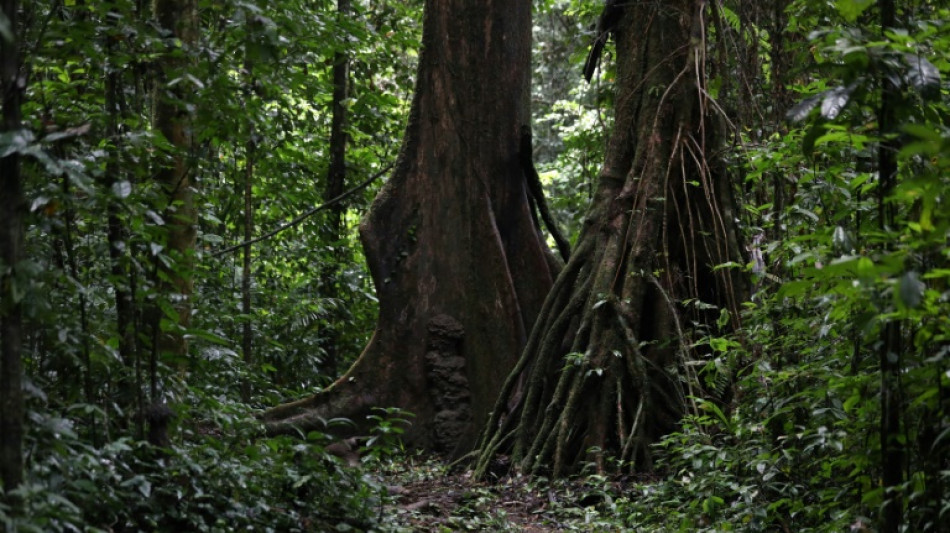
More than 9,000 tree species still undiscovered: study

 Lights out in Laos as electricity exports surge

 Steven Strogatz weighs AI mathematics advances and their consequences for researchers

 Anthropic boss calls for AI slowdown, Altman and Musk agree

 French IT giant Capgemini sells subsidiary after row over ICE links

 Quebec Brokerage Qubit Insurance Announces New Data on Coverage Shortfalls as Rebuilding Costs Rise

 Lady Gaga welcomes first child with fiance: US media

 Bhutan business bets on hazelnuts for farming future

 'Widow's Bay' and 'The Pitt' are favorites for Emmys night

 Coastal erosion forces cancellation of California music festival

 Argentina's Dirty War rears its head in Venice film

 UK lawmakers throw out bill to legalise assisted dying

 US inflation steady in August, fueling Fed rate hike expectations

 New York marks 25th anniversary of 9/11 attacks

 Nepal flood reconstruction bill to be $4.78 bn: foreign ministry

 JUMO and Standard Bank launch Social Finance Framework to scale inclusive finance in Africa

 Doomsday tech: could AI really kill us all?

 French comedy show 'Call my agent' makes film comeback

 It's all coming back: Celine Dion fans gear up for Paris return

 Researchers eye AI revolution in natural disaster forecasts

 US braces for inflation report that may push Fed to hike rates

 Musk threatens legal action over documentary

 Latin America fact-check group asks Meta not to replace verification practice

 AI Risks to Enter 60–80% of Liability and Cyber Insurance Underwriting by 2028, ScienceSoft Predicts

 Tribal Launches Campfire, Letting Business and Technical Teams Build on Salesforce Together

 Stocks fall as fresh oil surge fans inflation fears

Researchers estimate there are significantly more species of trees on Earth than currently known, with more than 9,000 species yet to be discovered, according to a study published Monday.
"Estimating the number of tree species is essential to inform, optimize, and prioritize forest conservation efforts across the globe," said the study, which was published in the US National Academy of Sciences journal PNAS and involved dozens of scientists.
About 64,100 tree species have already been identified.
But according to the study, which is based on a more complete database and uses a more advanced statistical method than previous ones, the total number of tree species is about 73,300 -- 14 percent more.
That means about 9,200 species have not yet been discovered.
Overall, the study said that "roughly" 43 percent of all tree species are found in South America, followed by Eurasia (22 percent), Africa (16 percent), North America (15 percent) and Oceania (11 percent).
Half to two-thirds of all known species are found in tropical or subtropical rainforests on five different continents, the researchers estimated.
A large proportion of the species yet to be discovered should therefore be found in these same regions, where fewer surveys are conducted.
Additionally, nearly a third of the world's tree species are scientifically classified as rare, with low populations in limited regions. These species are therefore more vulnerable to the threat of extinction.
Only 0.1 percent of species are found in all five of the regions identified by the study.
South America also has the highest proportion of endemic species, or species only present on that continent, at 49 percent.
"These results highlight the vulnerability of global tree species diversity," the study authors said, especially in the face of changes to the land due to human activity, and "future climate."
"Losing regions of forest that contain these rare species will have direct and potentially long-lasting impacts on the global species diversity and their provisioning of ecosystem services."
Species surveys are very time-consuming and present many challenges, including lack of access to certain areas and consistency of identification, and several botanists may characterize the same species slightly differently.
C.Peyronnet--CPN